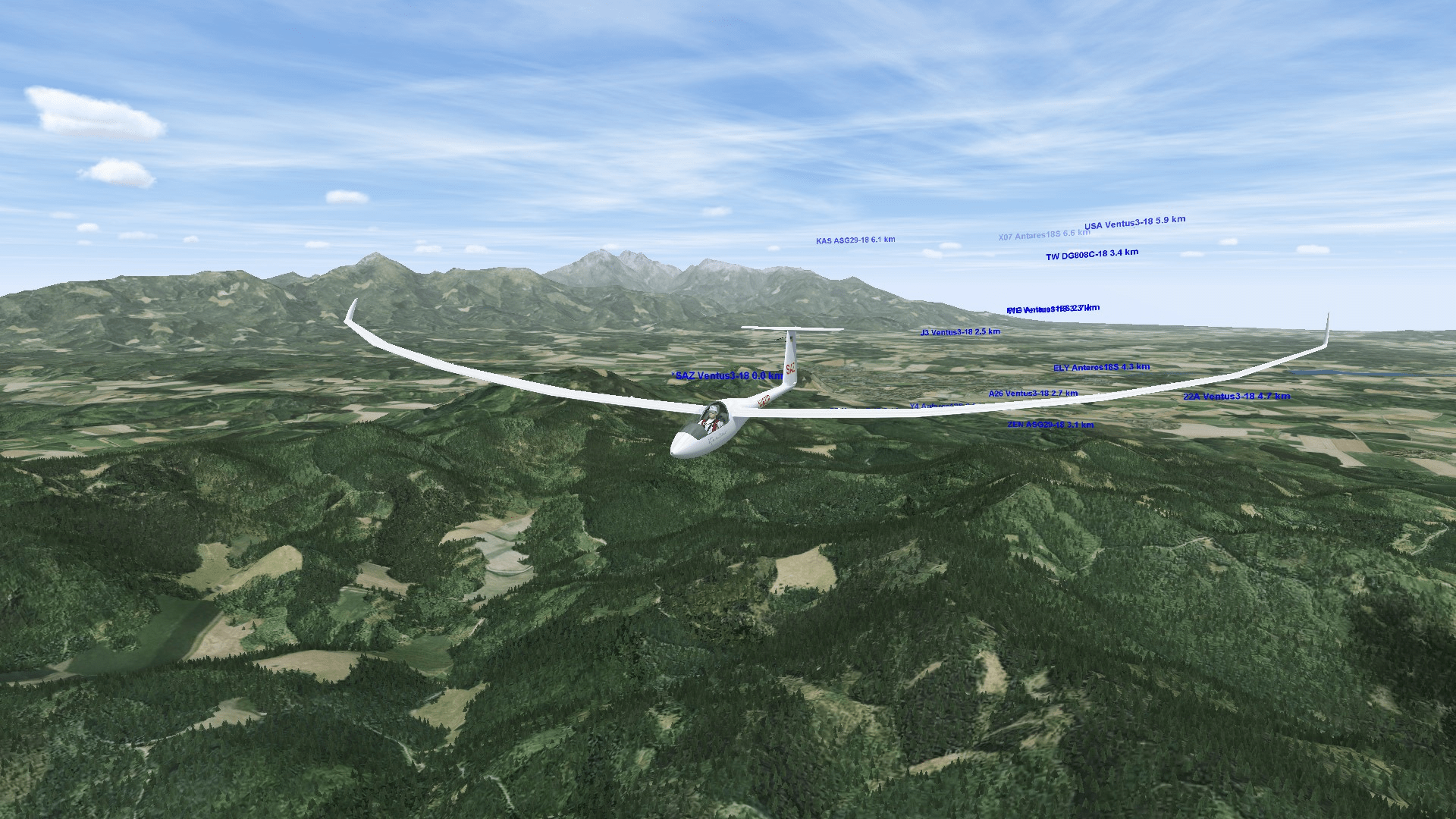
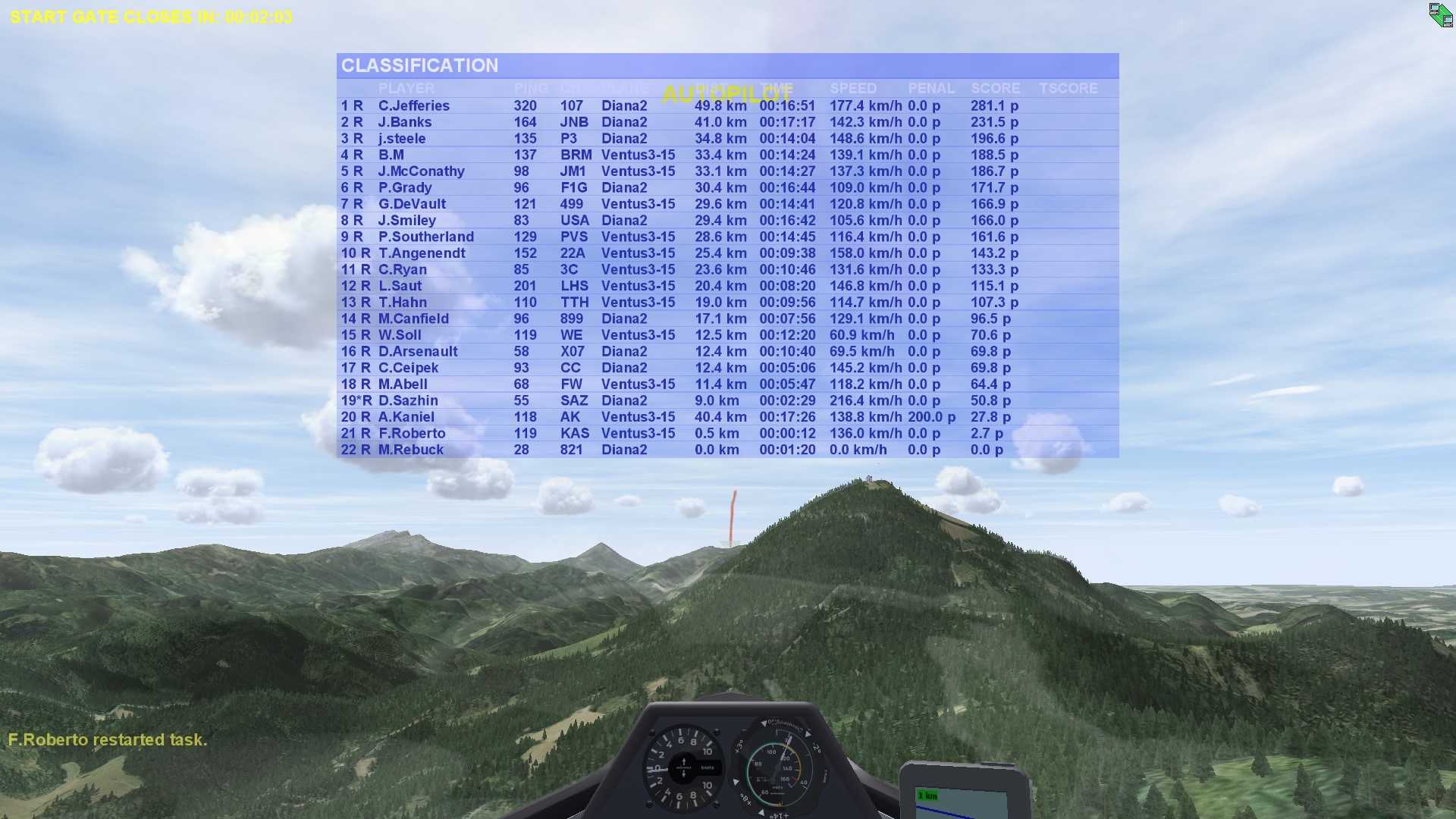
33 pilots flew on US Nightly Soaring last night! We haven’t seen this many participants in many years and boy was it a blast to fly with everyone.
The task was very fun, involving dynamic conditions. The first leg involved slowly lumbering along with weaker thermals. The lift was blue or marked with little wisps, forming a large gaggle along the course line. The latter half of the second leg got us into the mountains, with improving thermals and some ridge lift.
The pilots who worked the gaggle the best on the first leg and then efficiently made the transition into the mountains were highly rewarded. Lots of gear-shifting!
The final leg had quite a bit of ridge lift, although with some high ground to contend with. Some folks got stuck trying to get high enough for final glide. But most made a blazing fast leg to get home.
Mark Rebuck, a Condor regular won the day. Honorable mentions go to Clemens Ceipek, Mike Abell and Sean Fidler who had very good days.
There was a large junior contingent last night. Noah Reitter, Jacob Fairbairn, and Collin Shea all flew. Timo, a 22 year old real-life German gliderpilot is routinely cleaning up the field every night, joined us at 3am his time.
Come and fly with us tonight at US Nightly Soaring at 9pm Eastern! Find the serverlist here!
Last night we had 6 folks using Teamspeak to communicate using voice. Download it for free and find us on the USNS/MNS channel. The server is ts3.virtualsoaring.eu:9982 Password: ask13.
For the next several days we will still fly in Slovenia. But stay tuned… we will be heading to other wonderful places all around the world! Think Mifflin, New Zealand, Blairstown, Nephi, Alps, and more!
More and more folks are getting back online all around the world. US Nightly Soaring had 22 pilots flying last night. We haven’t had this many folks in many years. About five years ago we used to max out the servers with 32 occasionally, but that was a long time ago.
A lot of new people are getting on and joining the fun. Folks from New Zealand, Germany, Australia, Argentina, Brazil and all over the US are registering for the competition. I am getting emails every day from new folks who haven’t flown in USNS asking for guidance how to sign up. Feel free to contact me, or refer to the previous post for help!
I would not be surprised if we get over 30 participants tonight.
I’ve forgotten how awesome Condor is. Condor does a million things well, but it captures the essence of racing spectacularly. We do straight up assigned tasks. The old style start gates with a redline start. Half km beer-can turnpoints. Finish on the deck. You see the other pilots pull in the thermals and you can make a perfect entry if you pay attention. Keep a close eye on the terrain to run the better energy lines.
Condor even does wave and you can run little lines of rotor and wave lift if you keep an eye on the markers.
You are right with the other pilots. You can see how one decision or another gets you plus or minus several hundred feet. You race head to head on final glide and cross the line abreast with the others. Last night the winner won by three seconds! You’re totally absorbed by in it when you’re doing it.
Condor is fun, but racing is a whole other level of awesome. Come and join us at 9pm Eastern at US Nightly Soaring!
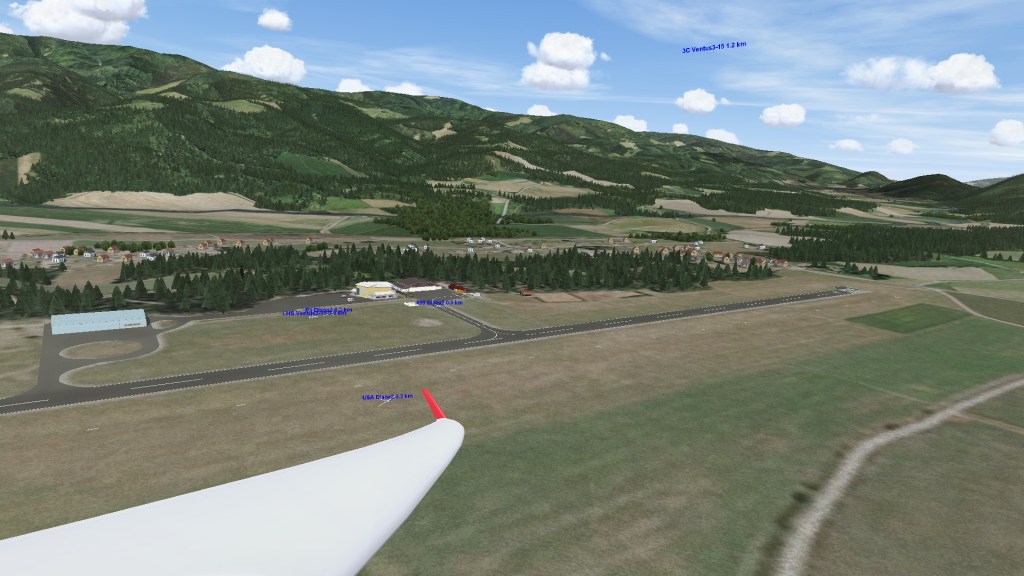
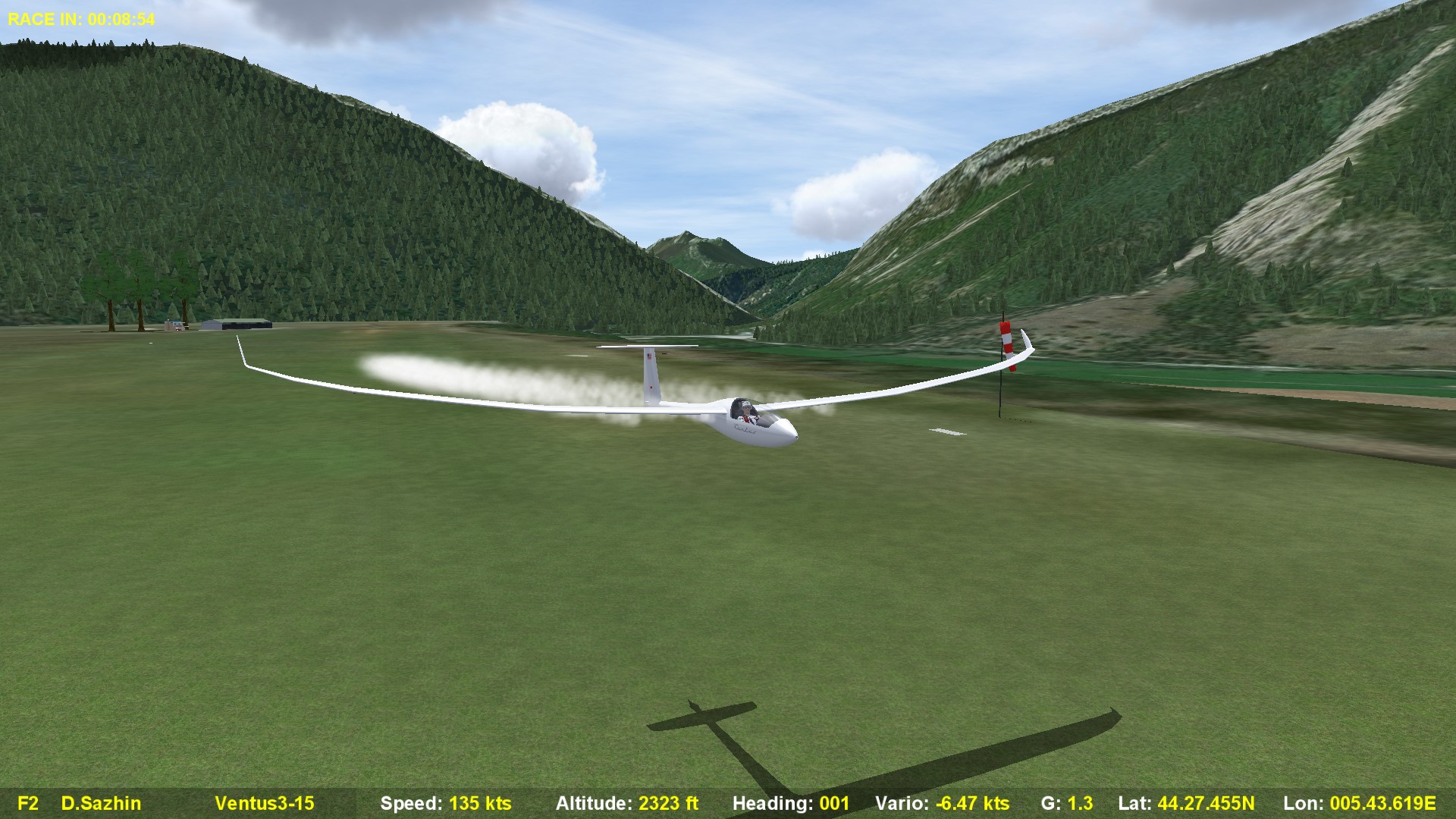
With COVID-19 clamping down on flying activities and keeping us home, it looks like many will only be able to get their flying fix in the virtual skies. Here is a guide to some options for individuals and clubs to use Condor for soaring the next couple of months.
Check out existing competitions on Condor Club.
I run Monday Night Soaring (7 and 10pm Mondays) and US Nightly Soaring (9pm daily). Each day uses a different task and scenery. To find out the scenery, take a look at the contest page and it is listed for the night. After you register (for free), there will also be a task briefing sent to your email.
To register, first become a Condor Club member. Then go to: http://www.condor-club.eu/comp/competitions/202/ and select the competition you would like to attend. Press “Your Registration” and click Submit!
To download sceneries easily and quickly, download the Condor updater. Simply click on a scenery you want and it will even install it for you!
To log on to the tasks, go to https://condor.hitziger.net/serverlist/ at the designated time (7/10pm Eastern Time for MNS, 9pm for USNS). You could join these respective competitions for 10 minutes.
Set up Condor night for your club!
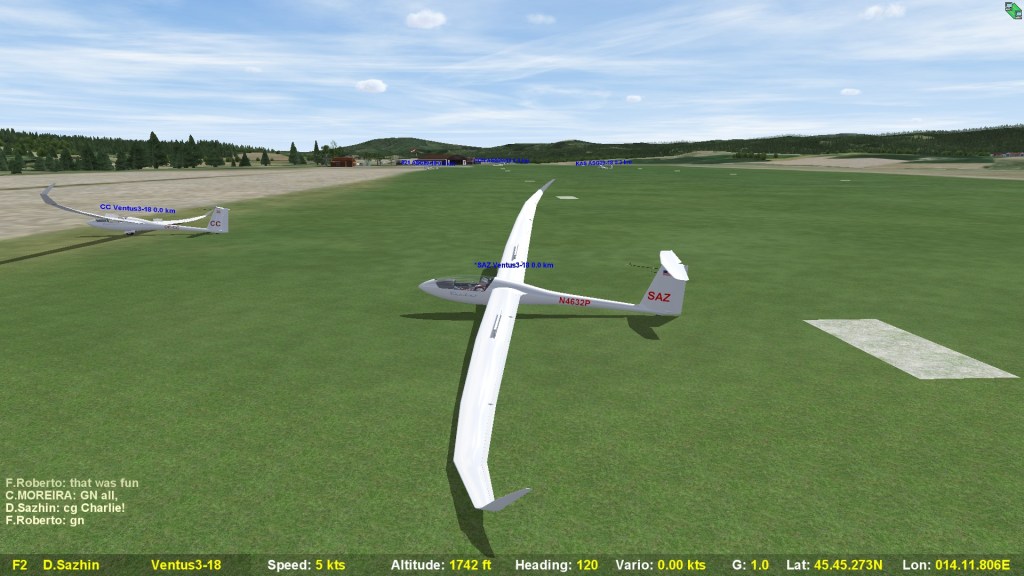
For club members who are not experienced with Condor, still learning the basics, or simply looking for a place to virtually hang-out, set up your own server! Make a task in the Flight Planner, possibly even at your home airport! Then go to Multiplayer, click Host, and select a Host Name. Select your task in the flightplanner and your friends will be able to join the server!
I set up a Condor night for Aero Club Albatross at 7pm on Wednesday. Check out the server and join us!
Condor Coaching
I have been contacted by several people who would like to receive paid one-on-one coaching with me. If you would like to schedule a time to work on advanced soaring concepts in Condor (thermal selection, racing, centering, racing strategies, speed-to-fly, landouts, spins, risk-management, ridge soaring, wave soaring, etc. etc.), feel free to contact me through the Soaring Economist contact.
__________________
Feel free to follow up with me if you have questions about how to get Condor set up, for you or your club.
The weather forecast at Blairstown for next Wednesday is moderate SE ridge and 6000ft thermals with cumulus clouds… in Condor.
It’s nice being God in the virtual world!
For next week I developed a simple task to get the Condor group set up for future weeks. The objective for Wednesday 7pm is simply to get set up. Mission accomplished if we get everyone on the server and have a fun time! I set up a task, but you don’t have to race around it… you could simply join the server and fly locally near the airport if you so choose!
Here are the steps for folks who have Condor experience.
It’s wonderful when holidays align with ridge conditions. Ron Schwartz, Steve Beer, Claudio Abreu, Khanh Nguyen, and I, ACA’s hardiest ridge rats, came out on a frigid Monday to soar. The high for the day was around 25 degrees Fahrenheit, with a temperature aloft of around 17 degrees or so. We looked like abominable snowmen, with layers upon layers of wool, cotton, and polyester. On my account, I had on three layers of thermal shirts and pants, fleece, heavy fleece and my winter flight suit. Electric socks, with the cord snaking to a battery in my breast pocket so I could control the temperature. A ski mask covered my whole head, plus a wool hat and gloves.
Not a single square inch of my body was exposed. NASA probably has less difficulty fitting their astronauts to launch into space. But it worked; I was reasonably cozy the entire day!
I arrived early in the morning to help Steve assemble ACA, the club’s LS4. It was to be his second flight in the glider and he was eager to take it up on the ridge to get a taste of high performance soaring. I scrutinized the wind sock after taking the trailer out of the hangar; the wind slightly favored launching on 7. Steve and I bantered back and forth on the merits of either runway and Steve noted that the sock went limp. Expecting to depart from 25, we brought the trailer to the very end of the runway.
Halfway into assembling the glider, the wind sock turned around and we now felt a stiff tailwind. Tommy the tow pilot arrived and we agreed that it would be much safer to launch into the wind on the other end. Poor Steve, he’d have to haul the glider across the whole runway!
Khanh was the other unfortunate fellow for the day. We planned to do a short ridge flight in the club 2-33 (affectionately nicknamed the Mad Cow), but the ship was hopelessly frozen. There was no prospect of removing the thick layer of ice on the wings, so we had to postpone our effort for another time. Khanh was a great sport and took the unwelcome news in stride, helping us stage and launch. We really appreciated his help!
I hustled to the hangars again to bring out the Duckhawk. Since becoming airworthy, it’s been an ongoing process of fiddling and tweaking to get the ship tiptop for the upcoming spring. After assembling it and completing a thorough preflight, I helped Claudio put together his ASW24.
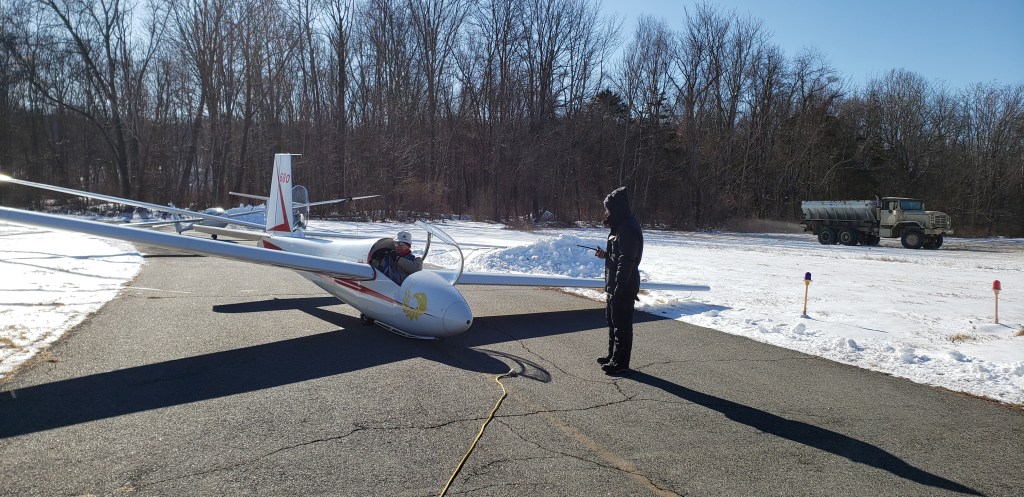
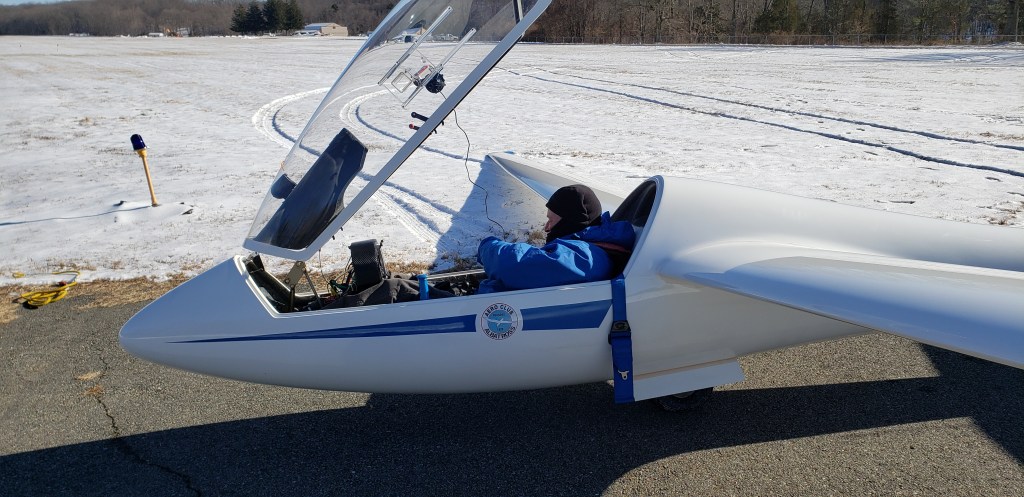
Rather than launching off the snow, we took advantage of the quiet airport to launch on the blacktop. We gridded on the taxiway and positioned the rope at the edge of the runway. Tommy and I worked out the sequence of operations; the glider pilots would push the glider over to the pavement, hook up and go. When the towplane would return, he would drop the rope to avoid dragging it on the asphalt. At the subsequent launch, the ground crew would hook up both the glider and towplane and promptly send them on their way.
Ron Schwartz getting ready to launch in his 1-26.
Schwartz launched first. Tommy made an airshow quality performance when he came back to land. You could see him fighting the crosswind and the turbulence on short final. Dropping the rope was like an accuracy contest. He pulled the release as he approached the threshold.
The rope fell square between the 20ft gap in the middle lights, with the glider end of the rope perfectly positioned, right at the threshold. Damn Tommy, that was cool!
Steve Beer in the club LS4!
Steve was up next in the club LS4. I gave him a short takeoff briefing and then we hauled him out onto the runway. He bravely fought the crosswind and stayed in position with the towplane, eagerly departing toward the ridge.
I was up next in the Duckhawk. Launching on the pavement was fantastic. The hardtop made for a fast acceleration and the towplane climbed like a banshee thanks to the -2000ft density altitude. Tommy was on his game. The Cessna 182 at his controls was totally steady; it looked like the gusts and turbulence didn’t affect it at all. He made an absolutely perfect turn toward the ridge. I couldn’t have done it better if I simply willed the towplane around as it flew. He was just great!
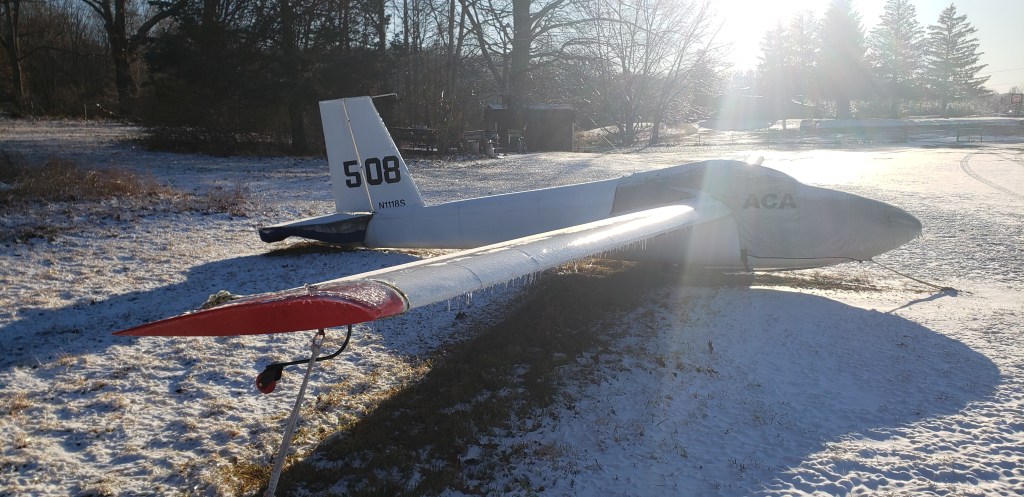
Upon release, I was greeted with a call from Steve. I *love* this glider! It’s amazing! I hope that 508 isn’t listening! I replied not to worry, that 508 (one of the club’s 1-26s) didn’t have its battery on! It certainly is a magical experience taking up a high-performance ship on a ridge for the first time.
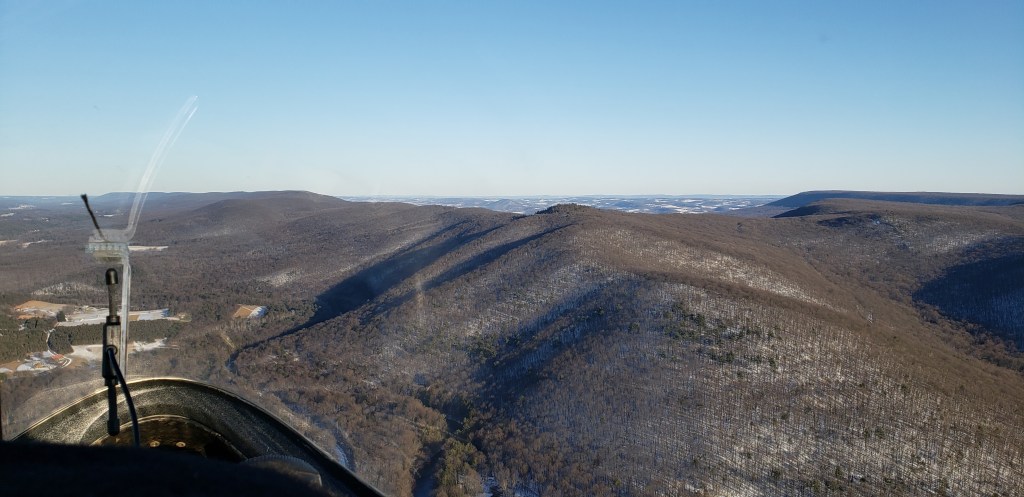
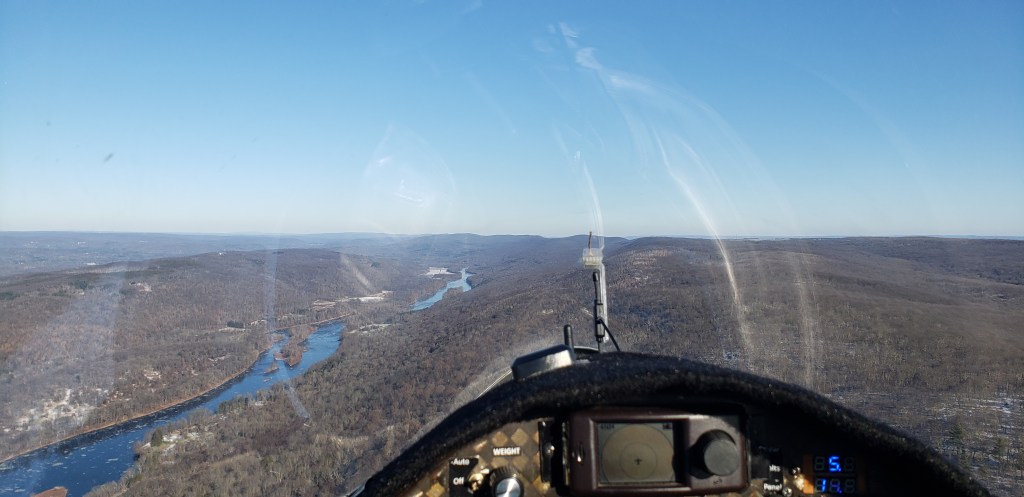
The lift band was totally solid. The cold, dense air worked especially well; the hang-glider pilots call it “fat” air. I charged down the ridge, heading southwest-bound at the speed of heat.
The run down to Hawk Mountain went quickly and I contemplated going farther. However, the thermals weren’t working well and the wind sharply slackened off from 20 knots down to 15. It looked like Hawk was as far as I’d get today. Back to doing laps, I suppose and I turned around, 100km from my starting point.
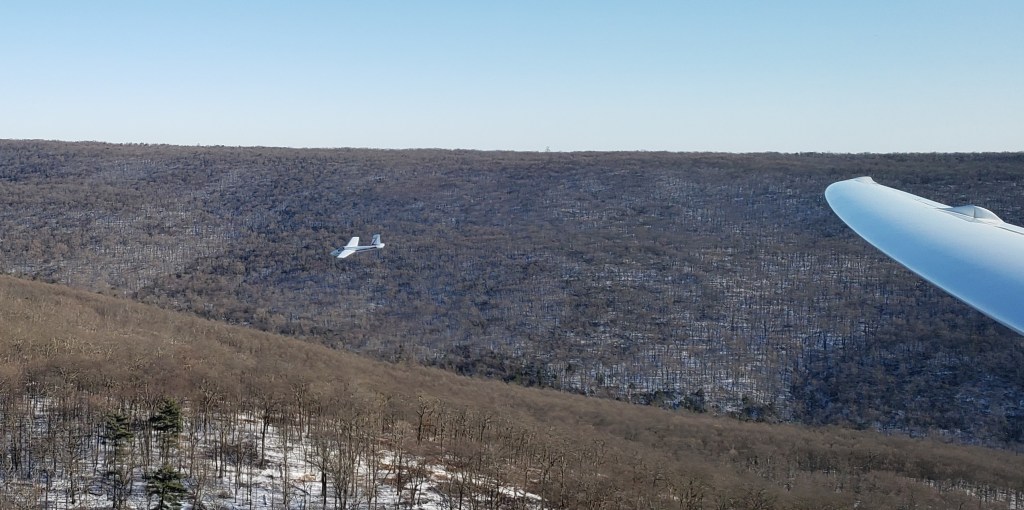
Looking at the valley upwind at the end of our ridge.
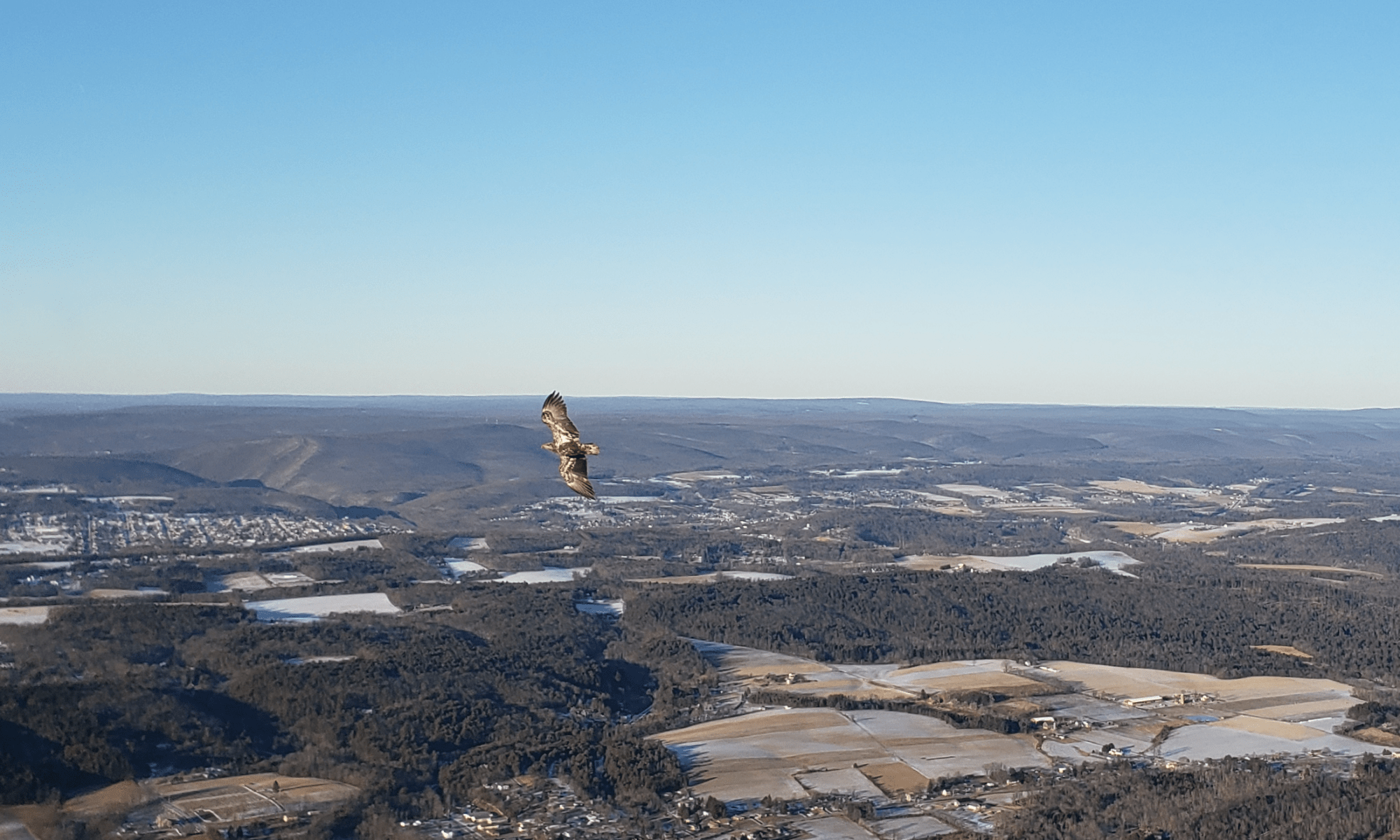
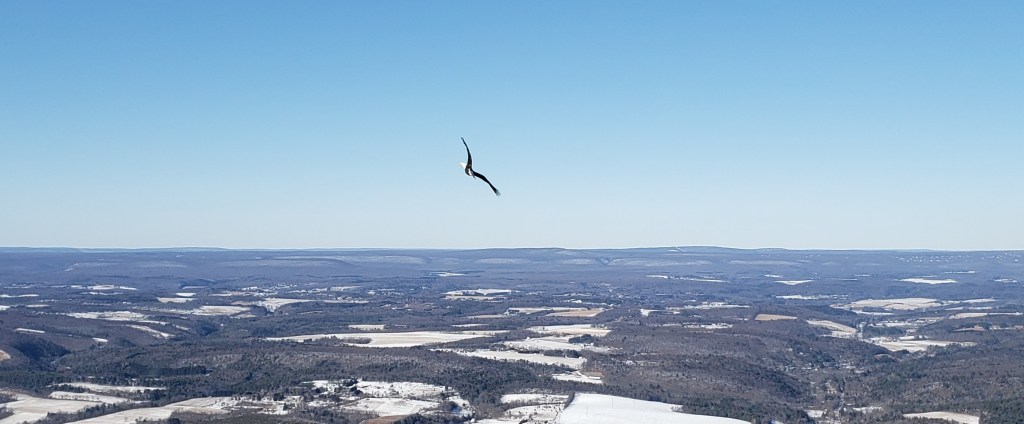
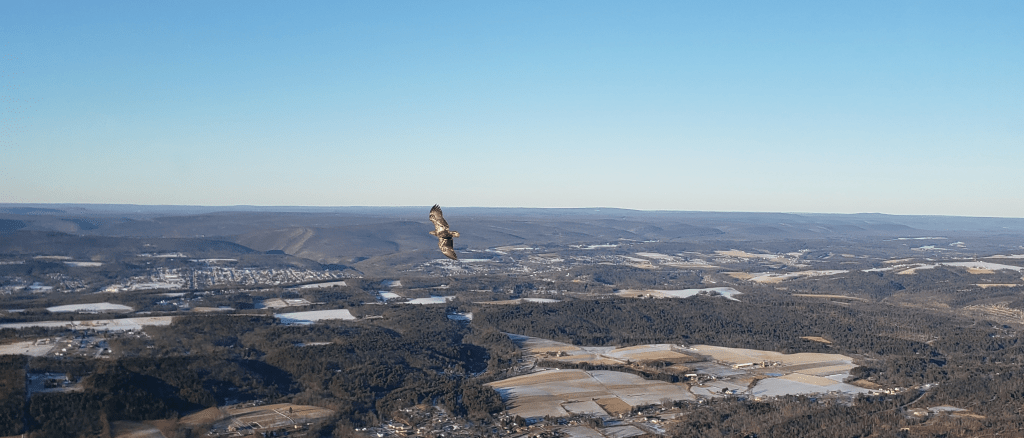
I spotted a bald eagle and swung the glider around to fly with him. This guy was moving along at a pretty decent clip, at least 40 mph! It was difficult to stay with him, even with the spoilers fully extended and the flaps down to 20 degrees. To remain in position, I resorted to S-turning, setting myself up for a “bomber run” and then passing near him.
This guy wasn’t as thrilled about my presence as the eagle I flew with a month ago. Steve later noted, he was probably confused whether I was a duck or a hawk!
Nonetheless, he indulged and played with me for a little while.
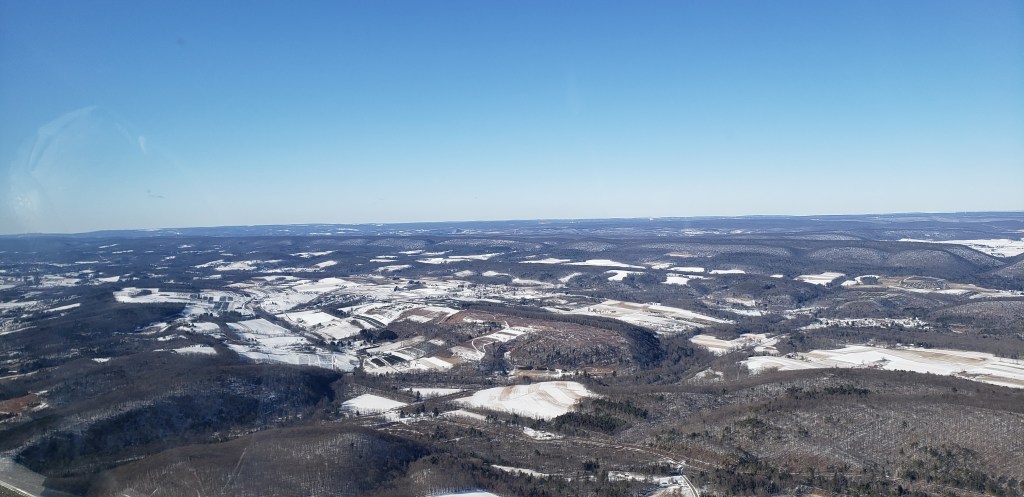
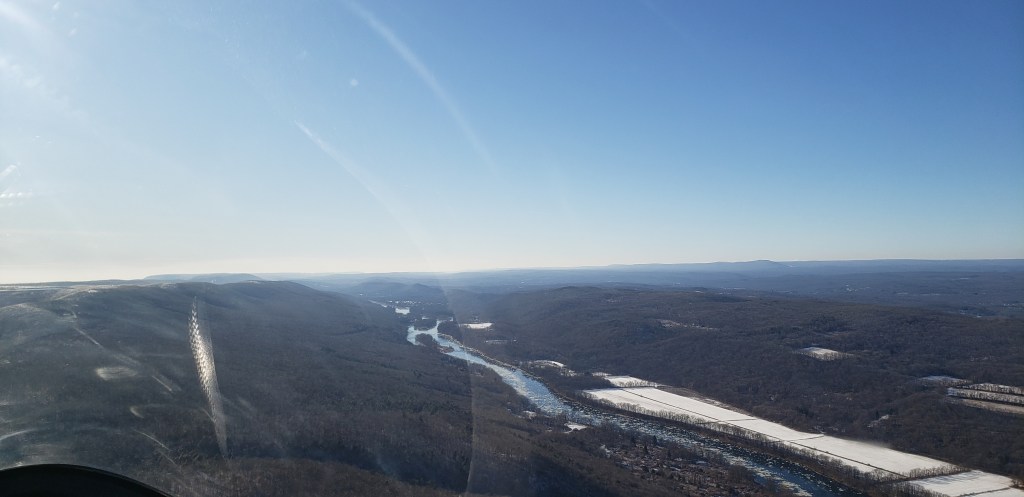
It was really fun watching the changing landscape. When you do laps, the light directs your attention on various features. With different shadows, you will see distinct rock outcroppings, fields, houses that you haven’t noticed before. The valley was beautiful, with a hard white crust on top of the snow covered fields that glistened at low sun angles. Unlike other winter days, the snow was so thin that it looked more like frosting on top of a cake. The snow didn’t completely overwhelm the region, which often makes the land look sad and monochrome.
The visibility was unbelievable, genuinely unlimited. At a couple hundred feet above ridge top, you could just make out the tops of the New York City skyscrapers poking above the hills. It was easy to spot the airliners from the Flarm. They looked like big insects that you could just reach out and pick up as they passed over the canopy.
Many folks enjoying a day off at the Blue Mountain Ski resort.
Delaware Water Gap.
Hawk Mountain on the second lap.
At the tip of Hawk Mountain, heading back northeast-bound.
Bobby Templin likes to say that the second lap is the least appealing. This is when you notice you’re getting a little tired, cold and some parts of your body start to hurt. The first lap is always exciting since you’re trying to make miles. The last lap is fantastic because the valley gets lit up in a gorgeous glow. The second lap can feel like a drag.
I call it the second lap blues. Coming back from Hawk Mountain, my legs couldn’t find a comfortable position and I was getting hungry. Glancing at my watch, I saw it was 2:40pm. It struck me that Runway Cafe closes at 3:30pm and that I could get a great cup of coffee and a prime rib sandwich if I hustle back home.
The prospect of rich, dark, black coffee overwhelmed my senses and I pushed the nose over.
The trees were flashing off my right wing. The ship settled in at 110 knots, 100 ft above the ridge. The air was choppy, but established a steady rhythm. There was a cadence to the gusts, like the reassurance of riding waves up and down on a sea. The lift band just felt *so solid*, as though it was reaching out and gripping the glider.
Approaching the Delaware Water Gap, the sun was coming around to the west and lit up the mountain in a gorgeous glow. And there was Schwartz, driving along in his 1-26! That old dog lined up for the foreboding upwind jump only several hundred feet above ridge top. He knows the ridge like an old school London cabby driver knows his city’s streets. He feels the air as a bird, gently swaying to and fro and following the air’s natural ripples, eddies and snaking currents. It was beautiful watching him float across, hardly losing any altitude at all.
Ron Schwartz at the Delaware Water Gap.
Now on the local ridge, I got a second wind and regained the motivation to do another lap. And as far as my hunger, I ate a rock solid Cliff Bar. It was so frozen that it felt like I could break a tooth on it! Hot coffee was merely six minutes away, but the temptation was averted. Time to head southwest-bound once more.
We sometimes call this the “victory lap”. At the end of a long flight, it’s amazing to watch the ridge light up in the oranges and reds of the setting sun. The trees let go of their latent heat and the lift band becomes smooth. There is a cinematic quality as you soar effortlessly in the beautiful glow.
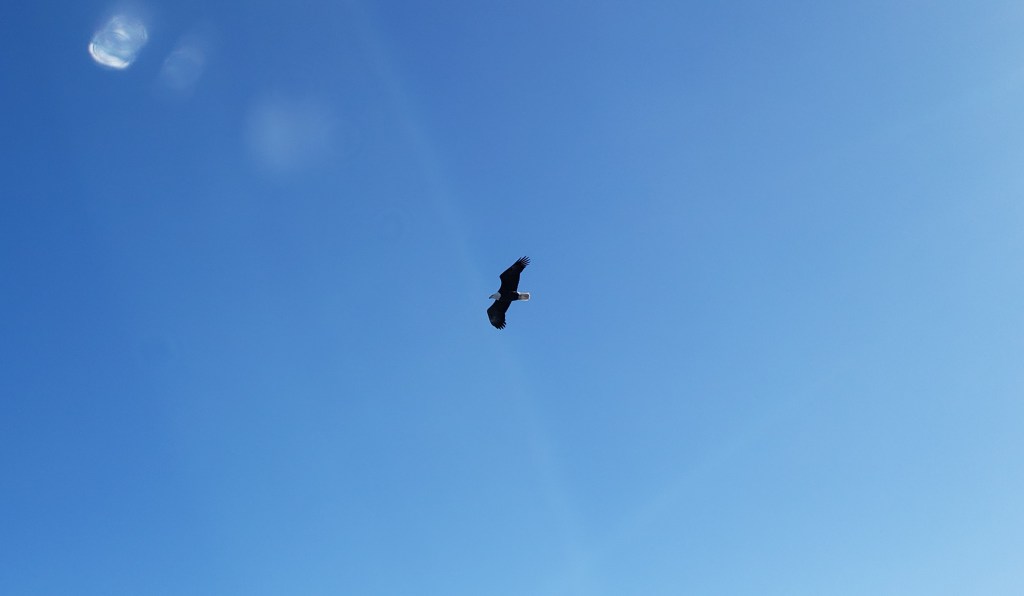
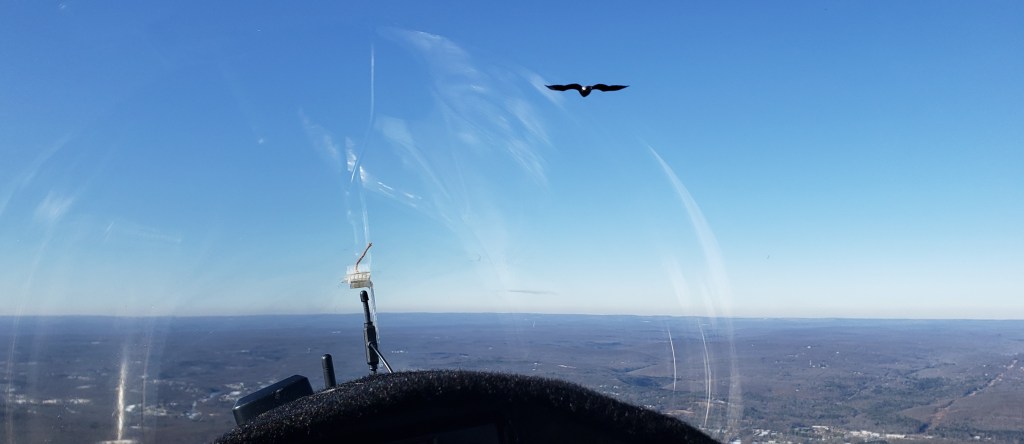
On the way back, I stumbled across another eagle. This one was not like the others; he was a bit bigger and golden colored. I couldn’t pass up the opportunity and swung the ship around to meet him.
To stay with him, I slowed down and started S-turning. As I would come close to him, he would turn toward me and slide in behind me. We were “scissoring”, a well-known air combat maneuver. We did this for a half dozen cycles for almost ten minutes, at times less than a wingspan away!
Later, he turned into a nice thermal. I joined him and got to my highest point of the day, less than an hour before sunset!
There’s nothing like flying with these amazing birds. When you soar with them, you forget about the glider, about the here and now. As they look square into your eyes, they communicate something that words cannot convey.
You’re flying.
Thanks a million Tommy and Khanh for towing and running the operations! You guys are the best!
Over the winter, I have developed several new resources for ridge pilots. I have updated The Ridge Map, developed a slideshow of landmarks and fields along the Blairstown ridge (from Millbrook to Hawk Mountain), and made a CUP file landout database from Vermont down to Virginia.
I have updated a tab on the site as “Other Ridge Resources” where you could learn more about this project.
After six months of body-filling, sanding, sanding, sanding, gear door fixing, parts ordering, FAA registering, lubricating, cleaning, and inspecting, the Duckhawk was ready to fly. Bill Thar donated his magnificent flying machine to me. I was awestruck, even dumbfounded when he offered me the ship. I even thought he briefly went crazy and made sure to point out that he could take a week or two to rethink the whole affair. Nope, he had thought it all through; I would take care of the bird and use it to promote research in soaring and junior flying. The aircraft is the perfect vehicle to explore weather, dynamic soaring, optimizing the use of autoflaps and more. I wholeheartedly agreed to take the project on.
After many months of work, I was eager to fly the bird. So after my classes and research work at Temple went into winter break, I took the very first chance to go soaring. The forecast called for a light northwesterly breeze, just enough for the ridge to work. This was a good opportunity to do a little bit of soaring and a systems check. Thanks to Bill’s continued sponsorship, I had flown the Duckhawk maybe 250 hours or so; I wasn’t worried about flying the ship. But that said, I find that soaring for a couple hours on a low-key local flight is the best way for me to get acquainted with a glider. My landings are a lot better this way than when I go up for 10 minutes and come straight back down.
In any case, it looked like I was going to be the only person to enjoy this day. Tommy came out to tow regardless. What a sport! I actually appreciated that there were few people around as I assembled the glider, looked it over and got it ready. Cookie and Andrzej were very helpful in assembling the ship and launching me; thanks guys!
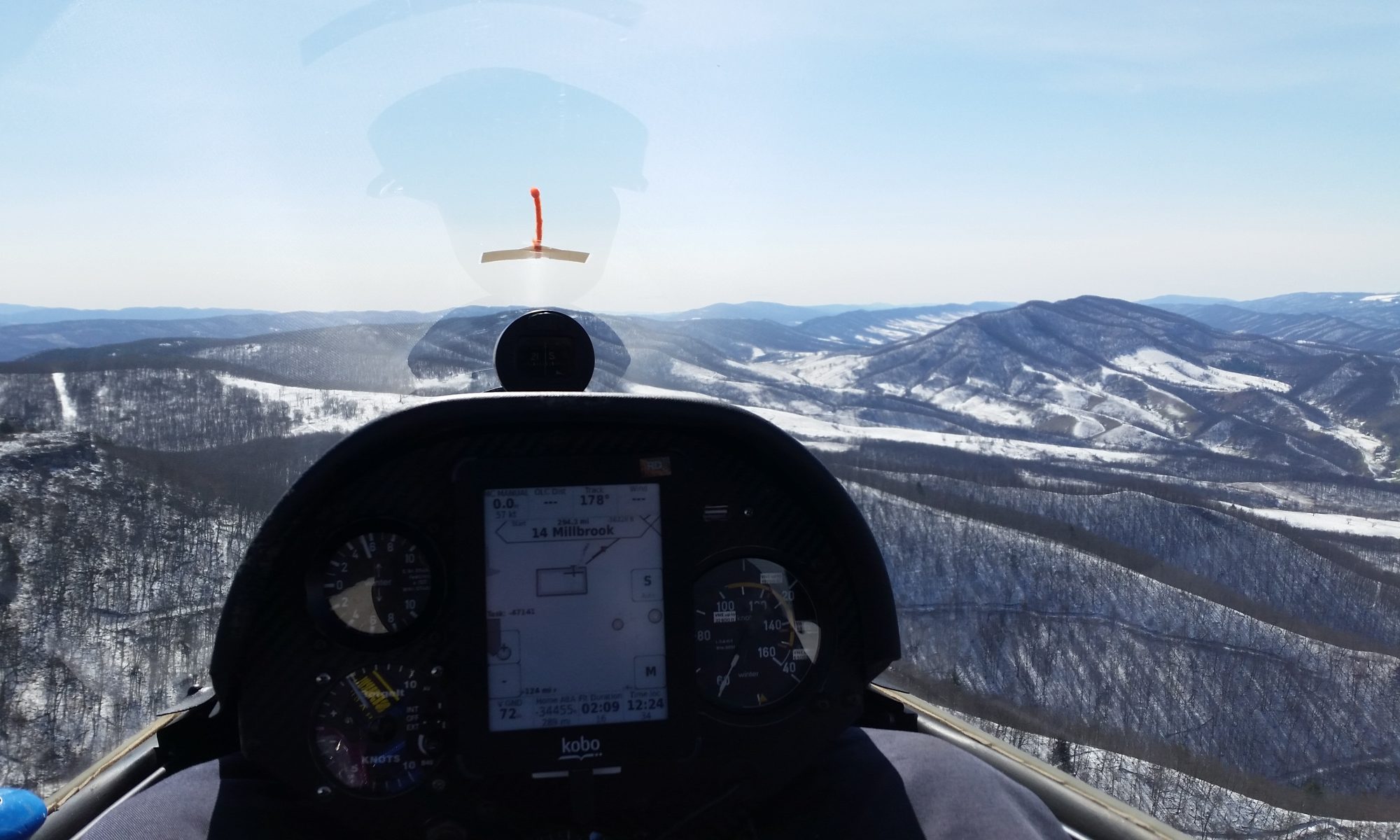
We took off at 12:30pm and took a quick tow over to the ridge. Testing the ridge revealed that it was fairly weak, so I was much keener to stay in the higher lift band. As I headed toward Millbrook, I fiddled with some of the systems, working the electric flaps and adjusting some of the settings on the ClearNav. As I rounded the bend on the Catfish Ridge, I looked up and saw three bald eagles spiraling in a thermal.
I have never been so eager to forget everything and just throw the glider into a turn.
Having picked out the highest eagle, I stuck with him in the thermal. My eyes were glued on to him and we stayed on opposing sides of the circle. I completely forgot about the glider; I was just flying. When he leveled out and headed northwest, I chased after him and took some great photos. There were several times he was closer to me than the end of my wingtip.
We soared together for about ten minutes. I stayed with him until I approached the limit of gliding back to the ridge behind me.
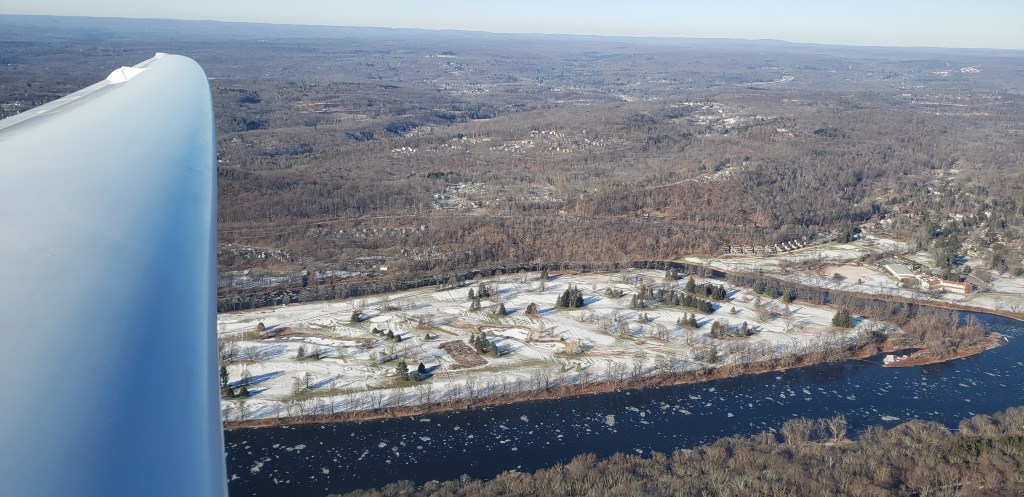
Afterward, I headed up to Millbrook. Upon turning around and heading southwest-bound toward the sun, I was awestruck by the sight of the whole forest glistening in the sunlight. There was an ice storm several days ago and the whole land was coated with a layer of clear ice; the whole landscape sparkled like a million diamonds. Through all my years of soaring, I had never seen anything like it. It felt like I entered a winter wonderland. Not a single soul was there to enjoy it; no hikers, no bird watchers. It was just me and this wonderful sailplane, gently floating along in the breeze. This was one of the most peaceful flying experiences I ever had.
As I soared up to the Delaware Water Gap, I looked down at the icy black river. Ice floes gently floated down, marking the snaking path of the current. The water was absolutely crystal clear; you could see all the way to the bottom of the river bed in many places.
It was a real joy to fly this wonderful machine. The conditions were weak, with an inversion at around 2500ft MSL and the wind at ridge top perhaps around 12 knots or so. I was not eager to go anywhere in particular, so I was perfectly content to mosey around. I took turns here and there and practiced thermal entries. It was really fascinating just watching the ship fly. There are so many different ways to thermal it; slow and flat, fast and steep and all sorts of nuances in between. Many different ways to center it; bank and yank or mosey around at 50 knots and nibble at the lift in a flat turn. The ship has a lot of character and feel. Most gliders have a certain way they want to be thermalled and you adapt each thermal to its “style”. The Duckhawk can be flown in many different ways and you can feel the difference when you do it right. I felt like it will take 500-1000 hours of consistent flying to really figure out how to get everything out of it in the climb.
I spent most of the time floating around at 60 knots. On one instance, I nosed over to 85 knots. The deck angle changed, but the glide angle didn’t. As I let it go, it felt like the ship was a racehorse, relieved that this incompetent fool finally cut it loose. Boy was this ship happy to fly fast!
It’s a crime to fly the Duckhawk slow, but I wasn’t keen on working hard today. You have to be sharp flying this fast, ready to fling the ship into a turn in an instant. I pulled the glider back from its canter to a trot, patted it on the side and said in due course we will let ‘er rip.
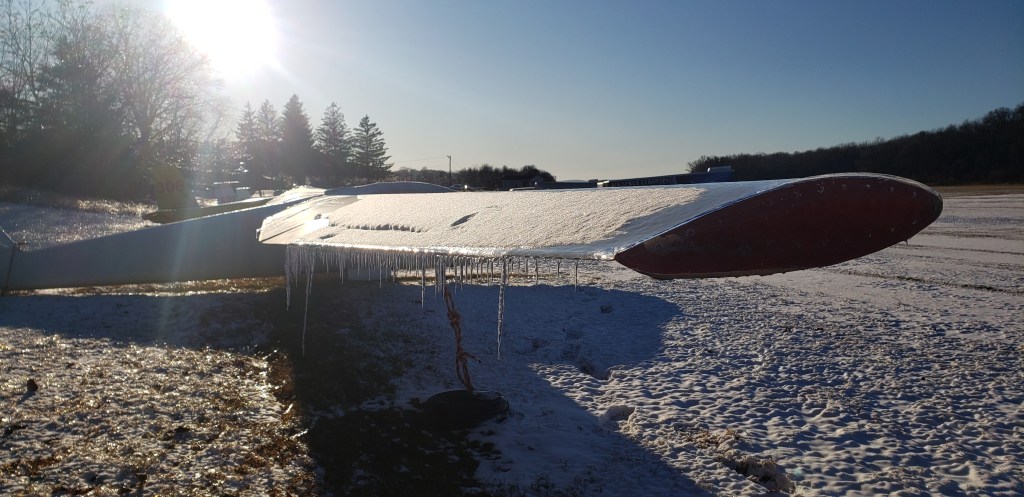
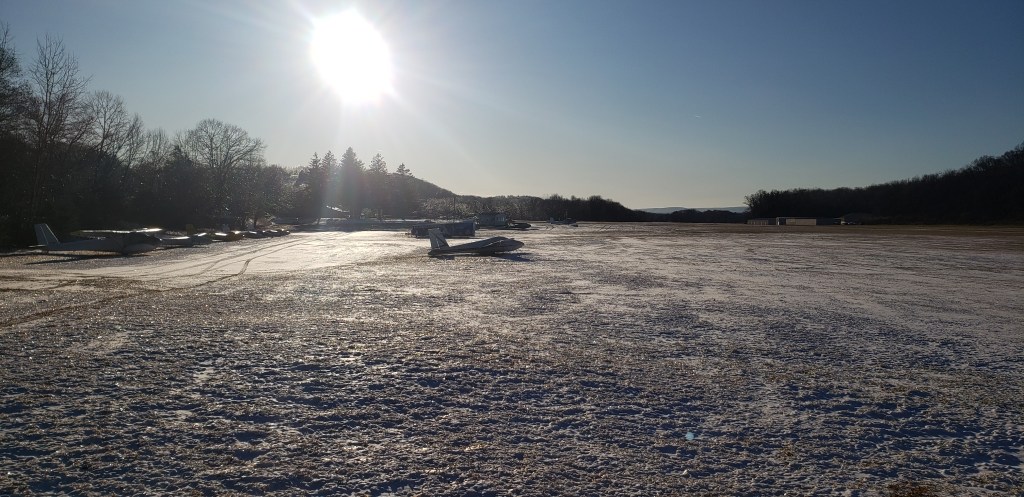
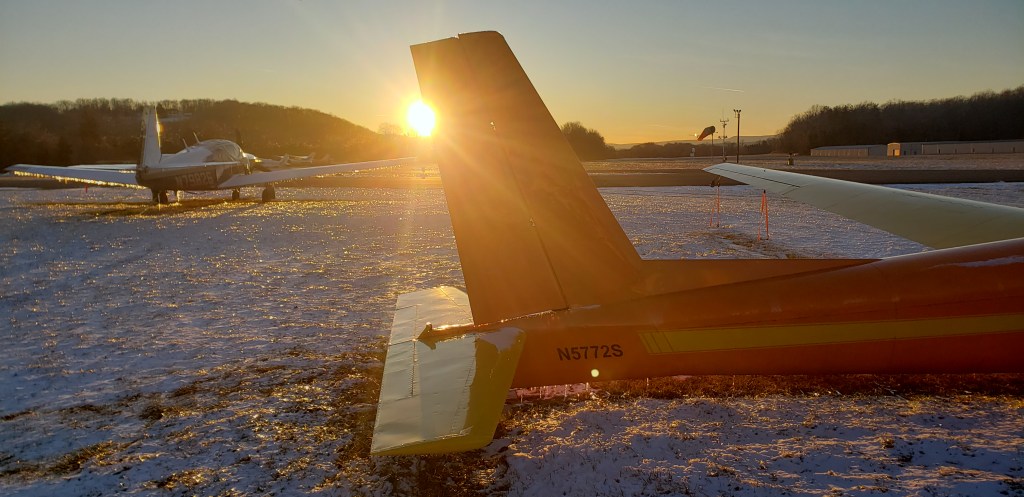
After two hours I was ready to call it a day. Everything was working and the ridge was softening up. After a nice landing, I pulled the ship off the runway. There was not a soul around, so I was now stuck with a beautiful machine with no way to get into its box. A quick call to Gus and he was willing to help disassemble the ship on his ride back from work. In the meantime, I went over to get the trailer to bring it to the glider. It’s much easier to move the car and the trailer than it is to move the glider across the whole runway! Along the way, I marveled at the beautiful ice coating all the gliders and the airport.
Thanks a million to Cookie, Andrzej, Gus, and Tommy for helping me fly today. Thanks to Bill Thar for giving me the opportunity to fly this magnificent sailplane; in the past, present and future. I hope to not disappoint.
Normally winter is a quieter time for glider operations. Not so for Aero Club Albatross! We just wear the appropriate cold weather gear when it gets chilly. As Philip DuPlessis, our resident expert sailor says, there is no bad weather, just poor choice in clothing. And this year, we came up with a very enjoyable way to spend an early December day; learning to launch using a winch!
Beltzville Soaring Club has a winch, but few opportunities to use it. So when I contacted David Bradley to express that several ACAers were interested in learning how to ground launch, he was very eager to help! Dave suggested that we fly from Grimes Airport, a wonderful little grass strip at the base of the ridge about 70 miles from Blairstown. The airport management at Grimes is very familiar with glider flying and has hosted quite a few events and fly-ins. They don’t operate much this time of year and were eager to host us. Gerry Wild was our local airport contact and all-around great glider guy. He volunteered to help instruct, run the operations and drive the winch!
Aero Club Albatross, in turn, voted in David Bradley and Gerry Wild as honorary members and the club volunteered to handle a considerable portion of the logistics. We brought our venerable 2-33, nicknamed the Mad Cow to the event. To our knowledge, no one has ever ground-launched the Cow before. We were really excited!
The event was a massive undertaking, involving a large and motivated crew. On Friday, Pete Ayers and Tommy came out to prepare the towplane and the Cow for its long aerotow to Grimes. They cleaned off all the snow and ice on the 2-33 so it didn’t have to thaw in the morning before its journey. On Saturday morning, Philip and Luke DuPlessis volunteered to do the long cross-country tow. To deal with the frigid temperatures and drafty cockpit, they were instructed to wear clothing fit for an arctic expedition! Tommy and Sebastian towed in the club’s Cessna 182 towplane. Jonathan and Gus picked up the canopy covers and tiedown kit and followed the Cow to Grimes in their Aeronca Champ.
Phillip towing from the front seat behind ACA’s 182. ( Photo Credit: Luke DuPlessis)
Gus and Jonathan in the Champ! (Photo Credit: Philip DuPlessis)
Steve Beer picked up Bobby and membership documents for Dave and Gerry. Rob Dunning brought lawn chairs, coffee, bagels, and donuts. Bob Graf brought two cases of water and more chairs. Cookie and Joe (Dave’s son) also came to help out and crew.
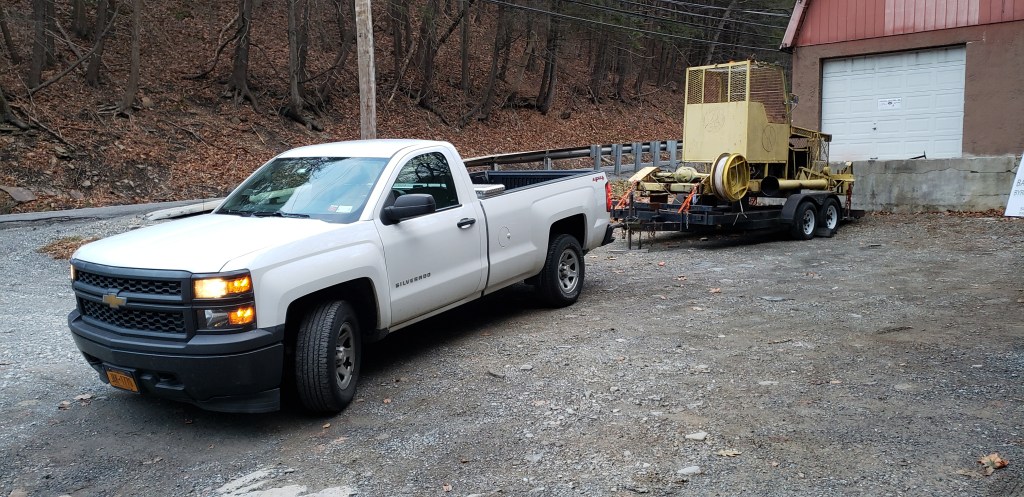
My job was to haul the winch from Dave’s shop to Grimes.
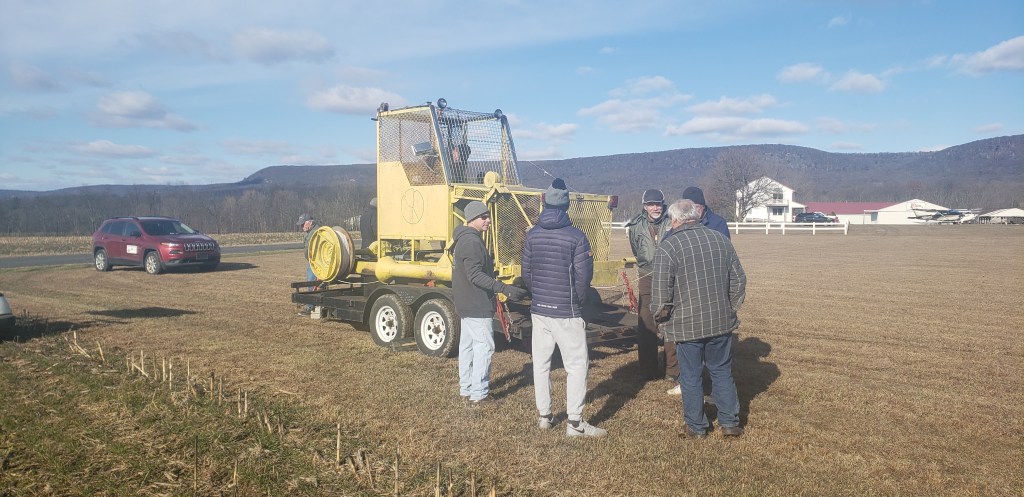
The winch was a freakin’ monster! It weighed 6-7000 pounds, with 600lbs on the tongue. Only a large vehicle like a pickup truck could move it safely (and legally). It was an ordeal getting it on the hitch and we had to position the truck perfectly. Then we found we couldn’t get it on the hitch because the tail end of the trailer would hit the ground. Through a combination of gingerly pulling it with a chain, a 12-foot pole as a lever to lift it, concrete blocks and huffing and puffing, we finagled the trailer onto the hitch. We were finally ready to hit the road!
Joe joined me for the drive as the navigator. The winch was a real monster to drive; unlike glider trailers, you *feel* this thing behind you. So did my gas mileage; I was getting 8.5 MPG thanks to the weight and the flat plate dragging through the breeze. But we arrived safely at 9:20 am, right as Phillip and Luke lined up on short final. Everything was coming together!
Gerry and Dave started the morning ground school and briefing at 10am. Gerry introduced the museum and noted that it’s a volunteer, non-profit organization. Gerry’s wife, Kristin also introduced herself as a contributor and made us feel very welcome. She was so kind as to cook hotdogs for us and provide a variety of snacks! They offered membership forms and five of us joined to support the organization.
Dave discussed the mechanics and safety of winch launching, emphasizing the decision-making at different points of the launch. When launching, first establish a 10-degree climb until reaching a safe altitude around 100-150ft or so. Then rotate into a 30-degree climb, while maintaining adequate airspeed. Flying too fast is bad; you don’t get as high and you can over stress the glider. If you have a rope break, you have to shove the nose forward and visually verify that you’ve got airspeed. Dave’s mantra was, think with the stick forward and emphasized that experienced pilots training to winch tend to think faster than their airplane can fly. After releasing, consider your options. If you are within a 5-1 glide, land straight ahead. If you’re above 250ft or so, consider tear-dropping back. Use judgment, maintain airspeed and be coordinated in the turns.
We really liked Dave’s approach to safety. He clearly conveyed, here is how winching can kill you. The winch driver can accelerate the glider too quickly and flip it over. Once you’re in the air, the glider can over-rotate, break the rope and hit the ground before getting flying speed. During the tow, you can have a rope-break, fail to achieve flying speed, and subsequently stall/spin. And for the folks on the ground, the rope is moving at 50-60 mph and can unpredictably go in different directions. Stay clear, behind the glider or on the safe side of the winch while the operation is in motion.
Then there was the fateful moment when Dave asked,
“So who’s going first?”
Everyone looked at each other, offering the opportunity to someone else. Finally, I volunteered to be the guinea pig.
Next, we hustled over to the winch. After some fiddling and adjustments, it roared into action. While Gerry and the onlookers were figuring it out, I walked on over to the Cow, patiently waiting on the side of the runway.
The Cow looked like it was nervously grazing on the beautifully manicured grass runway. She was probably thinking, “What are we doing here, so far from home? I can see it their eyes, these guys are up to no good!“
I walked around the glider and it looked in ship shape. A whole entourage of glider pilots rode over in the golf cart, eager to see Dave and me off. They brought the rope and we strapped in.
The experience of winch-launching is on the edge between being excitement and terror. Steve hooked us up and was our wingrunner. Once on the tip, he waggled the wings up and down, up and down, indicating to the driver to take up slack. Once he stopped, the winch driver “hit the goose” and we rocketed up. We were airborne in less than three seconds, screaming along at the speed of heat.
It was quickly apparent that we were going too fast, approaching 80 mph on the dial. Dave kept the angle flat rather than rotating to minimize the load on the wings. After getting to only 250ft, Dave released and said, here you go! I did a quick 180 and landed back where we took off.
After landing, Dave called up Gerry to ease off the throttle and turned us around. He said that I would have the controls on the next launch.
It was amazing how quickly we were airborne! I kept too much forward pressure and Dave eased us back. At 100ft or so I rotated into a climb. We were still too fast and climbed to little more than 250ft.
I made a dumb decision after releasing the rope. Figuring we were a bit more upwind than we were, it felt that we lacked the room to maneuver to turn upwind (we had a slight NWerly crosswind). I did my 180 to the left, downwind and this did not work out well at all. I drifted in the turn much more than I expected and button hooked the final turn. I was not happy with that approach.
The third flight was better. This time we got to 450ft, enough to do an abbreviated pattern for a downwind landing. I was not eager to do a “full” pattern from this height.
The fourth flight was better yet and we got to around 550ft on this launch. I still had to work on rotating more deliberately, but I got the mechanics of the launch figured out. We were high enough to do a full pattern and had an uneventful landing.
Dave asked me if I wanted to do the next one on my own.
Sure deal and better now than later; I want to do it while the training is fresh!
Dave hopped out, buckled up the belts around the cushion and cut me loose. After hooking up, I rocketed up. Man, the Cow climbs so much better solo! Climbing up to 750ft, I saw the airspeed bleeding off and firmly pulled the release twice. I was free!
A left 90 degree turn and I stumbled into a thermal. How convenient! I started circling, happily gaining height every turn. A raptor even joined me!
I looked down and watched the action on the ground. People looking up at me from the winch. The golf cart traversing along the runway. The cars buzzing along I-78. The beautiful and familiar ridge a little over a mile away. What a gorgeous place!
Grimes Airport. Note the winch near the treeline, right under the wingtip.
When I saw the golf cart making its journey back to the launching area, I cut my flight short and headed back. I felt like a king entering the pattern at 900ft. Compared to all the unusual attitudes and altitudes, I felt high. I even got to make my base leg at 500ft and turn final around 300ft or so. What a blessing!
After landing, everyone was smiling. Dave asked me if I wanted to throw his CG hook equipped 1-26 (020) together and try to soar in the afternoon. I eagerly agreed!
Dave’s son, Joe and I went on over to assemble the ship. We got halfway, but couldn’t find the fourth main pin to finish the job. We looked everywhere but to no effect! We relayed this to Dave, who arrived 45 minutes later after being relieved of his instructor duties by Gerry.
He found the pin stuck in a deep socket in his toolkit. We were all relieved that the pin wasn’t missing and Dave laughed his butt off and singing, “Victory!”
By now, Gus had taken several instruction flights and completed a solo flight. Jonathan was on his third flight. But then, the Cow decided it had enough winching for the day. On Jonathan’s last landing, the tire went flat. This unfortunately grounded the ship for the rest of the day.
Since the 1-26 was nearly ready to go, I quickly sealed it up and got it out on the line. Best to use the winch while we still had the chance to fly!
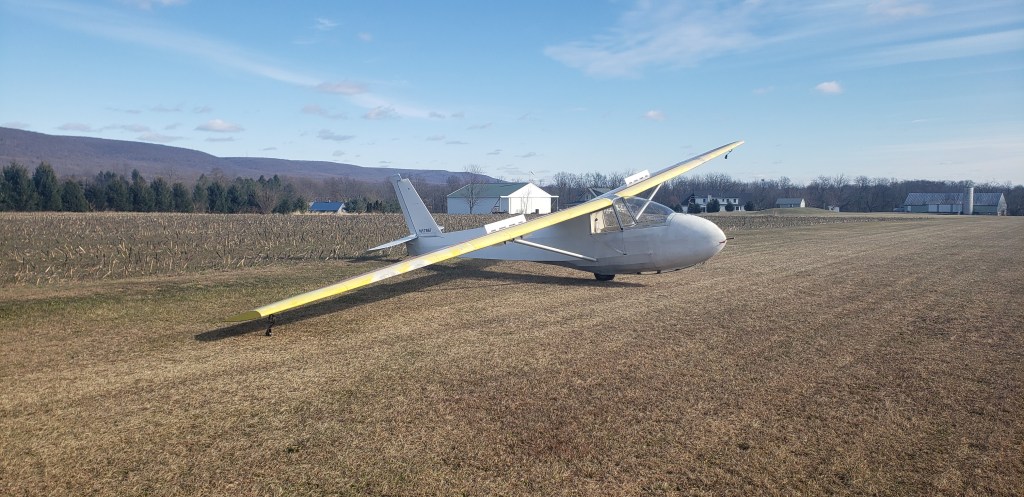
020, Dave’s 1-26. Note the CG hook on the bottom of the nose, under the cockpit!
Launching the 1-26 was really fun! It got airborne really quickly and settled into a very natural climb. The CG hook definitely makes it climb better! I firmly pulled the release at a comfortable 800ft. 020 is a simple ship, with basic instruments, but man it flies great. 1-26s are just a total blast!
The glider quietly sailed through the sky. There was little lift left this late in the day, so I quickly fell out and entered into the pattern. After landing, a whole bunch of folks eagerly took up the 1-26. Dave went up first and had a grand old time. He entertained the crowd with mild aerobatics and screaming along the runway at 100mph. 020 was surprisingly quiet at such a high speed! Dave was all smiles, waving as he passed us at the winch.
Gerry and Adam then took their turns in the 1-26, getting as high as 1100ft off the tow!
As our friends were flying, we surveyed the Cow situation. We really wanted to get the wheel fixed, both so Steve B. had a wheel to fly on the following day back to Blairstown and so that the ship was airworthy when it returned. The mechanic at the shop found an old 600X6 tire, which fit the Cow’s wheel. A whole crew of us got to work. Bob Templin, Bob Graf, and Bob Cook all played key roles in this project, helping to get the glider jacked up and the wheel off. Walter, a local Grimes member helped coordinate different parts and materials and helped us a whole bunch. The rest of us Beltzville and ACA members lent our brains and brawn while these guys labored away.
The job took us several hours. The wheel hadn’t been taken apart in many years and the Cow resisted getting its appendages operated on. The axle had to be banged out. The backseat, torsion bar, and wheelbrake had to be taken apart to get to the wheel off.
Mike, the Grimes’ mechanic, AKA our savior!
Taking the wheel itself apart was a nightmare. The axle was deformed and the hub wouldn’t separate. Mike the airport volunteer mechanic spent a good hour and a half, sanding off the burrs on the edge of the axle and hammering the unit apart. As the sun went down at 4:30pm, we managed to get the new tube in, the wheel together and reassembled back on the glider.
Steve B, Bob Graf and I tied down the 2-33 in the darkness, all ready to fly the following day while Dave and Joe hooked up the winch to my truck. We all had dinner at the local Midway Diner, only four minutes from the airport.
After trading stories and having a great time, we parted ways. I went back with Dave and Joe to drop off the winch at Beltzville airport. I hit the road back to Brooklyn at 8:30pm, thoroughly satisfied after an awesome day of flying.
___________________
The next day, Steve and Tommy safely aerotowed the Cow back to Blairstown. The ship is now happily back in its tiedown, ready to fly.
The winching day was a real blast! Everyone had a great time and contributed to make this event a blast. We learned a lot about winching thanks to Dave and Gerry’s wonderful instruction. Thanks a million to Aero Club Albatross, Dave Bradley and the Beltzville folks and Grimes airport for making this happen for us. We are all eager to do it again, get more people endorsed and promote winch flying!
Clemens Ciepek wrote a thought provoking piece that computed the relative risk of dying in soaring in relation to other activities. He pointed out that statistically, glider flying is twice as dangerous as motorcycling. And the risk of dying while soaring in the next 1000 hours is approximately two percent, ouch.
Observing the responses and reactions, many people pushed back at the statistics. Sure, a lot of this reaction can be explained through cognitive dissonance. Yet the statistics speak for themselves; soaring is a high risk activity.
However, we should examine the risk concept a bit further. We have considerable control over the risk we accept. This is not a cop-out, but rather a factual statement. The reason we crash is due to human factors and poor decision-making, not things outside of our control.
However, we must also accept that overcoming our human foibles is difficult. It’s kind of like trying to beat the stock market; sure it might be possible, but everyone else is trying to do the same thing. The same psychological processes that prevent smart people from doing better than the market are the same ones that get us killed.
All that given, it’s still worth examining where the risk is hiding in soaring.
Almost all gliding accidents occur during takeoff or landing. The remainder includes mid-airs, health-related episodes, structural failures, etc. Most of us can exclude the remainder from the risk equation. Therefore, almost all of the risk is in the first and last five minutes of the flight; below 1000ft AGL. Otherwise, unless we hit a bird or an airplane, the risk level above 1000ft is nearly nil.
This suggests that our overall risk level should be low if we are totally professional when we do our takeoffs and landings. We can do this by meticulously performing checklists and strictly maintaining our margins in decision-making, airspeed and coordination.
The opposite is also true. If we rush through the pre-flight, forget to do our pre-takeoff checklist and an issue arises on tow, our risk level would be very high. When we thermal below 1000ft AGL, neglect choosing a suitable landing option for too long and fail to commit to a safe approach, our risk level would be extremely high. At a minimum, should we indulge in entering this high risk territory, we should acknowledge it and minimize the risk through our choices. But it’s best to avoid it.
For competitive pilots, there is the additional risk of a midair with another glider. It’s undoubtedly true that the likelihood of a midair in competitions is considerably greater than in casual flying. That said, incidents and accidents in competitions are overwhelmingly due to poor landout judgment. This is entirely in the domain of pilot decision-making.
Then there’s ridge/mountain flying. Here the risk level is probably an order of magnitude greater than in thermal soaring. This is due to the challenges of taking off and landing in strong winds, maneuvering in close proximity to the terrain in gusty conditions, and the poor landing options in the vicinity of mountains. There are many ways to mitigate these risks, but this requires a tremendous amount of experience and effort. We have to study the weather, terrain and learn the fields and their approaches. We have to train to handle challenging conditions. And even if we do everything right, we still cannot contain all the risk. To use Clemens’ analysis, ridge flying is probably as dangerous as climbing the Tetons. And interestingly, in the past I have used mountain climbing as an analogy for the risk level associated with ridge soaring.
That said, there are mountain climbers out there who successfully scale mountains their whole lives. They often do this by being cognizant of the risks and consistently mitigating them. They do this through good preparation, training and maintaining their margins.
My point is not to detract from the statistics. It is to give us tools to think about so that we can control our risk level. And since there’s a lot we can do, we can greatly minimize the risk of dying doing what we love.
There are three ways to crash. The first involves factors well outside our control, such as a rope break at 150 ft with nowhere to land straight ahead. We tend to disproportionately worry about these kinds of events and yet they account for a very small proportion of accidents or fatalities. The second involves deficiencies in basic airmanship. This includes situations like confusing the gear handle for the spoiler handle and fruitlessly cycling the handle up and down while screaming down the whole length of the runway. Lack of experience or recency tend to be the significant factors. However, complacency or an unfamiliarity with a new aircraft systems could still bite experienced pilots.
The third kind of accident involves critical errors in judgment or decision-making. This is where many of us get into serious trouble. Accidents related to “when to stop soaring and start landing” fall into this category. Also relevant is when to abandon a task or determine that the conditions are too challenging.
Matt Wright’s and Dale Kramer’s accidents come to mind. Both cases were similar in that other experienced pilots flew in the same conditions and chose to abandon their respective flights. Both pilots were driven, pursued difficult weather and then drove themselves in situations that were unrecoverable.
Why is it so hard to avoid this trap?
The underlying issue is that glider flying is unforgiving of overstepping safety margins. And yet the margins are not clearly demarcated. The glider flies until it doesn’t and departs into a spin. We can clear a tree line over the last field before the airport, or over the top of a ridge, until we can’t. The outcomes are either we are unscathed or end up plastering ourselves into the ground.
Sure, we sometimes scare ourselves. We may realize that we “cut it too close” on a flight. But tragically, even this experience will not always help us.
Worse yet, as we expand our margins, we can slowly erode our way into the territory where we are at serious risk. Ideally we scare ourselves before we go too far, but not everyone is so lucky.
And more importantly, as our margins become thinner, the more we enter into the gray area where we might lose control of the situation. There are limits to our control; even the best pilot can only keep his airspeed within certain bounds, suppose +- 1 knot. If his aircraft is exactly at the edge of stall, he would have a 50 percent chance of failing. And extending this logic to other situations, just how low can we reliably clear a treeline? Or how low can we thermal near a field? And if we get away with it once, twice, ten times, twenty times, does it mean we can do it 100 times or 1000 times?
The problem is that we only need to fail once for it to be game over.
To summarize their findings, they point out that decisions from “description” or “experience” are processed very differently. A doctor who has many years of providing vaccinations is likely to have never observed a patient have an adverse effect. A patient reads online that 1/9000 people experience complications. Both doctor and patient are processing the risks of adverse effects, but they are doing it in different ways.
Both kinds of judgment have been studied experimentally. An example of a decision made from description is playing a simple lottery:
Suppose you can take $2 for sure.
OR
You can flip a coin. If you land on heads, you will win $5. Land on tails, you win $0.
Which do you choose?
In this case, the description of the lottery provides clear probabilities and the payoffs.
In contrast, decision-making from experience would have you learn the probabilities and payoffs over time. For instance, I could give you three urns that each contains a total of 100 balls; red or white. The urns have 30, 50, and 70 red balls respectively.
You are given time to sample from each urn. You can take out a ball, mentally note its color and then put it back into the urn. You are allowed to repeat this process as many times as you like.
Finally, you are told to select an urn and pull out a single ball. If it’s red, you will win $5. If it’s white, you will win nothing.
If you spent a sufficient time sampling from the urns earlier, you will readily pick the third urn.
_______________________
Where decision-making from experience fails.
Now consider an urn that has 99 red balls and 1 white ball, but the white ball is radioactive. You might sample from that urn 20, 30, or even 50 times and never find that white ball. And maybe those red balls give you a pretty big payout each time. It would be awfully tempting to keep pulling the red balls from that urn.
That is until you stumble into the white ball and you die.
The fickle nature of safety risk in gliding is such that failure is rare, yet catastrophic. Much like sampling from an urn with a radioactive white ball.
And studies show that in such examples, people systematically under-weigh the risks of failure (Hertwig et al. 2004). When people rarely experience bad things, it’s especially easy for them to think it can’t happen to them.
But what about those times we got scared after a “close call”? Or when our friends crash? Usually this gives us pause and gets us thinking about our margins and choices.
The trouble is that when people base their decisions on experience, they over-represent recent events in their memory.
“Rare events have less impact than they deserve not only because decision makers have not encountered them, or have encountered them less frequently than expected, but also because they have not encountered them recently” (Hertwig et al. 2004).
Unless you were recently scared, or someone recently had something bad happen to them, your experience is not necessarily going to help you avoid making a bad decision.
This is especially evident in glider clubs. Someone crashes, maybe even gets hurt and there’s that cathartic moment when everyone becomes safety conscious. Some time passes and everything return to “business as usual”. Then two years later, there’s another accident, and the process repeats itself.
We can’t help ourselves.
_______________________
What can we do about it?
One of my club members has a mantra, what can possiblygo wrong? It’s usually easy to figure out well in advance that we might get ourselves into serious trouble. Suppose we’re watching our final glide bleed away and become marginal. Well if this continues, we may come up short, or we might just squeak it in. What are our options? What is our plan? How low are we comfortable pressing on?
There’s even more risk soaring in mountains or on ridges. On the Blairstown ridge, there have been countless incidents and accidents. Often time when I pass an accident site, I think about the poor fellow and what happened to him. This keeps reminding me of what could possibly go wrong.
When flying near places where I had scared myself, I visualize what happened. Passing through Snyders, I shudder when I remember how I fell off the ridge to the field below. Or how I crossed over Rt.81 uncomfortably low making the transition over to Bear Mountain. These incidents are seared into my memory and I routinely remind myself about them before entering comparable situations (maybe I should take that thermal an extra 500ft, thank you very much!).
This certainly makes the case that experience is helpful. But the point is that we have to actively summon past experiences for them to be useful.
Short safety talks in competitions or in clubs can also be helpful. Done well, they can remind people of what can go wrong and get them thinking about it in their routine flying.
Training
Training for judgment can be difficult. We try to provide simple tools for success. For example, when we start cross country soaring we are usually given rote heuristics for when to land in a field (3k- choose area, 2k- narrow down, 1k- commit to land). There’s a lot to be said that having strict decision rules is good for keeping us within acceptable margins.
However, this does not work in situations that vary considerably. For instance, ridge soaring does not lend itself well to making decisions by rote. Attempting a transition at a certain altitude can work well with one wind direction, but not if the wind shifts 30 degrees. Experience lets you predict the conditions and make the necessary adjustments. This is what makes it fun, but with room for judgment there is even more room for error.
And if things start going to hell in a hand basket, where and when to leave for a field can be tricky. There are places where you have to be high enough to clear the ridge to make it to fields downwind. Other times, there are fields on the upwind side, but you might have to glide out a considerable distance. Where and when you can make these fields will change depending on the wind speed, direction, expected sink and more. There’s a lot of judgment that goes into maintaining these margins.
It is impossible to prepare for or train for all of these situations beforehand. The only way to deal with these circumstances is to build experience incrementally. Even better is to be guided by experienced coaches or mentors who can alert you as to what can go wrong.
Another way to explore the limits is to fly in the simulator. Condor lets you fail without the consequences. You can see what happens when you fly too slowly near a ridge, turn downwind into the mountain, wait too late to commit to landing and all sort of other common and fatal accidents. This is useful toward learning the boundaries and the limits of what you can get away with.
_______________________
Decision-making research shows that glider pilots will nearly certainly under-weigh the likelihood of crashing. And unless we continually remind ourselves of what can possibly go wrong, we are susceptible to making really bad decisions. Experience is worth nothing unless we use it. We must learn from our mistakes and the mistakes of others. We must train incrementally and stringently maintain our margins.
And above all, remember that we are our own worst enemies.




















 Soaring Economist