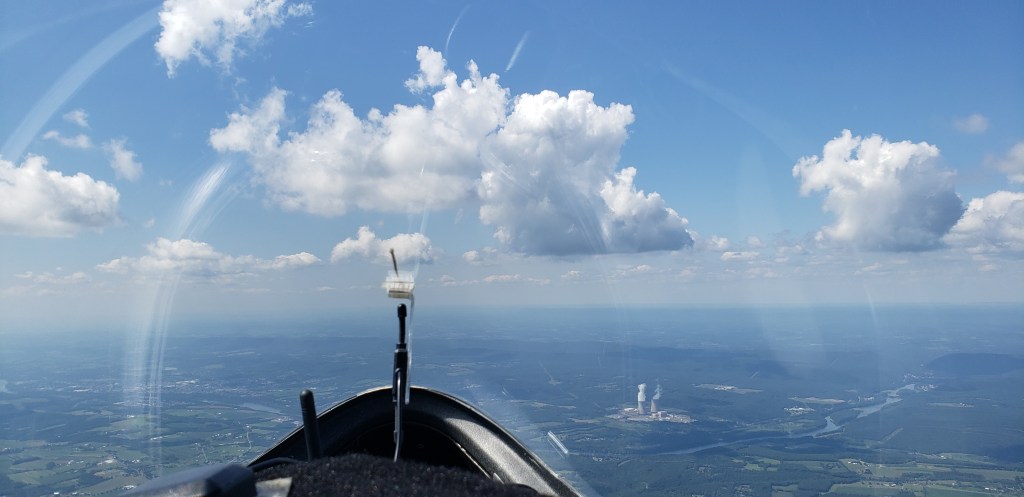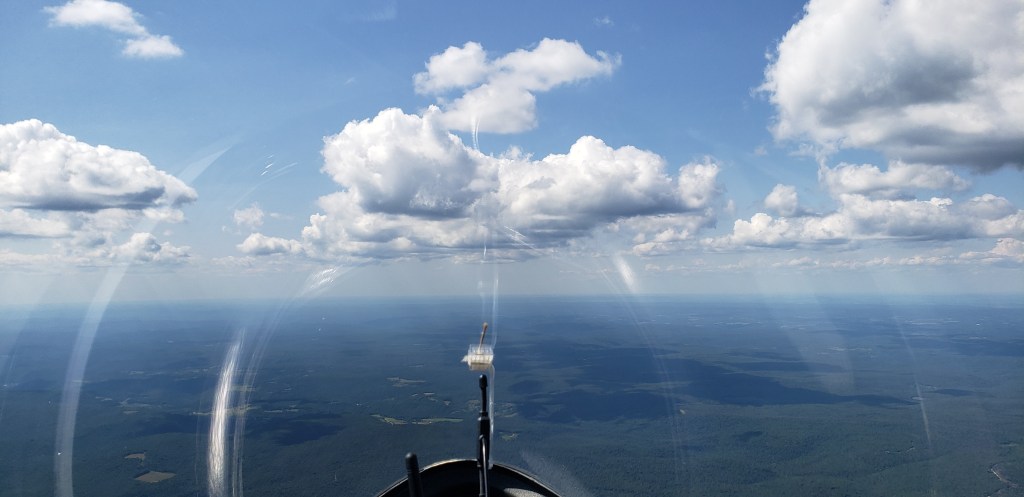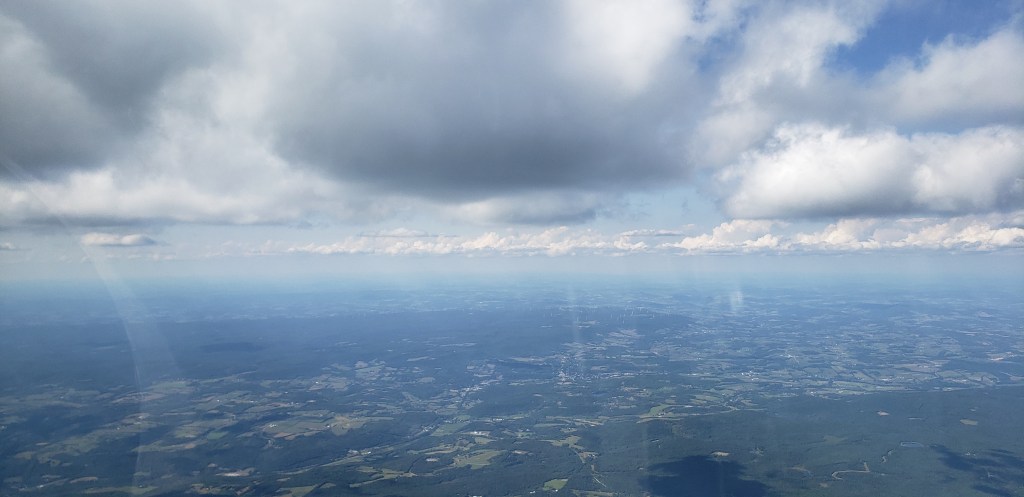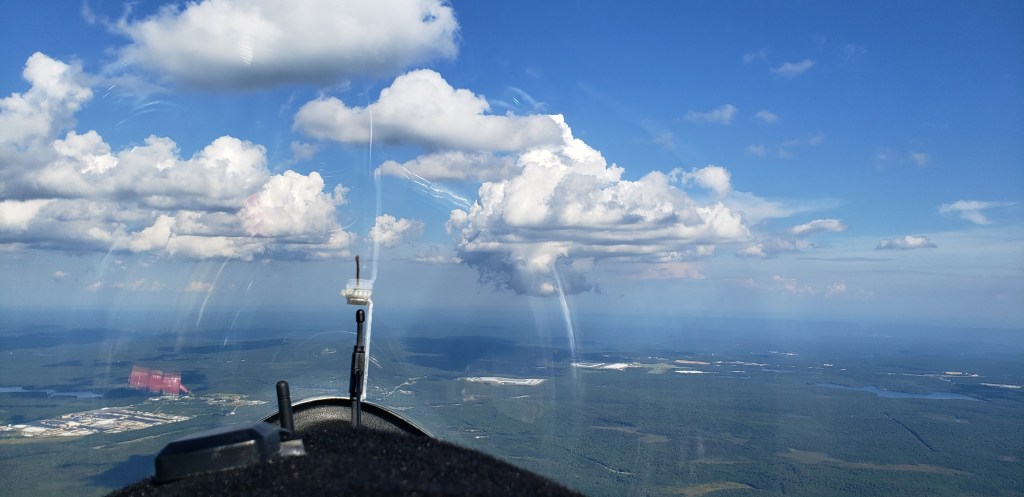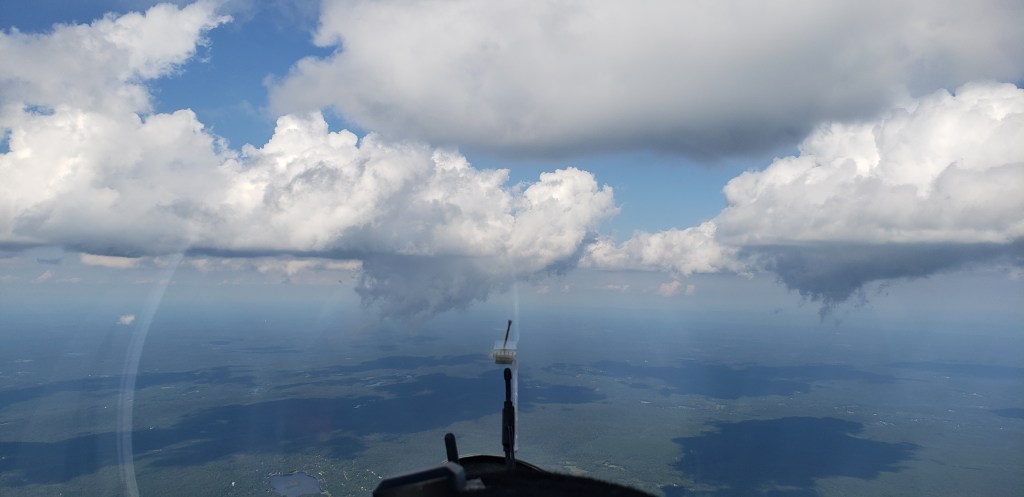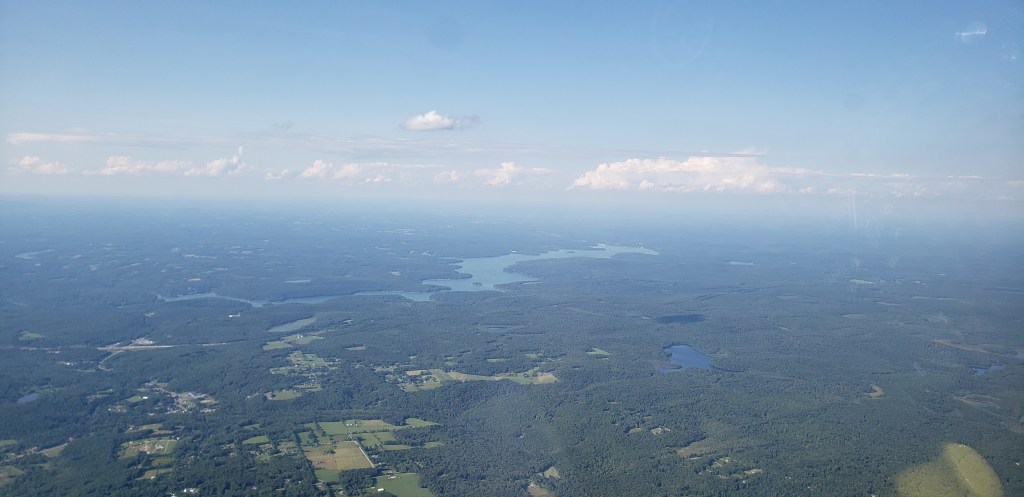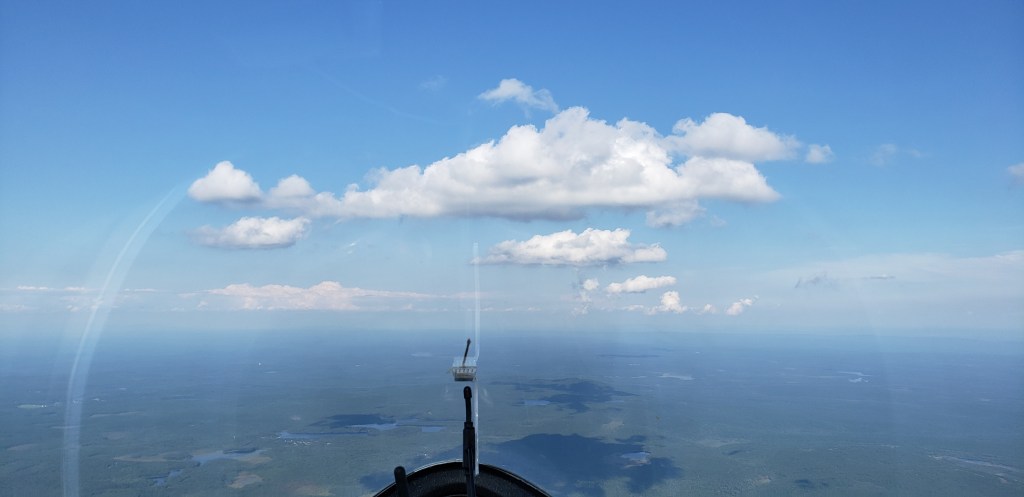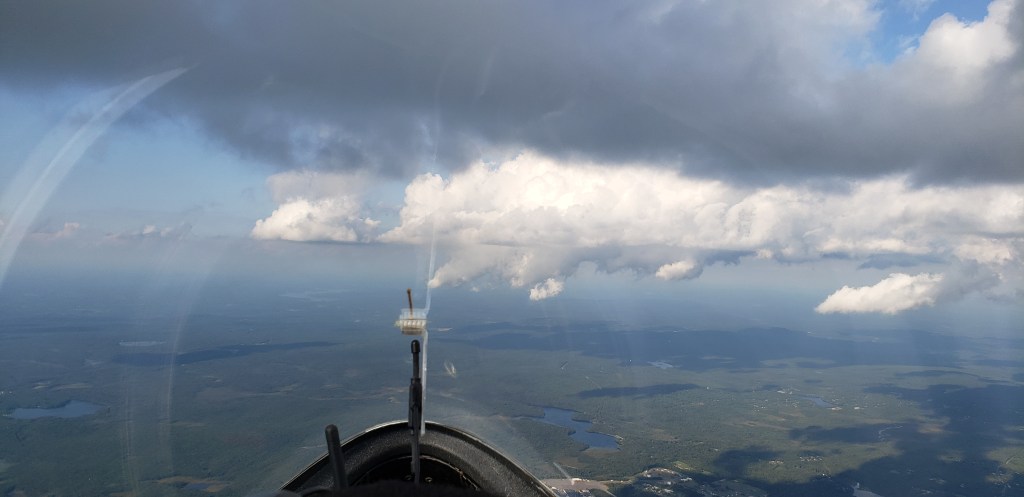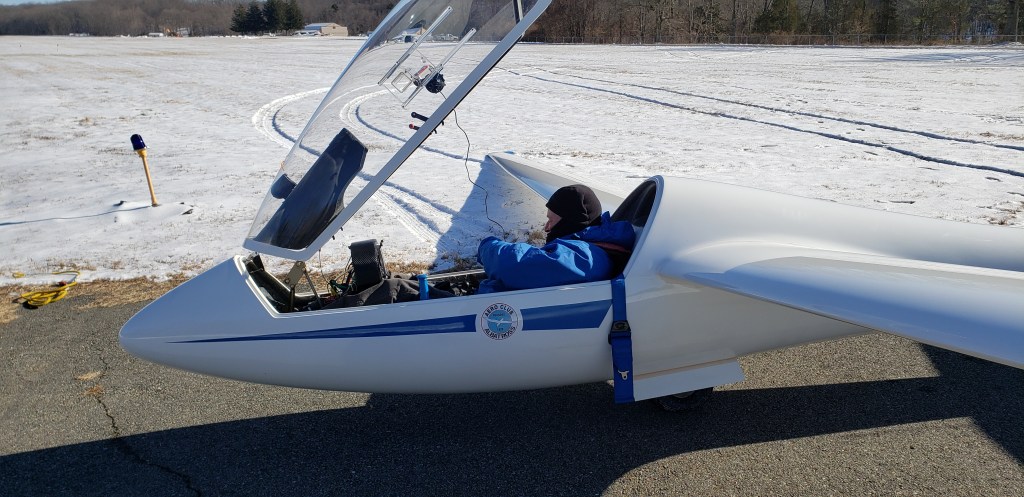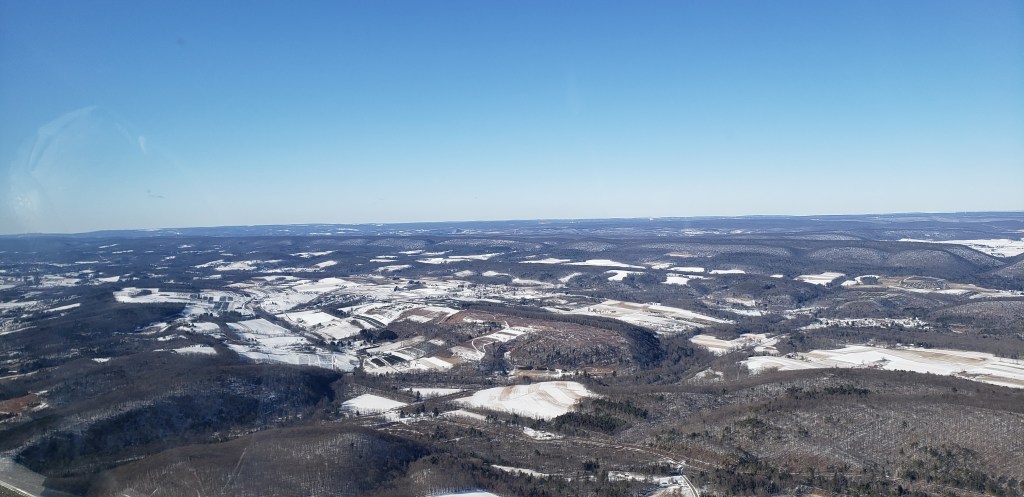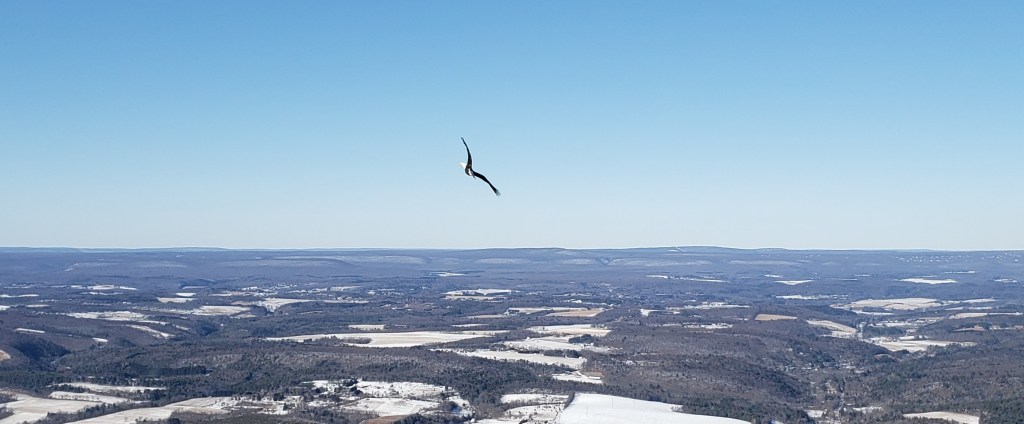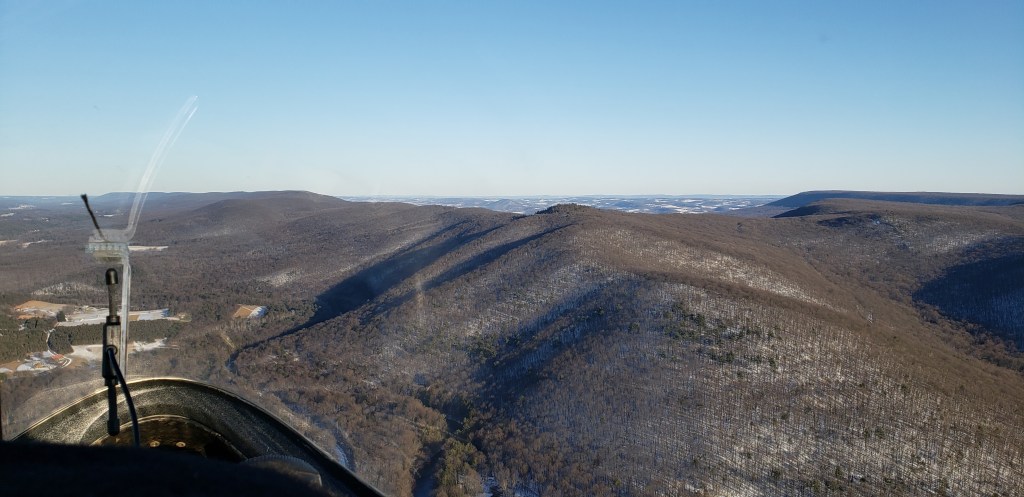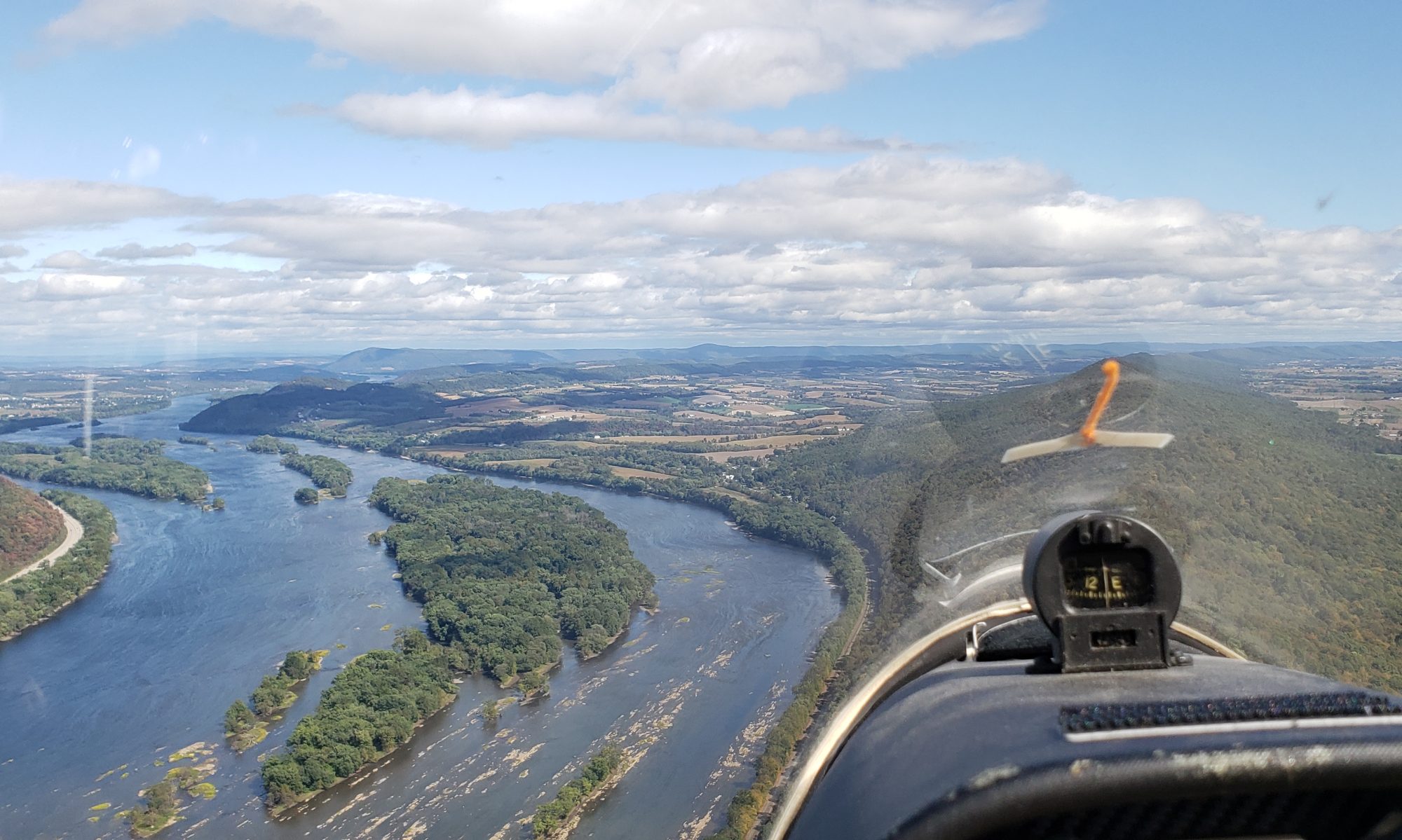
08-07-21 | Stop, Take a Breath and Enjoy the Show!

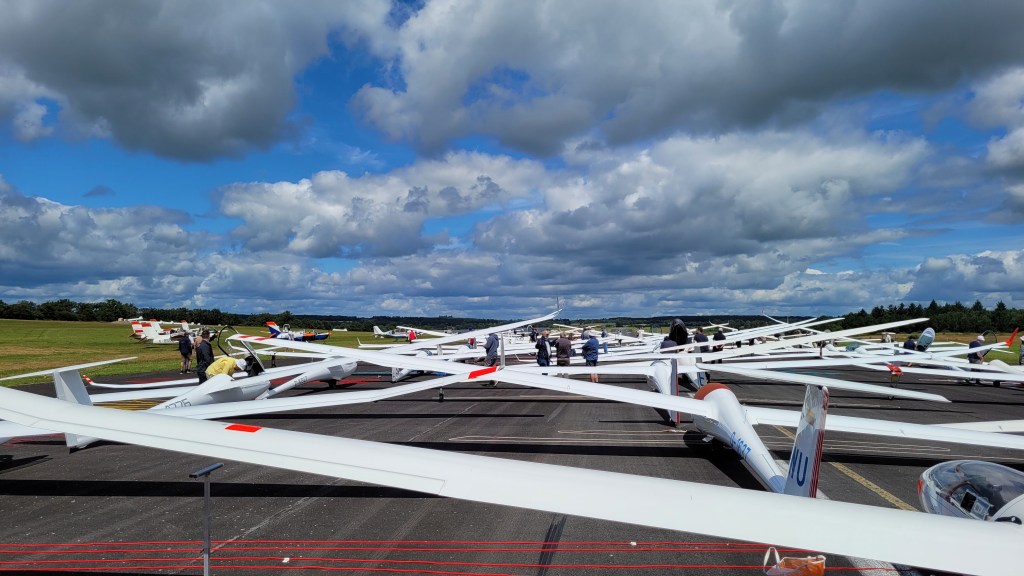
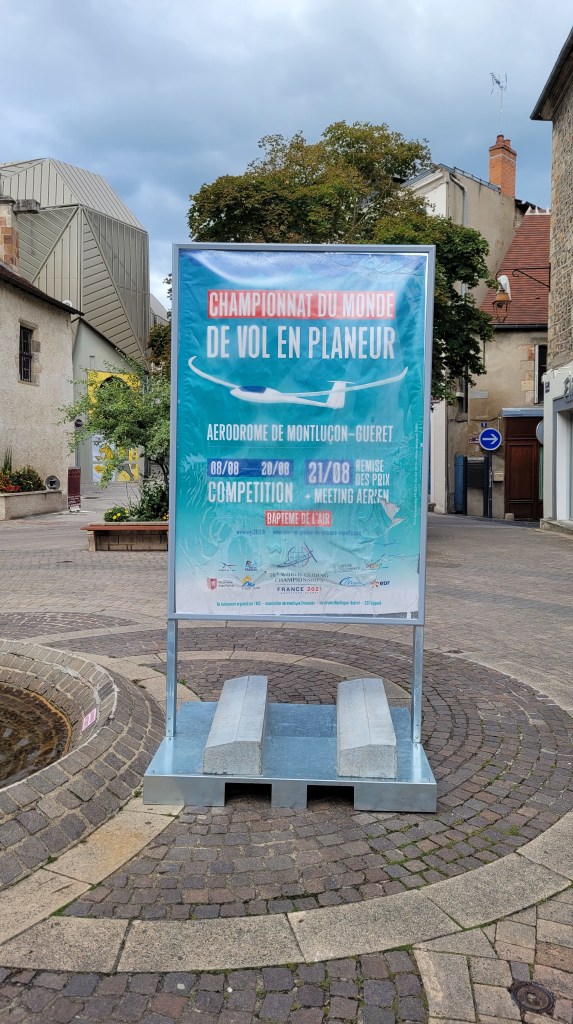
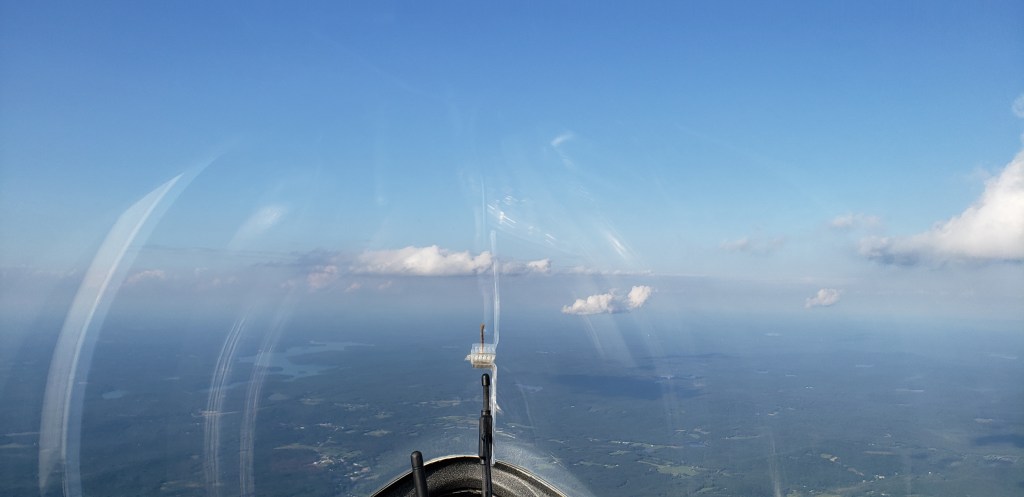
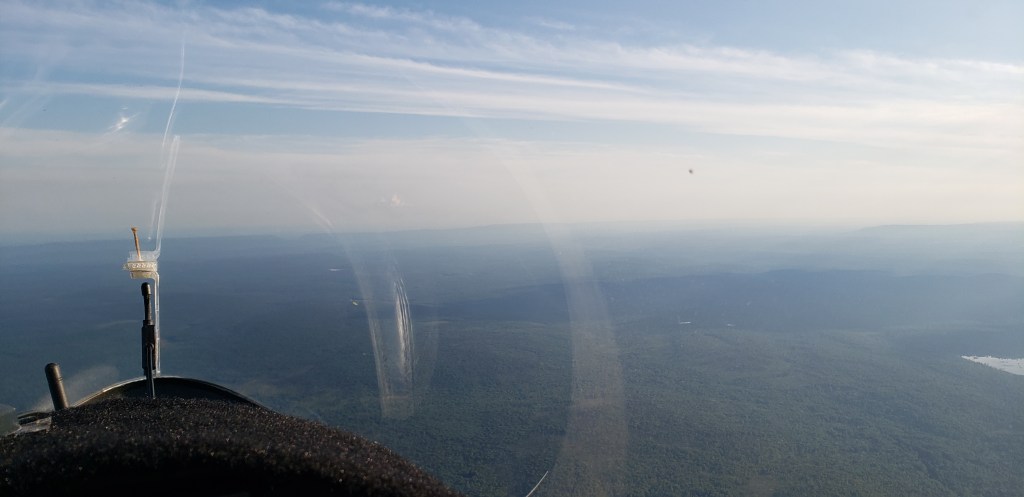
It’s been a heck of a year. We have seen our lives upended in ways we couldn’t have even imagined. In the midst of all this, any illusion of a future we envisioned for ourselves collapsed in the face of overwhelming uncertainty. We took a moment to reexamine our priorities as the day to day busyness of our lives turned into silence. Writing this, I am amazed to be here at all, in Montlucon France, on the eve of a World Glider Championship. It seems to be an illusion of relative normalcy while at the same time feeling somewhat peculiarly off. Like the initial feeling of confusion when you’re vividly dreaming, before you realize that you’re in fact in a dream. And then, the following feeling of delight when you grasp that you can let go of your grip in your confused reality and embrace the fleeting moment of freedom in your dream world.

I’ve been very lucky during these difficult times. I thankfully did not lose any family and friends to COVID. Personally, I have been greatly fortunate to be in a Ph.D program, which successfully retooled to conducting research remotely. If anything, I have had so many projects recently that I have had hardly enough time to remember to breathe! Leading into the competition, I was working days and nights to get everything squared away with hardly enough mental bandwidth to get packed and prepped for a glider contest. This was followed by a long journey from Philadelphia, New York, Paris, Le Mans, Zurich, and finally to Montlucon, lasting a full exhausting four days, employing all sorts of trains, planes, and automobiles.

A key character in helping coordinate these logistics was Alain Daumas, a fellow Aero Club Albatross club member who lent me his car and a place to stay on my first night in France. He even arranged for his friendly neighbors to invite me for dinner, feeding me a full course meal of oysters, crabs, steak, shrimp, and a variety of vegetables and cheeses. None of them spoke more than a few words of English, and I certainly was unable to speak French, which made the evening all the more entertaining. Later we used Google Translate on a phone, which worked splendidly. They asked me what I thought of Biden and Trump and I in turn asked them about Macron!

It turned out that the host, Claude, was a recently retired masterclass butcher. He invited me over to the neighboring billiard room to reveal all the medals and food trophies he won and a mural on the wall of his former butcher shop in the middle of the town. His face beamed with such well-deserved pride and dignity of an expert having spent a lifetime to become the master of their craft. It was such a delight to spend an evening with such wonderful folks!

The following two days consisted of a long journey to get the rented ASW-20a owned by Ross Drake in Switzerland to Montlucon, the site of the competition. The 15 hours of driving were complicated by my lack of a working phone, which I thought would be easily resolved by simply finding a SIM card at the airport or in a town. Beyond communication, getting my phone working was necessary to get Google Maps set up for the journey! It turned out this was not as easy as it used to be in the past years, and I was delayed some time finding a SIM card. As I crossed the border into Switzerland, it stopped working again and I repeated the process in the evening, in a large mall not far from Zurich.

After locating another SIM card in the mall, my excitement was not over yet. When I came back to the car and proceeded to drive toward the exit of the mall, I realized I had lost my parking ticket. The parking lot was completely empty for the mall had closed and I was stranded in this massive underground cavern, with no way out! After 20 minutes of frantic searching, walking to the payment machine, and back to the boom gate, and back to the car, I realized that there was an info button on the kiosk near the boom gate and pressed it. Thankfully a friendly Swiss lady answered and I words gushed out of mouth as I explained to her my predicament. She didn’t speak much English, but hearing the my fretting voice, she opened the gate and it simply stayed open. With that signal, I sprinted back to the car and drove out of there as quickly as I could!

Later that evening, I met with Ross Drake, who rented me his wonderful ASW20a. This glider is absolutely gorgeous, perfectly prepped and ready to go. He just got it out of his shop after a laborious refit, resealing, and polish. The glider hadn’t even flown this year! He gave me the rundown of the ship and the trailer, wished me good luck in his friendly New Zealand way and left me with the parting words of wisdom, “Fly it like you stole it!” And as if to reiterate the point, he noted that there was a sticker on the middle of the panel to remind me of this advice on a daily basis.

In the next days, I arrived in Montlucon and spent the time prepping for the contest. All of the US Team were already present and upon arriving I was greeted by all of their grinning faces. Colin Meade, our team captain was glad that I arrived safely and was relieved that all of his cats were in at least some semblance of a herd. JP Stewart, my now four time teammate gave me a bear hug. I cannot tell you how excited I am to fly with JP. We have known each other since we were 15 and have flown in many contests as teammates. When we are flying, I can look at the sky in front of me and know almost exactly what JP is thinking. Every time I look over my shoulder, he is always there, right off my wingtip. There is nothing more comforting than knowing for the next two weeks I will be sharing the sky with my good friend and long time teammate.
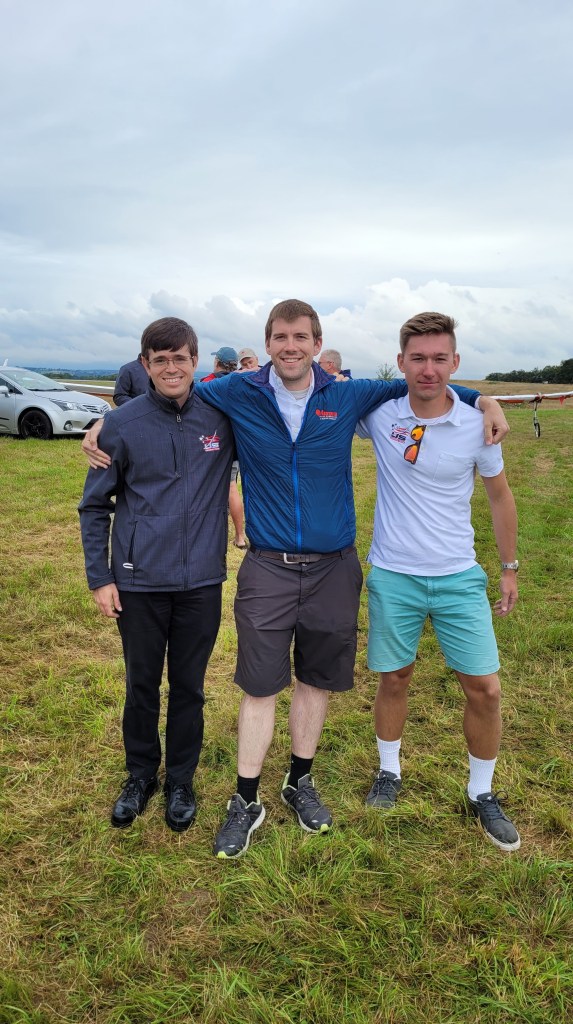
At this time I also met Donat-Pierre Luigi, my crew for this contest. He is a very interesting fellow, a Frenchman who spent 20 years in America, doing work related to biophysics and quantum computing. He recently started soaring actively after flying extensively in Condor. We spent the following couple days mastering the rig and working out the squawks in the ASW20.

The glider is working out very well. Other than some of the avionics requiring some tweaking, which were promptly addressed after my first flight, the aircraft is a total sweetheart. I can see why these gliders are as loved as they are! The ship thermalled beautifully with its generous flaps and climbed very well. The Maughmer winglets made the stall characteristics very benign, with no tendency to drop a wing at slow speeds. The 20 absolutely GOES on the cruise, with the negative flaps giving it excellent glide performance. It took no time at all to dial into this glider and I am very excited to fly it.
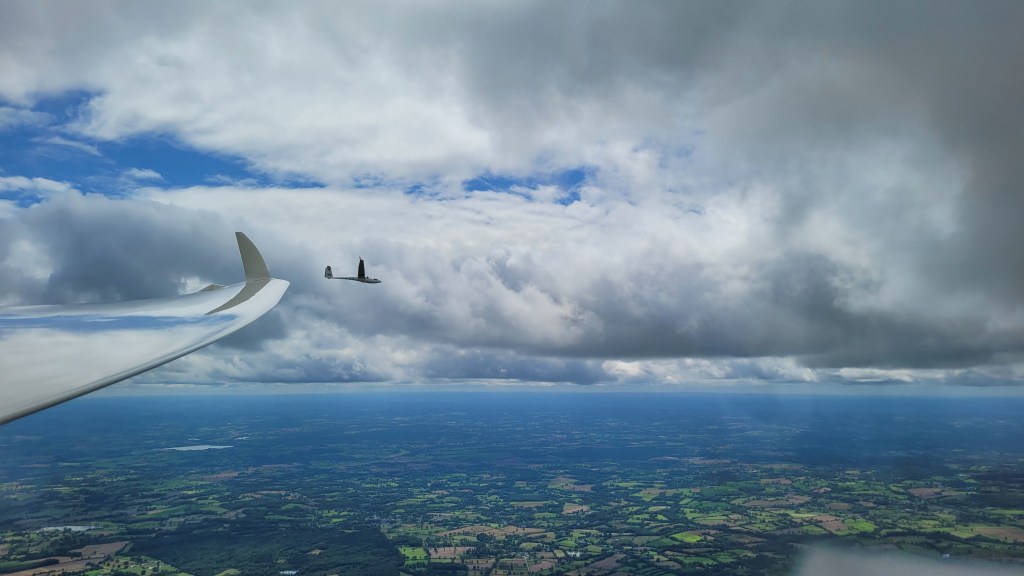
Unfortunately, on the same practice day my teammate Tom Holloran had a midair collision. Thankfully both pilots are fine and landed safely. Tom had minor damage on his wingtip trailing edge and a big paint mark on the underside of the wing. The other glider literally “traded paint” with Tom. Aside from a very scary big “bang” in flight, Tom was fine and his glider is flyable for the competition. The other glider hit Tom with his horizontal stabilizer and was extremely lucky that it did not come off both at the collision and in the time when he had landed. This was a very rude introduction to WGC flying for me. In my three Junior WGCs and all of my flying in US National and Regional competitions, I have never seen anything like that before. I hope that this is the only such incident during this meet.

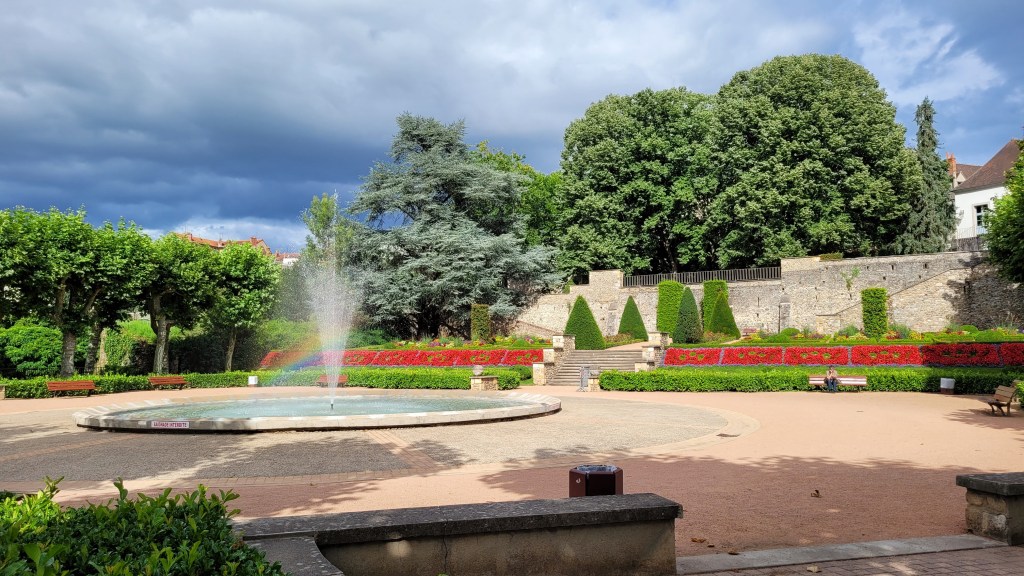
I took the next day off. After completing scrutineering, the mandatory competition inspection, and addressing a couple final squawks in the avionics system, I came back to Montlucon early and rested. The day was beautiful for a walk and I enjoyed the medieval city. Presiding over the city is a castle and chateau of the old House of Bourbon. These dukes later went to rule a large part of Europe, having climbed up the aristocracy out of their humble beginnings in this region. The castle was notable as is now a museum of pop music in Montlucon. This felt somewhat incongruent in the majestic walls of this military fort, hearing disco music played on a continuous loop. Europeans can be a strange bunch indeed!

Today JP and I, along with Donat and JP’s crew Jacob, scouted out fields along the five km finish cylinder. The fields in Montlucon aren’t that great and having landing options thought through is very important for safe finishes. We scouted 30-40 fields for the team from every quadrant in the finish cylinder and are satisfied that we have good landing options thought through for the competition ahead.

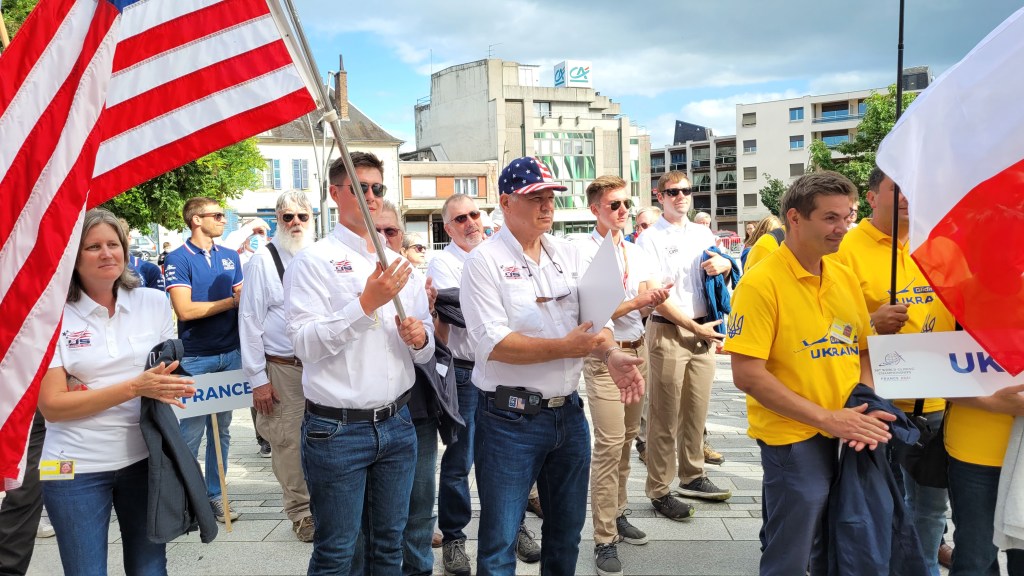
The big event today was the opening ceremony, which precedes the official opening of the contest. As the teams marshaled together in the middle of the city, among the noteworthy things for me was getting to interact with the Ukrainian team, my first time at a world gliding event. My family is from the Ukraine, so I got to speak with them in Russian and learn about their glider clubs. Later, all of the 23 teams attending the contest assembled in front of the town hall, wearing our team uniforms and holding our team flags as the local dignitaries gleefully addressed the pilots and crews, noting how the competition is such a huge event for the town. We were all excited to see the FAI flag unfurl, signaling the beginning of the competition.

And now, in a moment of self-reflection, I pause to take in this unlikely moment. It is hard to believe that I am saying this, but tomorrow I will fly my first day at a World Gliding Championship. After the joy of being selected, to see the world then fall apart, the competition postponed and for a while on the precipice of being canceled, and through all the trials and tribulations of simply getting here, tomorrow I will fly at a World Gliding Championship. After over 1700 hours of soaring and 16 years of being involved in this sport in one way or another, tomorrow, I will represent the United States of America at a World Gliding Championship.

______________________

Thanks to my friends at Aero Club Albatross, who have given me all resources, mentoring, and opportunities to grow as a recently aged-out junior pilot. Thanks to the many people who support me and the US Team to make flying at a WGC possible.

03-28-21 | The Masters of the Sky

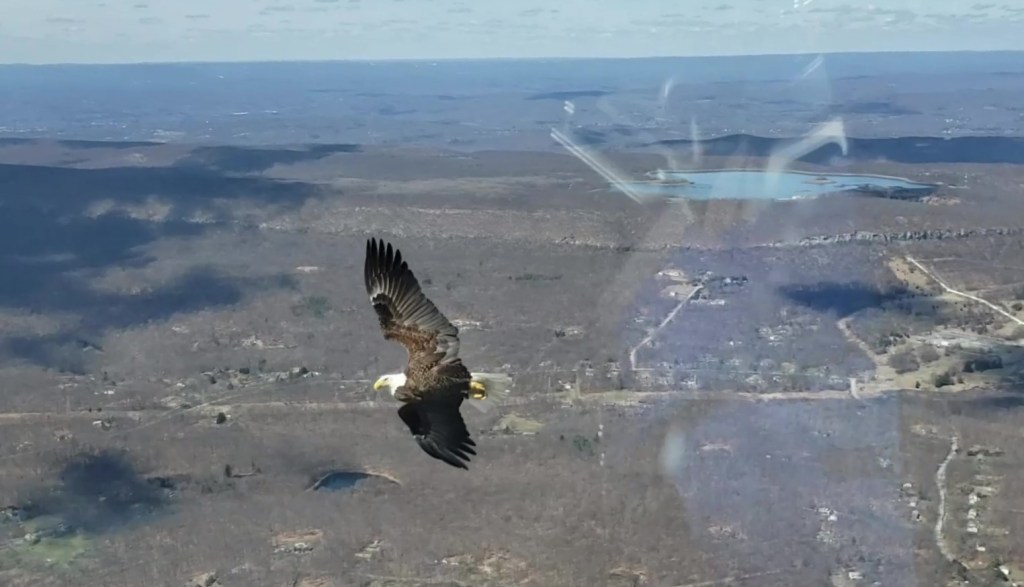
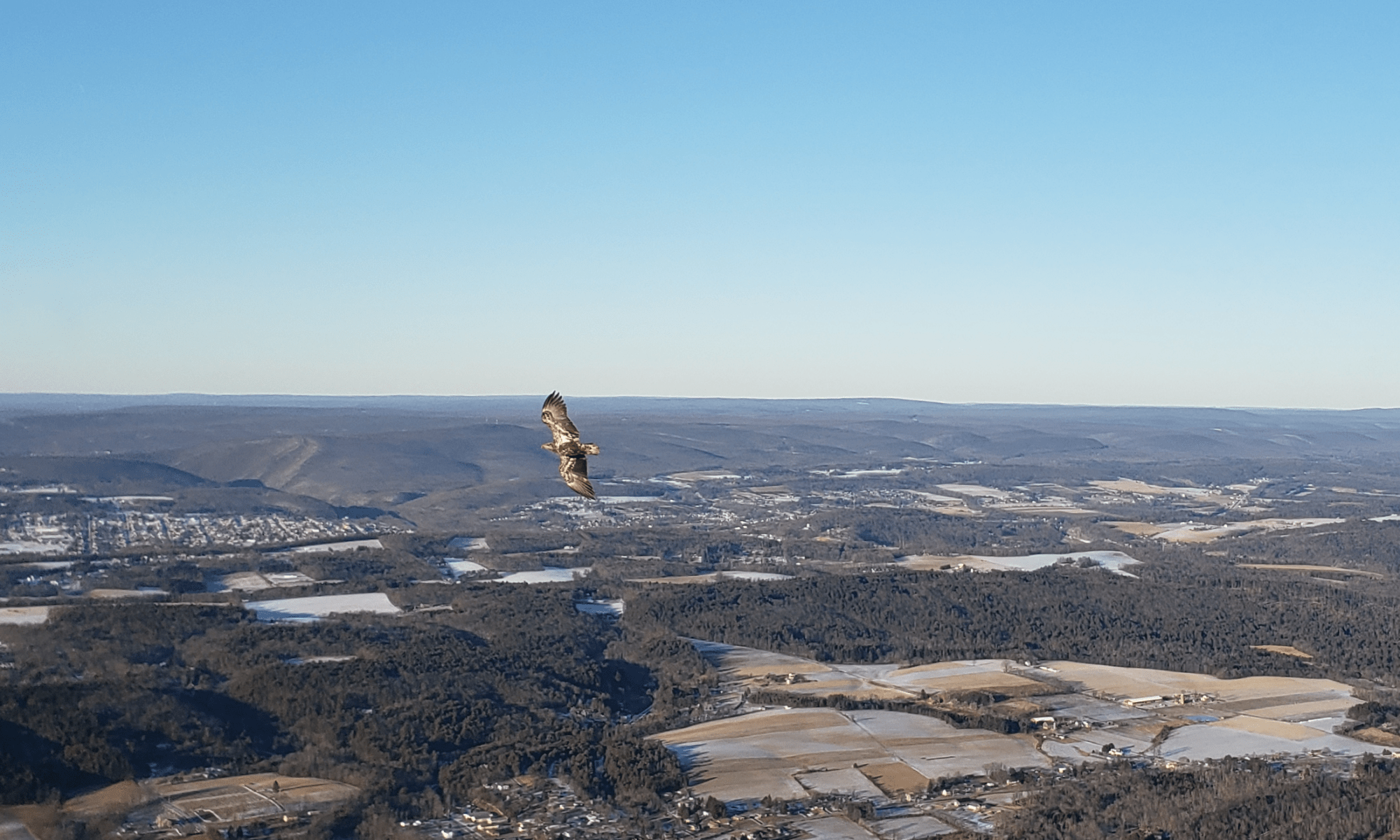
When Jen and I strapped into the Grob, we were looking forward to a short enjoyable soaring flight, like the ones we had last autumn. The most memorable of those was where we flew with a bald eagle. Jen loves eagles; the eagle has been her favorite animal since she was four. As a soaring pilot, it naturally makes it my mission to find eagles whenever I take her flying.

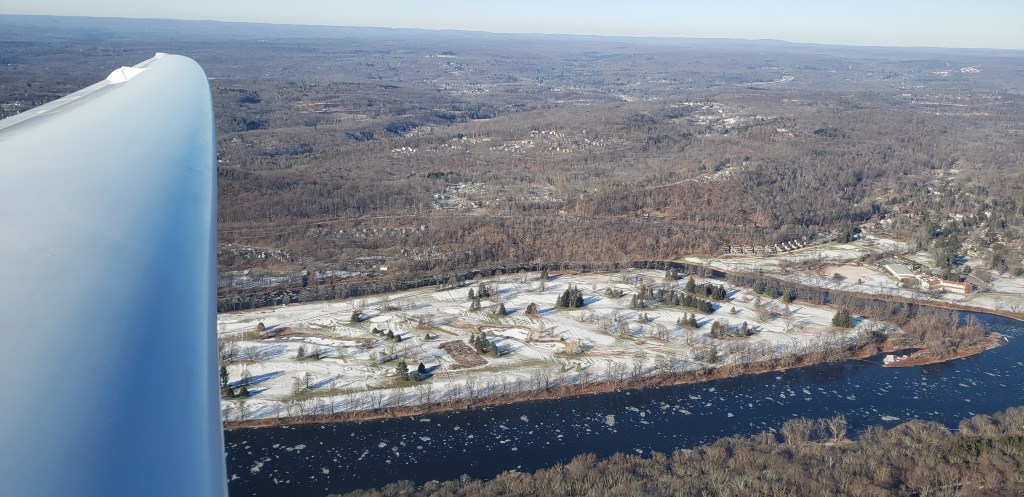
Yesterday we had pleasant soaring conditions at Blairstown Airport. We took off a little after 12:30pm, when the soaring conditions peaked. The lift and streeting were wonderful, folks easily got up to 6000ft before the wind shifted around to the southwest and the cirrus moved in later in the afternoon. I climbed up from 1900-3400ft MSL and than ran a street for about six miles from Blairstown Airport to a little beyond the Tocks Island Golf Course to find a solid 10 knotter. Jen noted that the glee in my voice seemed to match the ecstatic tone of the variometer.

As we headed back, Jen spotted two bald eagles below us. Naturally we needed to swoop by them for a closer inspection.

Up until this point, I had been flying very smoothly, completely attentive to making the ride as pleasant as possible.

Seeing the eagles, I got a little… target fixated.

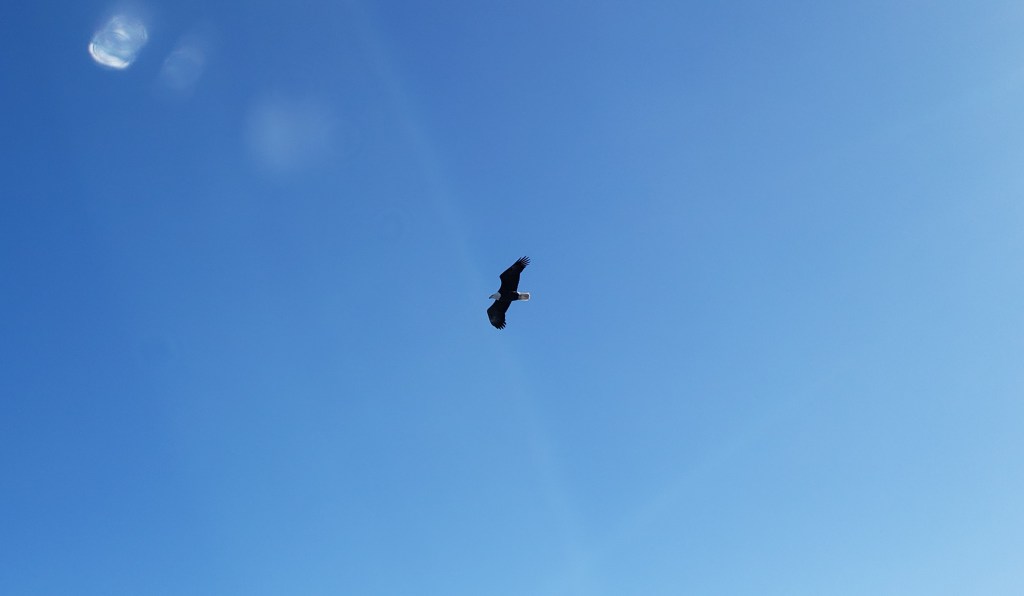
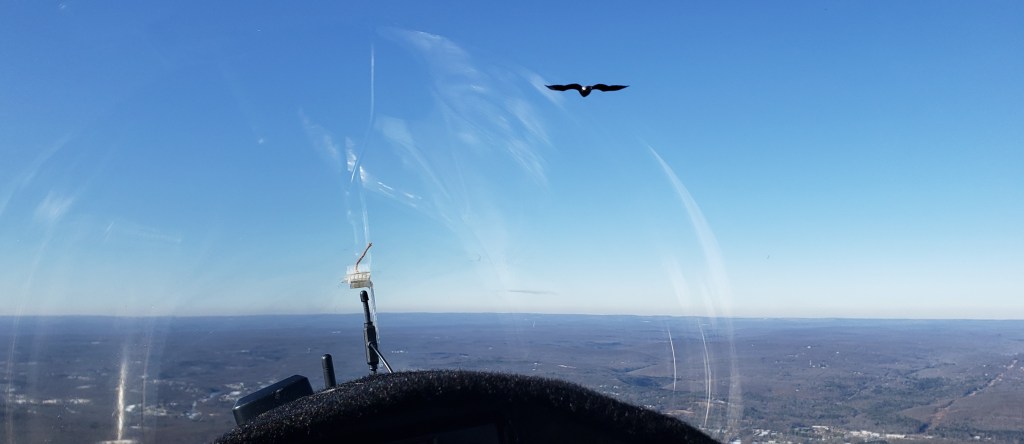
I banked firmly and pushed the nose over. Jen hadn’t experienced partial weightlessness in a glider before and quickly became as white as the bald eagle’s head. The clean Grob accelerated rapidly, the airspeed needle ticking through 60, 70, 80, up to 85 knots. The wind noise got louder and louder and the little speck of bird in the canopy getting bigger, and bigger, and bigger! We swept in several feet above the eagle, who did a hasty split-S and dove away. I proceeded with a climbing turn, converting the airspeed back into altitude.

I anticipated that this maneuver probably scared the bejeezus out of the bird, but I didn’t expect the level of adrenaline I put through my poor girlfriend.

After a couple moments to regain her breath, she clearly conveyed to me her preference to experience eagle watching using more gentle maneuvers.

I spotted the pair of eagles again, and this time I slowed the glider down and pulled out the boards. I slowly tucked Greta into formation with one of them, as close as he would let me go. Jen caught this one on an amazing video. It felt like you could reach your arm out of the canopy and touch his feathers.

After we landed, Jen said that I must be careful with all these eagle soaring flights she has been experiencing, for it may set expectations that every flight results in an eagle encounter. I told her that is true for in the summer time we don’t see them as often as in the spring and fall.

She also said that the poor eagle I dove on will probably be forever traumatized by the vision of an enormous, bone-white pterodactyl that almost turned it into a feathery lunch. His confidence as the master of the skies will be forever questioned by the presence of such monstrous predatory creatures in his midst.

12-13-20 | The Early Bird Catches the Worm

Sunday seemed an unspectacular day to go soaring. Strong westerly winds, low boundary layer, maybe even overcast clouds. No ridge, no thermals. Evidently no one was excited to come out until it became labelled a “training day”, with instruction flights offered to complete Bronze Badges and check-flights.

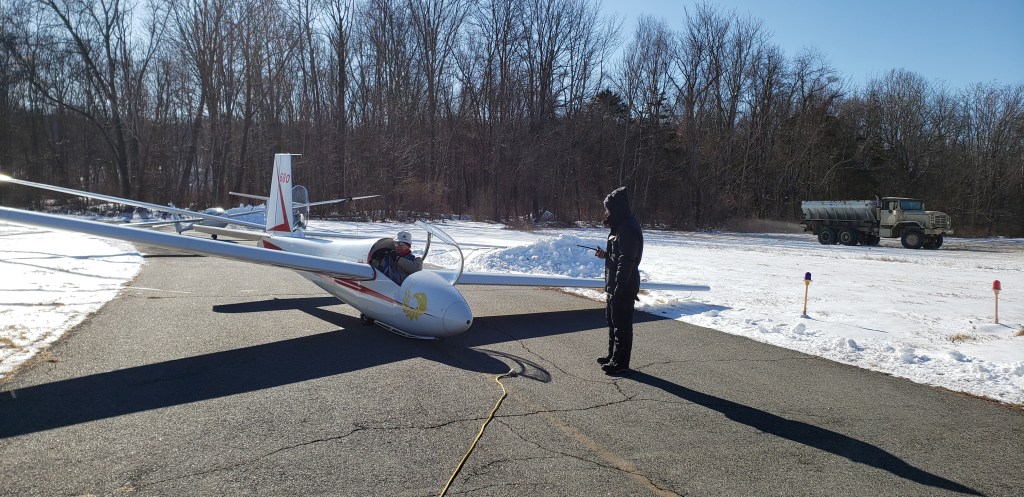
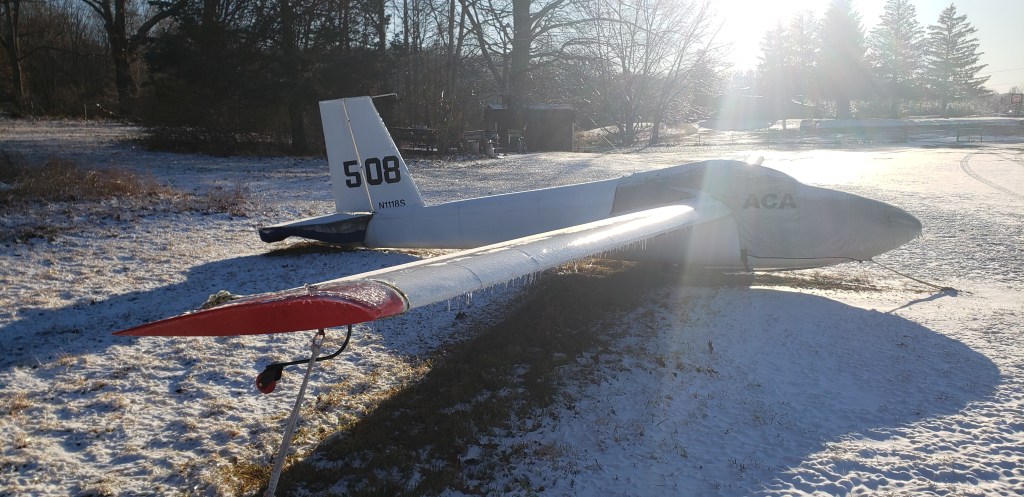
Allen, Guido, and Tommy arrived at 10am, ready to get the gliders ready and go fly. Instead, the airport was draped with a heavy fog. The soup was so thick that from the Cow you couldn’t see 508, several glider tiedowns away! Nonetheless, Guido had the Cow perfectly prepared, ready to be brought out to the line to go fly.

The fog refused to lift for awhile, so I gave Allen and Guido some things to work on. Guido completed his Bronze Badge written test while Allen worked on his long awaited Pilatus B-4 check-out. 

Closer to 11, Guido comes back smiling with his test complete and I ran out things to say to Allen with respect to the Pilatus. However, looking up we saw patches of blue. And with Allen sitting in the Pilatus and Guido standing nearby, I asked the guys what they thought about the soaring weather. While they scoffed at the thermals conditions and the wind angle for ridge soaring, I noted what about wave? With the low boundary layer and smooth, stable winds, there’s got to be wave around somewhere today.

Only moments later, we felt the sun starting to bake our shoulders and saw the Pawnee and 182 trotting over to the runway to take quick flights. Allen brought the Pilatus over to the runway, strapped in and ready to go fly while the wind was still manageable in the morning. Shortly after 11, he did a beautiful takeoff and tow, his first in this ship. Guido and I strapped in to give it a go in the Cow.

By now, the wind was rip roaring down the runway. Once over the treeline, Guido was working hard to keep the 2-33 under control. Perhaps a more apt name for the glider would have been Raging Bull rather than Mad Cow! I sat in the back, enjoying the show, noting that the air was considerably more turbulent that would be expected with stable, SW winds.

This is probably rotor!

We released at 2,900ft MSL in lift over the powerlines, halfway to the power grid by the Lower Reservoir. I promptly took control, turned into the wind and raised the nose as high as I could. We hovered at 40mph, climbing at 3-4 knots in the rotor. At about 3,500ft, we transitioned into smooth air.

We found wave!

Guido was ecstatic. I gave him the controls and coached him through the adjustments to make to stay in the lift. With no GPS, it was tricky to remain perfectly positioned in the lift. Instead, we used a known error method, slowly walking forward in the wave until it weakened, and then transitioning back. Similar deal with lateral position; slowly moving right until it weakened and then adjusting back left. We did this for almost an hour, climbing up to 4,500ft on a day that seemed the antithesis of “soarable”.

Meanwhile, Allen took a second tow in the Pilatus and also found the wave. He climbed up to 5,600ft, spending 1.2 hours in the wave until the conditions cycled out and the wave petered out.

While there were wave clouds later in the day and some rotor around, folks couldn’t connect with any more wave. My guess is that the short-lived wave Allen, Guido, and I found was created by our ridge. Despite the terrible wind angle, the air still dropped behind the mountain and bounced accordingly. With the fog in the morning, fully stable airmass, and strong wind conditions, we found as close to classic mountain wave conditions as could exist on the East Coast.

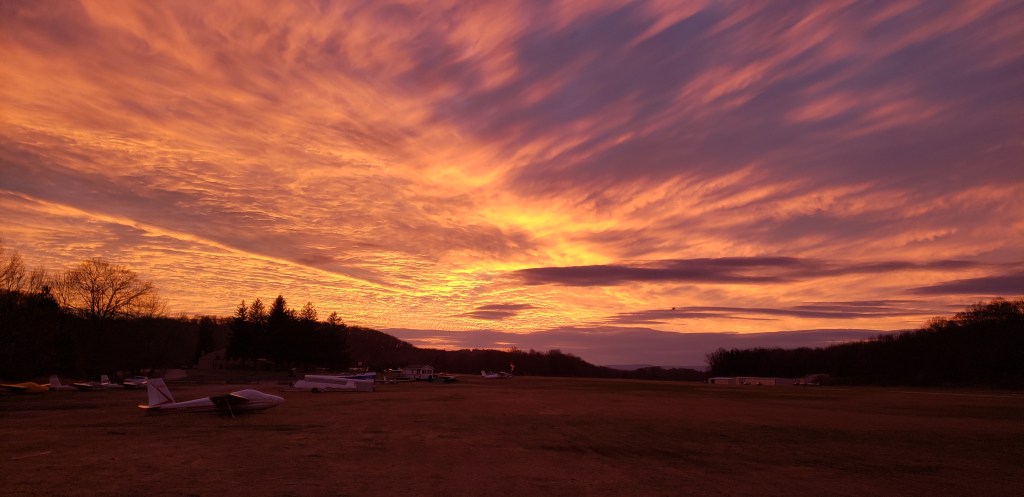
Later in the day, ACA members completed a total of 14 tows; a very successful December day indeed! I did five instructional flights, with Guido, Joe Fenske, Allen, and Oleg. There was a gorgeous sunset, highlighting some wave clouds hovering off in the distance.

11-14-20 | Trouble with the Troopers

Sometimes adventures in soaring take an unexpected turn. Considering that the last time I landed out from Blairstown was around two years ago, the concept of visiting a farm felt like a vague possibility; something that happens to other glider pilots, but not me. And driving out to the airport with Jen, my thoughts were more centered around flying with her and two other pilots in the club two-seaters on this gentle, autumn soaring day rather than heavy duty soaring exploits. A good day for many folks to come out, do some training, stay current and maybe soar on a couple afternoon thermals.

My morning started early, first flying with Anthony in the club Grob. We took a tow to the ridge, discussed situational awareness, ridge testing, and the arrival path back to the airport. Even this early in the morning there were some workable thermals near the airport and we extended our flight accordingly. Anthony did a great job, followed by another very nice landing! Afterward, Guido had the 2-33 all ready to go for my next flight and I took up a prospective member in the 2-33. And after this quick flight, Jen was up next for her introduction to the 2-33, having previously had three luxurious flights in the Grob Twin Astir.

She had considerably more trepidation getting into this old tin can wrapped in fabric nicknamed the Mad Cow. Or maybe it was that a couple weeks ago I was the one who pointed out a rusted rib on the horizontal stabilizer and grounded the glider. In any case, when the rope hooked on and we went on our way to the turbulent tow, she was content to simply hang on and watch. After we released, the wind noise died down and the glider settled into the gentle breeze. Jen took a couple deep breaths and took the controls, getting a feel for the attitude and turning characteristics of the Cow. As we headed over the town, she found a strong thermal and I prompted her to turn, turn, turn! Jen wrapped the glider into a nice, stable turn, climbing up and up at a steady 2-4 knots. Topping out at 4,500ft, she headed to another cloud and found another nice climb, and with the same great piloting climbed 600ft higher. Figuring that would do after 40 minutes of great soaring, we headed back to the airport and landed.

Seeing that the soaring conditions were solid, I decided to take the Duckhawk on an afternoon romp. However, by the time I released over the ridge, it was clear that the conditions were softening up. Nonetheless, I connected with a reasonable blue thermal by the campground and climbed up to 4000ft. Looking ahead, there were clouds in Pennsylvania and I headed over to find turbulent, but reasonably organized lift. These clouds were nicely lined up in a street over to the Pocono plateau, my perennial playground. Finding consistent lift between 4-5000ft, I was doing better going straight and dolphining than trying to circle in this narrow, tricky lift.

Going 40 miles upwind worked great and it was not even that much after 2pm! I always enjoy trips into the wind as they are great practice and make it easy to get back. All you need to do is find a weak thermal, work your way up as you drift downwind and you’re quickly back in glide of your starting location. However, to use a Fernando Silva expression, I got a little “frisky” and was tempted to keep going a little farther before turning around. There was a nice street heading off the Berwick nuclear powerplant, my favorite thermal, and I was tempted to cut across and pick it up.

It turned out I chose to go a thermal too far.

Making the transition over, I found the expected strong sink. However, once under the clouds, I did not find the expected lift! And at this stage, I was surprised to find myself seriously contemplating that this might not work after all. I had an airport in glide downwind of me, but this would near certainly result in a landout. Looking ahead, I could escape into the valley toward a beautiful hay field. Moreover, there were clouds nicely lined up along the way, suggesting that this might work to get me out of trouble.
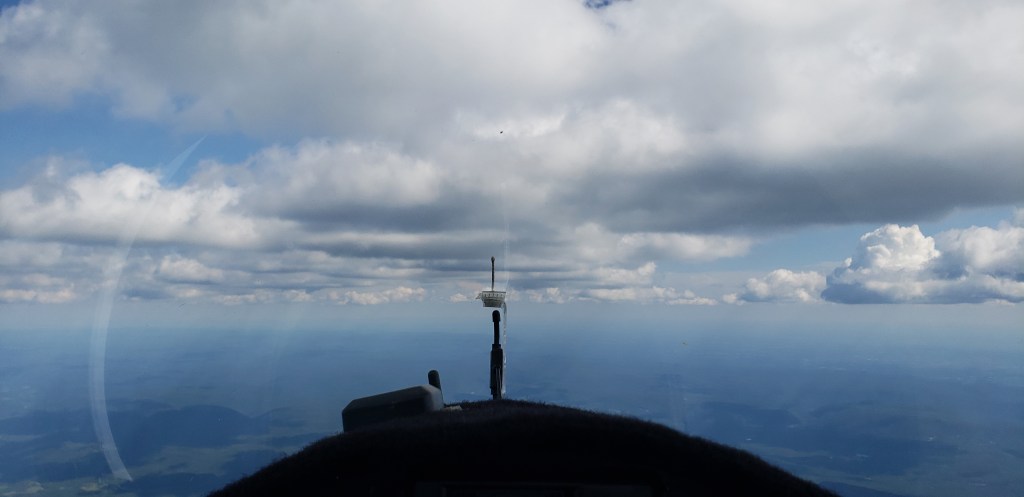
I’ve dug myself out of worse.

And so I headed over toward the hay field, trying one wisp, and another, and another. Nada. The wind lined up straight up the valley. Down to 1000ft abeam of the field and I felt a little bit of lift. Working this thermal only served to slow down my descent. I stared intently at the field, trying to judge its slope; better not screw that up with such a slippery glider!

Down to 600ft and the thermal picked up. But by this time, I was positioned downwind of the field, and I was drifting faster in the 12 knot wind than I was climbing. Time to knock it off.

Gear lever extended, button depressed, and the electric gear whirring down. Flaps switched into manual, extended to 20 degrees. Airbrakes all the way open; time to get on glide slope. Don’t mess this up, the Duckhawk will easily overshoot the field if you turn too soon. Extending the glide on base leg, followed by a steep turn, yawstring perfectly straight. Now set up with half spoiler on short final. Airspeed right on 50 knots, aimed square at the high treeline short of the field. Tuck it in as close as you can, as close as you can, full airbrakes! Nose over the trees and a hard flare over the field. In ground effect now, time to dump the flaps! Holding if off, holding it off, touch down! Hard on the wheelbrake, stopping as fast as I can without nosing over.

After the glider stopped, the variometer whirred a flat tone. I shut it off, and everything was silent. This is always the most magical moment, for after some of the most exciting flying you can do in a sailplane, you find yourself in a new place and time abruptly stops. I got out of the glider and took stock of my new surroundings. Looking ahead there was a deserted farmhouse and the cut hay gently bent over in the mild breeze.

I was very pleased with my field and my landing. For the past several months I’ve prepared myself for the possibility of landing in a field requiring clearing an obstacle. The Duckhawk is very unforgiving of extra energy on approach thanks to its only adequate airbrakes, which is a big issue when clearing a treeline. I consulted Bill Thar on the technique, practiced it in the simulator, and finally did such a landing at Blairstown airport. I calculated that I should be able to land the glider in a 1300ft long field, figuring I could get it stopped in 1000ft without resorting to ground looping or nosing over. I used up 950ft of the field, with about 300ft of that being ground roll. It was good to see that my preparation worked out flawlessly.
I called back to Blairstown for a retrieve crew. Since Jen had not driven my truck before, let alone with a trailer, I requested that someone else join her on the adventure. Bill Thar managed to convince Steve Beer to go, although Jonathan cajoled Jen to do the driving. She overcame her second bout of trepidation and hit the road behind the wheel of the truck!

In the meantime, I prepped the glider for disassembly and went for a hike to try to find the landowners. I must have been a sight to behold, dressed in my winter coveralls, wires hanging out all over the place, with my 10 liter Camelbak swinging over my shoulder. As I walked up the lane, I noticed that each dense tree had a “No Trespassing” sign stapled to it. And then I found a chain link fence with locks blocking the road.

Upon closer inspection, I found that the chain was mounted to the tree with open nails. With little effort I managed to take it down, eliminating this possible obstacle for my ground crew. I promptly put it back up, in case anyone went up the road before me. However, I got the message; I was going to endeavor to find the landowners before heading back up this road.

Another half mile later and I reach an intersection to find some houses and civilization. Seeing a gal on a tractor working her lawn, I waved my hand to flag her down. Despite my garb making me look something between an astronaut and a bum, I succeeded in encouraging her to approach me. I explained my predicament as a downed glider pilot and asked for her assistance to find the landowners of the field. Her husband quickly showed up and also took great interest to this unusual situation. They invited me into their house for a cup of coffee, taking great pleasure in sharing stories of this sleepy town, inquiring about my soaring exploits, and my work as a PhD student studying neuroscience. The time waiting for my crew passed by quickly.

Her husband made some calls, but had no luck finding the landowner. When Steve and Jen arrived, I invited my new friends to come and see the glider come apart. We went up the driveway, took down the chain link fence and promptly arrived at the Duckhawk. This retrieve was going so well, there was even enough sun on this short November day to take the glider apart with some daylight to spare!

At this point, I was a little surprised to note that my friends did not come to the glider. As it turned out, the caretaker of the land was taking his dog out for a walk and saw the wayward vehicles turning into his field. He intercepted his neighbors, who apparently were doing their darnedest to express the good and friendly character of us glider pilots and our friends. Nonetheless, with the glider packed up, sun setting to the west, and us heading toward the exit of the field, we were met with the irate caretaker and sensed there was going to be some trouble after all.

Further, as I walked out to meet him and his wife, I saw a state trooper driving up the driveway. Goodness gracious, here we go.

The field’s caretaker seemed most perturbed by the fact that his chain link fence proved not to be a barrier at all. I expressed my deep condolences for all the fuss, my yeomen’s effort at trying to find him or the landowners and how the field, glider, and my personal body were perfectly fine. A little while later he seemed to calm down, happier that “everyone and everything is safe”, leaving me to deal with the state trooper, firefighters, and ambulance who all showed up at the scene of the “plane crash”.

I refer to such occurrences as the circus showing up. Everyone comes to gawk at the glider, happy to have experienced the most exciting thing to happen at this town in the last decade. The state trooper had to dot all the i’s and cross all the t’s, insisting that he had to get a hold of the FAA. I told him go for it, my pleasure! And we sat around for ages, waiting for him to be satisfied.

An hour and a half later, I finally had enough and started calling up my friends, instructors, and DPE to see if anyone can get a hold of a person at the Allentown FSDO so the state trooper would finally let us be free. Right as Randy Rickert was dialing up his FAA contacts, the trooper informed me that I would receive a call from the FAA soon and let us be on our way. Steve, Jen, and I bolted out of the field.

After eating dinner at a local diner, we headed back to Blairstown, arriving a little after 8pm. Steve was in great spirits, thanking me for the opportunity to get to go on a retrieve! We dropped off the trailer, took a moment to look up at the beautiful stars. And then Jen and I headed back to Philadelphia.

There were many surprises on my Saturday adventure. But perhaps the most surprising thing was that Jen did not express an immediate urge to dump me after subjecting her to a) Getting up early in the morning, b) Flying an aircraft that seems destined to fall apart, c) On the drop of a hat, driving a scary vehicle with a 25 ft long trailer, and d) Arriving back home at an ungodly hour.

Instead, she said how exciting it was to a) Spend a day at a beautiful place, b) Get to fly a freakin’ glider, c) Challenge herself to do new things, and d) Have the excitement of going on an adventure, seeing a glider retrieve and having the amusement of watching me deftly deal with law enforcement. And how she’d love to do it again next time!

She’s a keeper!

_____________________

Thanks a million Steve Beer, Jen, Jonathan, and Bill Thar for helping me out on this retrieve. Thanks Rick, Randy, and Erik for assisting me with the authorities. Thanks Tommy and Andrzej for towing! You guys are the best!

See the flight here.

10-31-20 | Trick or Treat?

On this frigid Halloween, many youngsters were getting their costumes ready for a Saturday extravaganza. Houses were decorated with scary dragons, ghosts, and rotting pumpkins carved into contorted visages. In this odd American tradition, it becomes socially acceptable for children to take candy from strange people in the dark. And if you were to chart average blood sugar levels among most kids, they would look like a stock that suddenly rises, crashes, and results in wailing tantrums on the floor.

I never understood this tradition. Perhaps it never rubbed off on me because I was the one tasked with giving out the candy rather than the one dressing up and soliciting it. Or perhaps it was that time I was coerced to wear a crocodile onesie to take part in a Peter Pan themed Halloween party. No good things ever occurred to me on October 31st.

So on this Halloween, I was more than happy to be on the road to Blairstown Airport. My thoughts were not on the prospect of satisfying sugar cravings, but looking up at the sky and daydreaming about flying. Besides, I had enough to be scared about this Halloween. Skyvector indicated a complex set of restricted airspaces (TFRs) between Trenton, NJ and Reading, PA due to Trump furiously campaigning in the final days before the election. And there would be no worse Halloween trick than for me to be on the receiving end of a United States F-16 screaming across my nose, with nasty words to say to me on 121.5.

No, it would be much better if it were for me to play the tricks, leaving some poor and confused radar operator wondering as to how a glider squawking 1202 was staying airborne for hours, patrolling the outskirts of the restricted airspace. With the intention to fly as far as possible given the weather and airspace constraints, I planned to fly on the north edge of the Reading TFR and then maybe into the valley south once the Trenton TFR expired at 2:30pm local time. To cover my bases, I called WX-BRIEF to receive the most up to date information. I could sense the fellow raising his eyebrow upon hearing my plan to fly a glider to Beltzville Airport.

My day started early as Guido and Anthony Erlinger asked to receive some morning instruction in the club Grob, nicknamed Greta. Having completed my Flight Instructor rating the previous week, I was happy to oblige. Guido arrived early and got the battery and golf cart ready while I took a trip to the hangar to bring out the Duckhawk trailer.

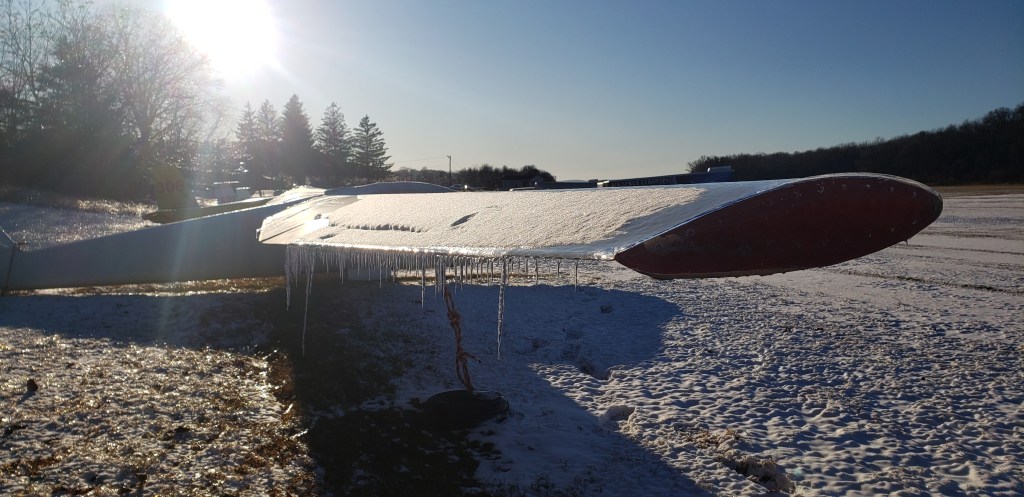
Upon arriving on the airfield, I was surprised to see all of the grass covered in a white, crusty frost. Guido is a true Italian and evidently not well adapted to the cold. When we started taking the covers off of Greta, he yelped in pain as the frost bit into his bare hands! Unfortunately, our efforts to start early this morning were for naught. With the air so moist, a layer of frost started covering the whole glider. We promptly moved Greta into the sun for deicing while Tommy the towpilot went to the airport cafe to get himself a warm cup of coffee.

At 10am, we were just about ready to start towing and we needed a wingrunner. Anthony arrived as though right on cue and with him on the scene, the show began. With the magnetos clicked on, starter whirring, and the propeller making several jagged jumps, the engine turned over and the Cessna 182 towplane was ready to fly. With the rope hooked up, wings leveled, the slack in the rope taken out, Guido keyed the mic and in a delightful and melodic Italian accent said, “ACA tow-ah-plane, glider is-ah ready to-ah take-ah-off-ah!”

Guido did a wonderful job. We reviewed all of the peculiarities of the club Grob, especially its insatiable hunger for rudder. He flew great, did a bunch of turns, some stalls, and most importantly, had a great landing at the end. Anthony was next and had the good fortune of launching as the soaring day began. We practiced flying the ship, along with some thermalling techniques. After Anthony came back, Guido took the third and final instructional flight of the day, with a quick tow to 1500ft followed by a prompt approach and landing. For this one, I sat in the back and whistled, pretending to be a passenger and letting Guido do all the work. Predictably he did well and ended the short flight with another nice landing. Just before noon, I was released from my instructional duties and was eager to go fly the Duckhawk.

Around this time, Ron Schwartz showed up to say hello. Seeing that he was willing to stick around for extended socializing, I asked whether he would be willing to help me assemble my ship, to which he eagerly agreed. This was probably a mistake on his part as the process was a bit more tortuous than usual. It’s like the Duckhawk wanted to make a point that I don’t fly her often enough by making it that much harder to put her wings on. And then making a fool of me when something wasn’t quite right and I was forced to take one wing off to fix it. With enough consoling and finagling, the bird was assembled and my preflight checklist was complete.

Looking up at the sky, I was surprised to see that the cumulus clouds did not wither away as expected. Instead, the cotton balls were nicely arrayed as far as the eye could see. This was going to be a better day than anticipated!

Launching at 1pm, I released in solid, nicely organized lift. The ship reminded me that it’s been over a month and a half since my last flight, with a couple instances when the wing wanted to drop after pulling a bit too hard in the lift. Backing off a skosh and working up to a little over 4000ft, I felt great and back in business. With honest and reliable lift all around me, it was time to do some exploring.

As I turned southwest bound, I was delighted to see that the clouds were nicely aligned in streets heading right up the valley. Normally the lift is much better over the higher and drier mountains, but today I accepted the usually risky proposition of flying in the lee of the ridge. With the lift so nicely organized and closely spaced, the Duckhawk made easy work of the energy along the way.

It felt like I was flying a 1-26 again. The 1-26 demands your attention as the last five percent of performance are the difference between flying well and ending in a field. With the Duckhawk, you don’t have the same prospect of landing out, but when you work that much harder you feel how much better you are doing. And in this case, the game was staying connected with the thin lift band under the clouds.

What worked well was to drop the nose and consistently fly at 60 knots. And when I’d find a nice bit of lift, to yank hard and dynamic soar the gusts. In the less lifty sections, to cruise at around 70 knots, with 80 knots reserved for sinking air.

The best moments were when the lift was off to one side and I could bank, yank, and pull hard. It felt like I was dropping my talons, gripping the air, and then ripping it out of the sky. The variometer would wail and the altimeter would wind up and up and up. This kind of dynamic soaring probably worked best because in a turn it was possible to maintain 1.5-2 Gs for a longer time, generating that much more momentary thrust.

In what seemed like no time at all, I arrived at Beltzville Airport. My eyes gazed around for other gliders and to my joy, I saw a 2-33 just below and heading away from me. Being too good of an opportunity to pass up, I dropped the nose, sped up to a leisurely 140 knots and said hello the white and red whale of the skies. After turning back, I saw a vintage yellow Ka-4 release in a thermal and gave him a similar greeting. With that, I climbed back up to cloudbase and started my journey back to Blairstown.

The sky just seemed like it was getting better and better, with the clouds aligned in a perfect row. The challenge now was to soar the 32 miles back home without turning at all. My eyes focused on the dark spots in the clouds and I keyed up my body to feel every bit of the air. The flaps clicked and clacked away as I’d make the glider jink, zig, and zag, flowing up and down the swells and rapids in the sky. Only minutes later, I arrived back at Blairstown Airport having hardly lost any altitude at all. And upon seeing Anthony flying in the club 1-26, I used this extra energy to give him a friendly Duckhawk greeting.

Being just after 2:30pm, this was a good moment to take stock of the sky and assess where to go next. Looking to the northeast, the clouds were withering away. Instead, I was eager to follow the nicer clouds nearby on another adventure to the south. Remembering that the Trenton TFR was to expire around that time, it felt that everything was lining up perfectly to head this way. But to be absolutely sure, I decided to contact Allentown Approach on 124.45 and check. And to my horror, Trump was evidently running late and the TFR was still active! Thoroughly annoyed, I doubled back from Hackettstown to wait a little while.

Half an hour later and somewhat listless, I called up Allentown again and requested an update to the airspace situation. And the controller responded, “The TFR has now been terminated.”

I responded, “Did you say that the TFR has not been terminated or has now been terminated?”

With a satisfactory response that the TFR was now no longer a factor, I got excited again, climbed up to cloudbase, and set my sights on Vansant Airport around 30 miles away.

At this point, the thermals were starting to get farther apart, resulting in a more traditional climb and glide style of soaring. Upon entering the thermals, I practiced making better entry turns, finding success entering the lift at 60 knots and making a very steep turn. And after starting the turn, to initiate a stepwise slowdown to 55, 50, and 45 knots, using my speed to adjust my position in the thermal. The tricky bit was making a solid pull to initiate this process, but not pulling so sharply that it would cause the air flow to separate on the wing and make a lot of drag. You need to be really on top of this glider for it to fly most efficiently.

As I crossed the Delaware River, I had Vansant Airport in view, but unfortunately no friends in the sky to fly with. The air was also devoid of any movement and the altimeter unwound enough to cause a bit of concern. Looking ahead, I could see Philadelphia’s skyscrapers beckoning in the distance and sunnier skies above. Several miles beyond Vansant, I dug out from a little above 2000ft above the ground and figured it was high time to make the journey back home.

Being a little after 4pm on a late autumn day, I resolved to be patient and get nice and high before heading back. To my mild frustration, the thermals were poorly organized and kept me struggling along a little while until a solid three knotter got me comfortably up to cloudbase.

The glide computer indicated I only needed another 2000ft to gain to get home, a little over 30 miles away. It was hard for me to believe that the glider could actually make that work. My mental calculations suggested that this was around 7-8 miles per thousand feet and it just felt that this was too good to be true. So after I tanked up with a little extra altitude in the final thermal, the glider surprised me yet again when it sailed on home, perfectly making the glide.

The best part of the day is when the sun starts to set over your shoulder and the valley lights up in a brilliant glow. Looking over toward Bethlehem and Allentown, the landscape looked like a canvas brushed on with warm oranges, reds, and yellows, occasional glittering blue lakes, punctuated by the gentle steam of distant powerplants, and a misty mountain snaking as far as the eye can see. Autumn is a joyous time to fly in the northeast.

With the additional altitude at my disposal, I flew over to my ridge to see if the wind had picked up enough for the ridge lift to work. Upon dropping down to 1700ft MSL, I found that the wind was at 195 degrees and 12 knots. Surprisingly the lift was fairly solid! This enthused me enough to make two shorts laps up and down the local ridge, getting a close up view of the leaves on the trees and the hikers at Mt. Minsi. As much as I enjoyed flying the ridge again, I was also nearly continuously shivering having under-dressed for the cold, having anticipated lower, warmer, and blue conditions. With the temperatures at ridge top not being high enough to warm me up, I called it in after a delightful three and a half hours in the air.

After landing and spending a good thirty minutes thawing my feet and warming up my body, I was ready to take the aircraft apart. Since there were no club members around, I wandered over to the flight school to see if I could find a hapless victim to help me disassemble. First, I set my sights on the younger Kevin who was tying down his 1-26, but then my gaze later to the young kid nearby. He introduced himself as Andreas, turned out to be thirteen years old, and about 18 lessons into his flight training. Bingo!

I brought him over to the Duckhawk and invited him to sit in the cockpit. Comfortably seated, he started asking all sorts of questions about all the instruments, knobs, and dials. Do you really need all this stuff to fly? I chuckled and replied absolutely not! He asked me about the glider’s performance and handling characteristics, how the gear, and flaps work and why everything is the way it is. Twenty minutes later, it became apparent that I was the hapless victim in this bargain! Only when his dad wandered over to let his son know it was time to go home, he hopped out and eagerly gave me a hand taking the wings off.

On the way back to the parking lot, I briefly opened up the club LS-4 trailer and told him that if he kept working hard that someday he would be flying that beautiful ship. And you could see the gears turning in his head as I closed the trailer lid and he raced on home.

Turns out that this Halloween was a treat after all!

________________

Thanks a million Schwartz and Tommy for helping me fly today, you guys are the best!

See my flight here.

08-22-20 | A Tale of Two Airmasses

It was the best of times, it was the worst of times, it was soarable in Pennsylvania, it was miserable in New Jersey, there were cloudstreets, there were 40 mile blue holes, an airmass with strong and high thermals, and another that produced a thunderstorm that nearly wiped out the airport; in short, a memorable day!

I arrived at the airport with no expectations. It was August; hot and humid with a southwesterly wind pumping in air expended from the swelled up swamps of South Carolina.  My sweat accumulated after assembling the glider, completely soaking my clothes, and refused to evaporate. The few clouds triggering over the ridge were hardly much above ridge top. Having not flown the DuckHawk in a little over a month, I was content to simply get airborne and do a couple takeoffs and landings. And if I managed a short soaring flight, heck that would be an accomplishment.

Glancing at the forecast, the Poconos looked promising. Perhaps it would be good enough to poke around in that wonderful high ground? I set a short task up to Lake Wallenpaupack to do a little bit of sightseeing.

Taking off a little after noon, there were still low, scrawny clouds over the ridge. The first climb off tow was a struggle; 10 minutes in a half knot thermal to claw my way up to cloudbase at 3200ft. A short thermal street lined up into the wind, along the ridge. The DuckHawk was much more content flying straight than circling in these weak bubbles.

The line promptly ended at the hang glider launch, hardly ten miles away from the airport. A slow climb took me up to 3800ft and I looked over at the high ground to the northwest. The clouds were slightly higher over East Stroudsburg and the lift was fairly reliable. And heck, with a 50-1 glider, the odds are good that I’ll find something.
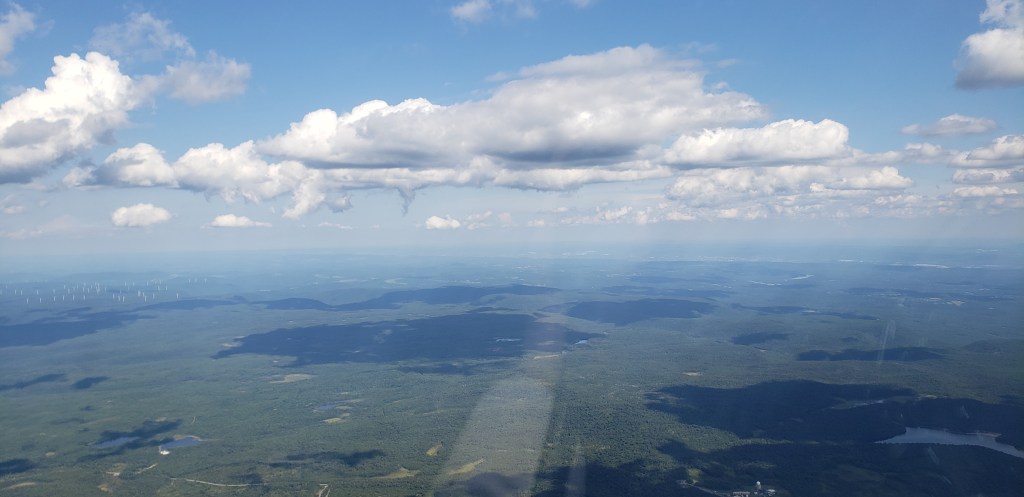
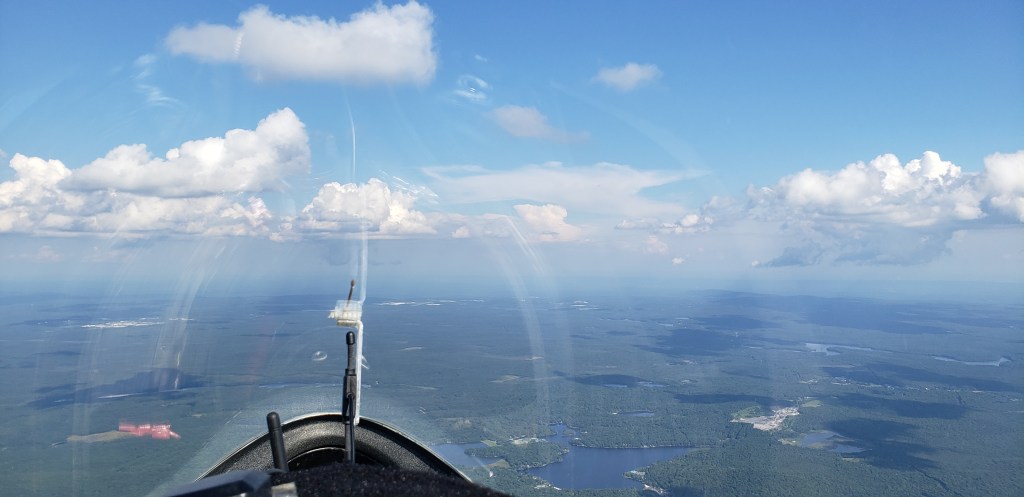
Sure enough, there were a couple bubbles along the way to keep inching upwards. Off my right, there was a rain shower; the sucker looked like an enormous billowing cauliflower, with a dark ominous bottom, slowly moving toward the airport. I didn’t think much of it at the time.

Looking dead ahead toward the Poconos plateau though, the sky totally transformed. The clouds formed little cottonball puffs at 6500ft and you could see miles and miles away. Once over the edge of the plateau, I found solid lift and climbed right alongside the clouds!

My flight computer read out that the wind was 300 degree or so; quite different than the 220-250 degree wind in the valley. I discovered that this was a new airmass, bordered by a trough parked right at the very edge of the Poconos. Coupled with the heating of the high ground earlier in the day, it created a steep boundary where the clouds rose thousands of feet. This was going to be cool to explore!

Along the edge of the line, the lift was not all that continuous, although it worked nicely where the clouds hung down like a curtain. And there it was really fun climbing up on the edge of the wispies!

Abeam of Beltzville, the line made a hard left and seemed to lose definition. I suppose it would be fun to poke deeper into PA. Who knows, maybe I could even make it to the Susquehanna River?

Picking up the pace, I found reliable 2-3 knot thermals under honest clouds. Going toward Hazleton, the cloud base dropped off, but no worries; my nose was aimed squared at the Berwick Nuclear Powerplant.

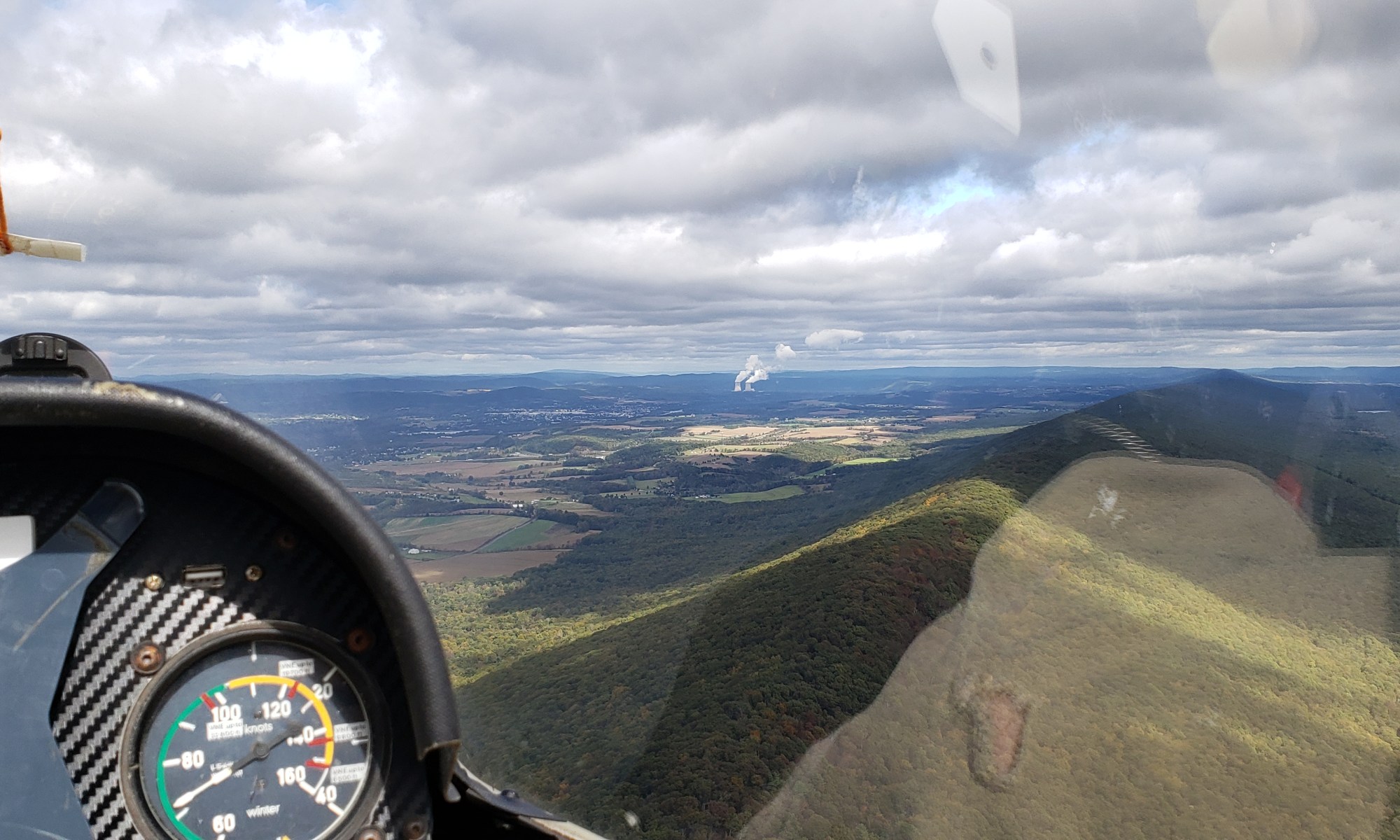
My name for the thermal that comes off the plant is Ol’ Faithful. The steam plumes are often visible from Blairstown, beckoning the wayward glider pilot like a siren to come over and harness its energy. Positioned in the middle of a valley, right by a river, it’s often the only lift within a considerable distance. The resulting thermal is nearly always marked by a cumulus cloud hanging a little lower than the rest; laden with the moisture coming from the stacks, the thermal is always in a hurry to condense into a cloud. And sure enough, there was a solid 3-4 knotter that picked up to a turbulent 5-6 knots near the top. The thermal was so gusty that at one point it nearly spun me out! After a fun rodeo ride, I was back in business at cloudbase.

Heading across Scranton, the Alleghany plateau invited me with beautiful clouds ahead. While I had flown up before, I’ve never directly flown across these imposing mountains. The wind is often times a bit too strong and the thermals are disorganized for many miles. Going into unlandable terrain, higher terrain, and a headwind is a dubious proposition. Most of the time the edge of this plateau acts like a brick wall.

This time, I cleaved into the higher ground without any difficulty, climbing right up to 7000ft. Out yonder, it looked even better!

But as I drove along, I ended down at 4500ft and felt low. There was an airport in comfortable gliding distance ahead, but that piece of property was situated at a daunting 2000ft MSL. Best to tread carefully.

After slowly climbing up and another tricky glide, I finally connected with a solid 2.5 knotter. A little stumbling around here and recentering there wound the averager up to eight knots. Woohoo!

I kept climbing, and climbing, and climbing. At 6000ft, the cloud above me didn’t feel any closer. Neither at 7000ft! Man, what’s going on here? At 8000ft, the thermal was still going and going, just like the energizer bunny.

That sucker topped out at 9,500ft! No wonder the sink was strong before; there were monster thermals around!

My watch inched toward 3:20pm. A pang of doubt crossed my mind; I better start thinking about heading home.

Around that time, the airport was experiencing an epic deluge. The shower I skirted earlier in the day turned into a massive, slow moving thunderstorm. The radar map showed all sorts of pretty colors and orange/red polygons. And then as you gaze at the legend, your eyes widen as you see a tornado warning in effect.

As the billowing cloud crept toward the airport, all the gliders airborne bolted toward the field. The pilots quickly landed, tied down and ran for cover. Those unlucky enough to be still outside when the rain swept in were caught in a torrential downpour. The wind was so strong that the rain came in sideways. This is the kind of the day when rusty stakes, frayed ropes, and creative knots are put to the test.

Meanwhile, I was oblivious to the mayhem back home. My thoughts drifted toward the ease and relaxation of being in the cool, dry air at 9500ft. My cloud was part of a cloudstreet extending ahead of me and it was just too good of an opportunity to pass up. I nosed over and flew up to the Buttonwood Ridge, 20 miles northwest of Williamsport, a good 108 miles from home. Figuring this would do for the day, I turned for home. It was 3:40pm.

Picking up the pace to 90 knots, it now was time to put the pedal to the metal. Better to run back home while the conditions were still working well! Sure enough, the lift remained totally solid over the plateau. Consistent 3-5 knot thermals to 9,000ft, good air in between and a tailwind for good measure too. This was glider pilot heaven!

Abeam of Scranton, 70 miles from home, the clouds ahead lost some of their definition. Off my left, the cloudbase dropped off precipitously.  I tanked up as high as I could; better to be thermalling up here, than down there! This climb took me to within 1000ft of a MC 3 final glide. This would comfortably get me across the whole Pocono plateau and might even do for squeaking it home in a pinch.

Over the next 45 miles, the air flattened out. The day was softening up; boy was I glad to have tanked up! I slowed up and floated in the good air, but there were no solid thermals for a long way.

Looking ahead, I could see Mount Pocono Airport beckoning in the distance, with many clouds still formed along a parallel line to the plateau. Sure enough, the trough line was still working! Beyond these clouds, the air was a hazy blue, devoid of all clouds. It looked like the streets at the edge of the Poconos were pushed into this invisible barrier, with the resultant cloud spewing in all directions; upwards, downwards, and sideways. The tendrils hanging down indicated solid lift was working ahead. I relaxed, knowing that I had it made.

Sure enough, approaching the line there was a good thermal and I easily climbed up for final glide with plenty of height to spare. But these peculiar clouds alongside me were just too tempting to simply bypass. Instead, I turned toward Lake Wallenpaupack and played with the line.

It was so much fun! When the glider sank a bit lower, I’d park my wing in the tendrils and thermalled right up the edge of the cloud. In between the streets, there was some mildly good air serving to extend the glides. This worked very nicely for a lap up and down the line, which was slowly inching its way northwestward. With my watch showing a little past 6pm, it was time to call it a day. After rounding the last cloud, the flight computer showing a MC-3 glide, I turned toward Blairstown Airport, heading into the blue, dead void.

Slowing down to best-glide speed, the air was dead smooth. I let go of the stick, turned the variometer down, and just watched the mass of trees under me, gliding toward the ridge off of my nose, the glider contentedly humming along. The upper reservoir was way off in the distance, slowly inching downwards in my canopy.

I looked down at the twists and turns of the terrain below, the setting sun off my right shoulder, and the clouds dissipating behind me. It was just so peaceful, so much so that it felt odd that the flight should ever end. It seemed like the sailplane will silently sail on forever.

Coming over the airport, the wind sock was dead limp. There was some mist forming off the runway and I lined up to land on 7. Since the original objective of the flight was to perfect my landings in this glider, it felt appropriate to oblige. I lined up over the trees, pushed over and landed short of the mid-field taxiway; a challenge completed!

Getting out of the glider, I was surprised to find the grass to be wet and squishy. Everything was soaked and the airport was totally deserted.

When young Kevin emerged out of the shack, it seemed like he was the sole survivor of an apocalypse. He greeted me with the harrowing tales of the afternoon and later helped me disassemble the glider. Later, a couple stragglers banded together to spend the rest of the evening trading tall tales of exploits in days and years past.

All in the adventure that we call a day at the airport!

__________

What a wonderful day! A day that started with no expectations, yet ended in a 270 mile flight! Blairstown offers such dynamic and wonderful soaring; no matter how long you fly here, there will always be new challenges. Thanks Tommy for towing and Bill Thar for crewing in the morning!

Find my flight log here.

01-20-20 | Temptations and Eagles

It’s wonderful when holidays align with ridge conditions. Ron Schwartz, Steve Beer, Claudio Abreu, Khanh Nguyen, and I, ACA’s hardiest ridge rats, came out on a frigid Monday to soar. The high for the day was around 25 degrees Fahrenheit, with a temperature aloft of around 17 degrees or so. We looked like abominable snowmen, with layers upon layers of wool, cotton, and polyester. On my account, I had on three layers of thermal shirts and pants, fleece, heavy fleece and my winter flight suit. Electric socks, with the cord snaking to a battery in my breast pocket so I could control the temperature. A ski mask covered my whole head, plus a wool hat and gloves.

Not a single square inch of my body was exposed. NASA probably has less difficulty fitting their astronauts to launch into space. But it worked; I was reasonably cozy the entire day!

I arrived early in the morning to help Steve assemble ACA, the club’s LS4. It was to be his second flight in the glider and he was eager to take it up on the ridge to get a taste of high performance soaring. I scrutinized the wind sock after taking the trailer out of the hangar; the wind slightly favored launching on 7. Steve and I bantered back and forth on the merits of either runway and Steve noted that the sock went limp. Expecting to depart from 25, we brought the trailer to the very end of the runway.

Halfway into assembling the glider, the wind sock turned around and we now felt a stiff tailwind. Tommy the tow pilot arrived and we agreed that it would be much safer to launch into the wind on the other end. Poor Steve, he’d have to haul the glider across the whole runway!

Khanh was the other unfortunate fellow for the day. We planned to do a short ridge flight in the club 2-33 (affectionately nicknamed the Mad Cow), but the ship was hopelessly frozen. There was no prospect of removing the thick layer of ice on the wings, so we had to postpone our effort for another time. Khanh was a great sport and took the unwelcome news in stride, helping us stage and launch. We really appreciated his help!

I hustled to the hangars again to bring out the Duckhawk. Since becoming airworthy, it’s been an ongoing process of fiddling and tweaking to get the ship tiptop for the upcoming spring. After assembling it and completing a thorough preflight, I helped Claudio put together his ASW24.

Rather than launching off the snow, we took advantage of the quiet airport to launch on the blacktop. We gridded on the taxiway and positioned the rope at the edge of the runway. Tommy and I worked out the sequence of operations; the glider pilots would push the glider over to the pavement, hook up and go. When the towplane would return, he would drop the rope to avoid dragging it on the asphalt. At the subsequent launch, the ground crew would hook up both the glider and towplane and promptly send them on their way.

Schwartz launched first. Tommy made an airshow quality performance when he came back to land. You could see him fighting the crosswind and the turbulence on short final. Dropping the rope was like an accuracy contest. He pulled the release as he approached the threshold.

The rope fell square between the 20ft gap in the middle lights, with the glider end of the rope perfectly positioned, right at the threshold. Damn Tommy, that was cool!

Steve was up next in the club LS4. I gave him a short takeoff briefing and then we hauled him out onto the runway. He bravely fought the crosswind and stayed in position with the towplane, eagerly departing toward the ridge.

I was up next in the Duckhawk. Launching on the pavement was fantastic. The hardtop made for a fast acceleration and the towplane climbed like a banshee thanks to the -2000ft density altitude. Tommy was on his game. The Cessna 182 at his controls was totally steady; it looked like the gusts and turbulence didn’t affect it at all. He made an absolutely perfect turn toward the ridge. I couldn’t have done it better if I simply willed the towplane around as it flew. He was just great!

Upon release, I was greeted with a call from Steve. I *love* this glider! It’s amazing! I hope that 508 isn’t listening! I replied not to worry, that 508 (one of the club’s 1-26s) didn’t have its battery on! It certainly is a magical experience taking up a high-performance ship on a ridge for the first time.

The lift band was totally solid. The cold, dense air worked especially well; the hang-glider pilots call it “fat” air. I charged down the ridge, heading southwest-bound at the speed of heat.

The run down to Hawk Mountain went quickly and I contemplated going farther. However, the thermals weren’t working well and the wind sharply slackened off from 20 knots down to 15. It looked like Hawk was as far as I’d get today. Back to doing laps, I suppose and I turned around, 100km from my starting point.

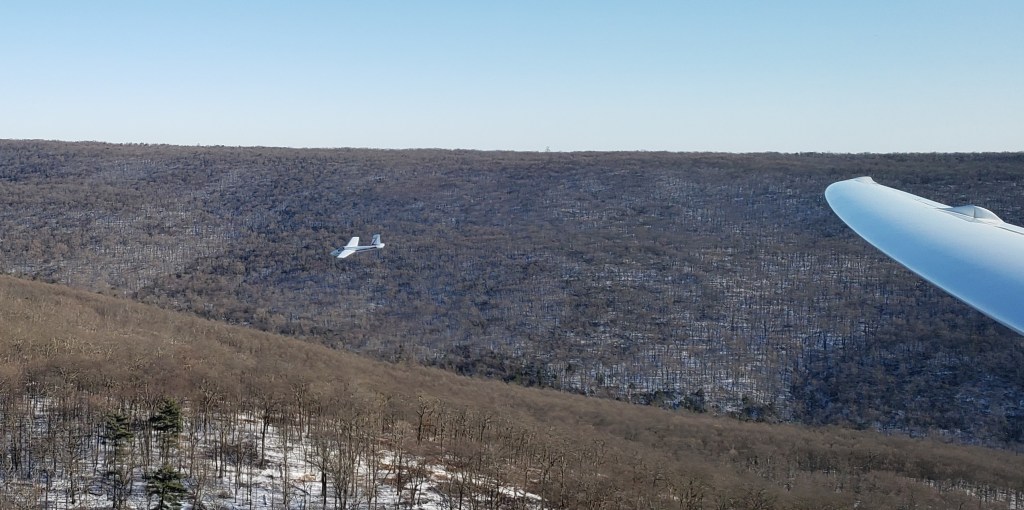
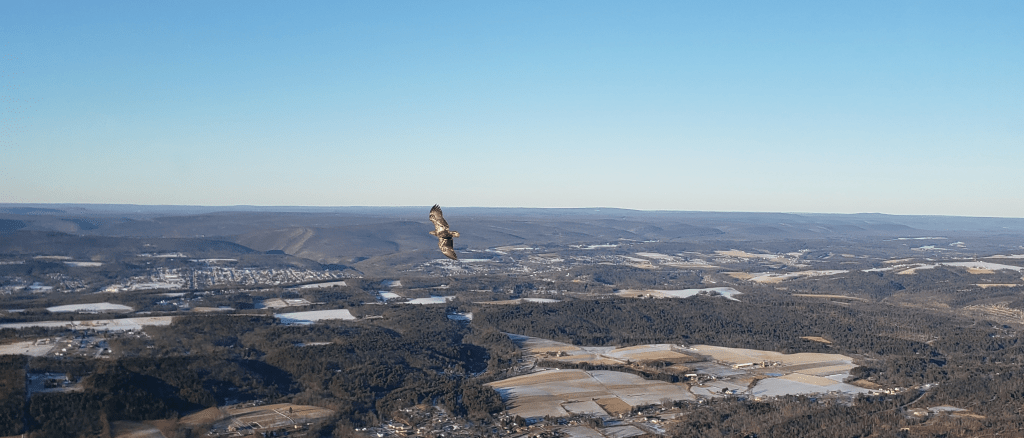
I spotted a bald eagle and swung the glider around to fly with him. This guy was moving along at a pretty decent clip, at least 40 mph! It was difficult to stay with him, even with the spoilers fully extended and the flaps down to 20 degrees. To remain in position, I resorted to S-turning, setting myself up for a “bomber run” and then passing near him.

This guy wasn’t as thrilled about my presence as the eagle I flew with a month ago. Steve later noted, he was probably confused whether I was a duck or a hawk!

Nonetheless, he indulged and played with me for a little while.

It was really fun watching the changing landscape. When you do laps, the light directs your attention on various features. With different shadows, you will see distinct rock outcroppings, fields, houses that you haven’t noticed before. The valley was beautiful, with a hard white crust on top of the snow covered fields that glistened at low sun angles. Unlike other winter days, the snow was so thin that it looked more like frosting on top of a cake. The snow didn’t completely overwhelm the region, which often makes the land look sad and monochrome.

The visibility was unbelievable, genuinely unlimited. At a couple hundred feet above ridge top, you could just make out the tops of the New York City skyscrapers poking above the hills. It was easy to spot the airliners from the Flarm. They looked like big insects that you could just reach out and pick up as they passed over the canopy.

Bobby Templin likes to say that the second lap is the least appealing. This is when you notice you’re getting a little tired, cold and some parts of your body start to hurt. The first lap is always exciting since you’re trying to make miles. The last lap is fantastic because the valley gets lit up in a gorgeous glow. The second lap can feel like a drag.

I call it the second lap blues. Coming back from Hawk Mountain, my legs couldn’t find a comfortable position and I was getting hungry. Glancing at my watch, I saw it was 2:40pm. It struck me that Runway Cafe closes at 3:30pm and that I could get a great cup of coffee and a prime rib sandwich if I hustle back home.

The prospect of rich, dark, black coffee overwhelmed my senses and I pushed the nose over.

The trees were flashing off my right wing. The ship settled in at 110 knots, 100 ft above the ridge. The air was choppy, but established a steady rhythm. There was a cadence to the gusts, like the reassurance of riding waves up and down on a sea. The lift band just felt *so solid*, as though it was reaching out and gripping the glider.

Approaching the Delaware Water Gap, the sun was coming around to the west and lit up the mountain in a gorgeous glow. And there was Schwartz, driving along in his 1-26! That old dog lined up for the foreboding upwind jump only several hundred feet above ridge top. He knows the ridge like an old school London cabby driver knows his city’s streets. He feels the air as a bird, gently swaying to and fro and following the air’s natural ripples, eddies and snaking currents. It was beautiful watching him float across, hardly losing any altitude at all.

Now on the local ridge, I got a second wind and regained the motivation to do another lap. And as far as my hunger, I ate a rock solid Cliff Bar. It was so frozen that it felt like I could break a tooth on it! Hot coffee was merely six minutes away, but the temptation was averted. Time to head southwest-bound once more.

We sometimes call this the “victory lap”. At the end of a long flight, it’s amazing to watch the ridge light up in the oranges and reds of the setting sun. The trees let go of their latent heat and the lift band becomes smooth. There is a cinematic quality as you soar effortlessly in the beautiful glow.

On the way back, I stumbled across another eagle. This one was not like the others; he was a bit bigger and golden colored. I couldn’t pass up the opportunity and swung the ship around to meet him.

To stay with him, I slowed down and started S-turning. As I would come close to him, he would turn toward me and slide in behind me. We were “scissoring”, a well-known air combat maneuver. We did this for a half dozen cycles for almost ten minutes, at times less than a wingspan away!

Later, he turned into a nice thermal. I joined him and got to my highest point of the day, less than an hour before sunset!

There’s nothing like flying with these amazing birds. When you soar with them, you forget about the glider, about the here and now. As they look square into your eyes, they communicate something that words cannot convey.

You’re flying.

Thanks a million Tommy and Khanh for towing and running the operations! You guys are the best!

See the flight log here.

12-20-19 | Winter Wonderland | Soaring with Eagles

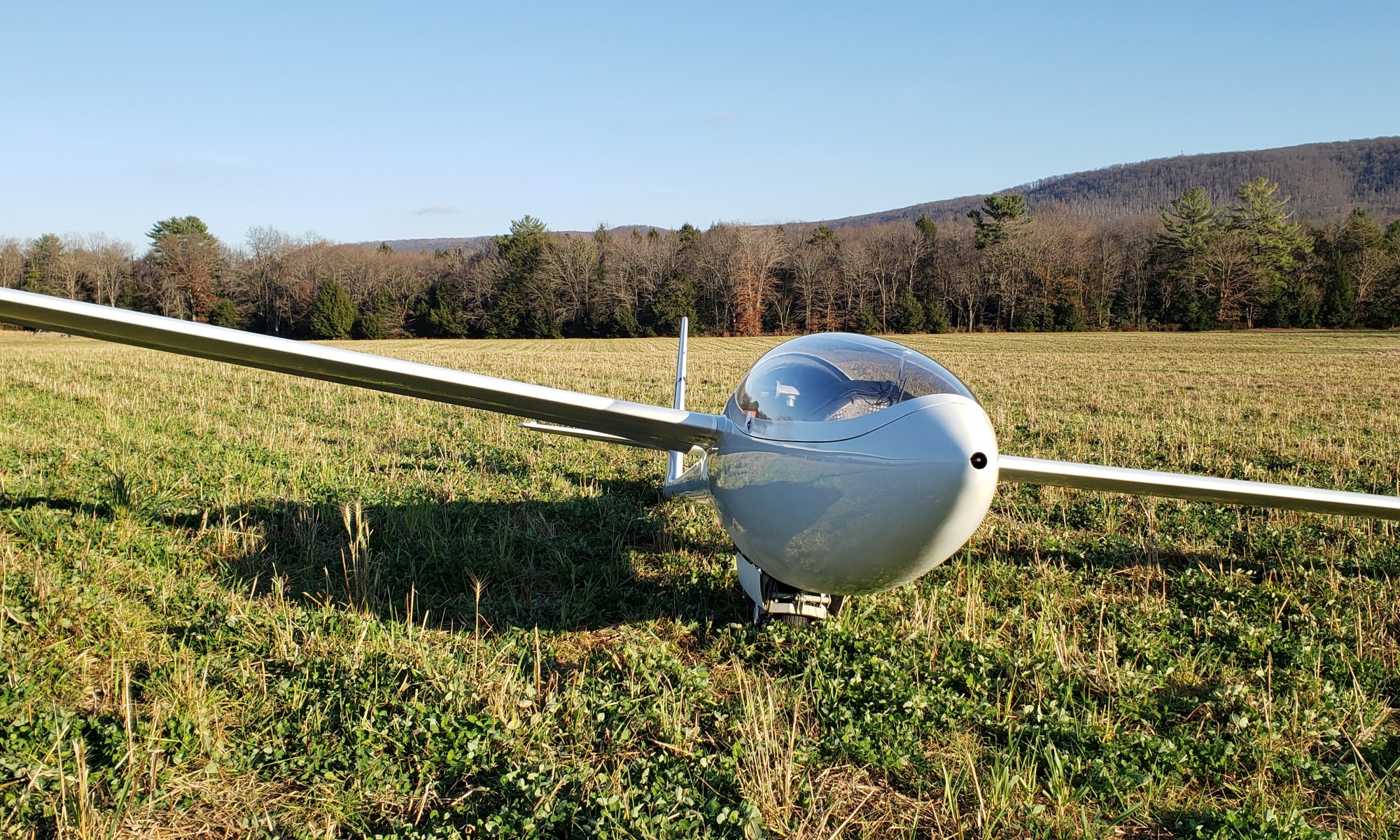
After six months of body-filling, sanding, sanding, sanding, gear door fixing, parts ordering, FAA registering, lubricating, cleaning, and inspecting, the Duckhawk was ready to fly. Bill Thar donated his magnificent flying machine to me. I was awestruck, even dumbfounded when he offered me the ship. I even thought he briefly went crazy and made sure to point out that he could take a week or two to rethink the whole affair. Nope, he had thought it all through; I would take care of the bird and use it to promote research in soaring and junior flying. The aircraft is the perfect vehicle to explore weather, dynamic soaring, optimizing the use of autoflaps and more. I wholeheartedly agreed to take the project on.

After many months of work, I was eager to fly the bird. So after my classes and research work at Temple went into winter break, I took the very first chance to go soaring. The forecast called for a light northwesterly breeze, just enough for the ridge to work. This was a good opportunity to do a little bit of soaring and a systems check. Thanks to Bill’s continued sponsorship, I had flown the Duckhawk maybe 250 hours or so; I wasn’t worried about flying the ship. But that said, I find that soaring for a couple hours on a low-key local flight is the best way for me to get acquainted with a glider. My landings are a lot better this way than when I go up for 10 minutes and come straight back down.

In any case, it looked like I was going to be the only person to enjoy this day. Tommy came out to tow regardless. What a sport! I actually appreciated that there were few people around as I assembled the glider, looked it over and got it ready. Cookie and Andrzej were very helpful in assembling the ship and launching me; thanks guys!

We took off at 12:30pm and took a quick tow over to the ridge. Testing the ridge revealed that it was fairly weak, so I was much keener to stay in the higher lift band. As I headed toward Millbrook, I fiddled with some of the systems, working the electric flaps and adjusting some of the settings on the ClearNav. As I rounded the bend on the Catfish Ridge, I looked up and saw three bald eagles spiraling in a thermal.

I have never been so eager to forget everything and just throw the glider into a turn.

Having picked out the highest eagle, I stuck with him in the thermal. My eyes were glued on to him and we stayed on opposing sides of the circle. I completely forgot about the glider; I was just flying. When he leveled out and headed northwest, I chased after him and took some great photos. There were several times he was closer to me than the end of my wingtip.

We soared together for about ten minutes. I stayed with him until I approached the limit of gliding back to the ridge behind me.

Afterward, I headed up to Millbrook. Upon turning around and heading southwest-bound toward the sun, I was awestruck by the sight of the whole forest glistening in the sunlight. There was an ice storm several days ago and the whole land was coated with a layer of clear ice; the whole landscape sparkled like a million diamonds. Through all my years of soaring, I had never seen anything like it. It felt like I entered a winter wonderland. Not a single soul was there to enjoy it; no hikers, no bird watchers. It was just me and this wonderful sailplane, gently floating along in the breeze. This was one of the most peaceful flying experiences I ever had.

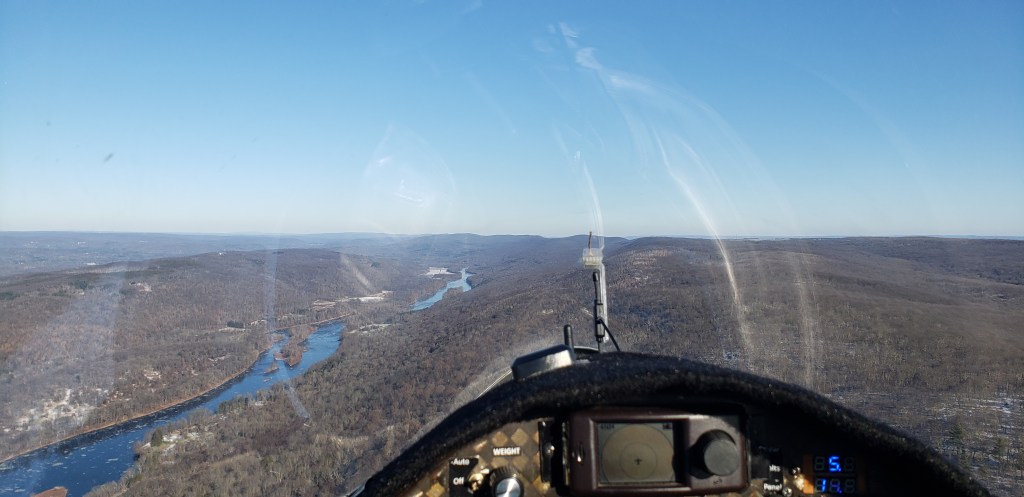
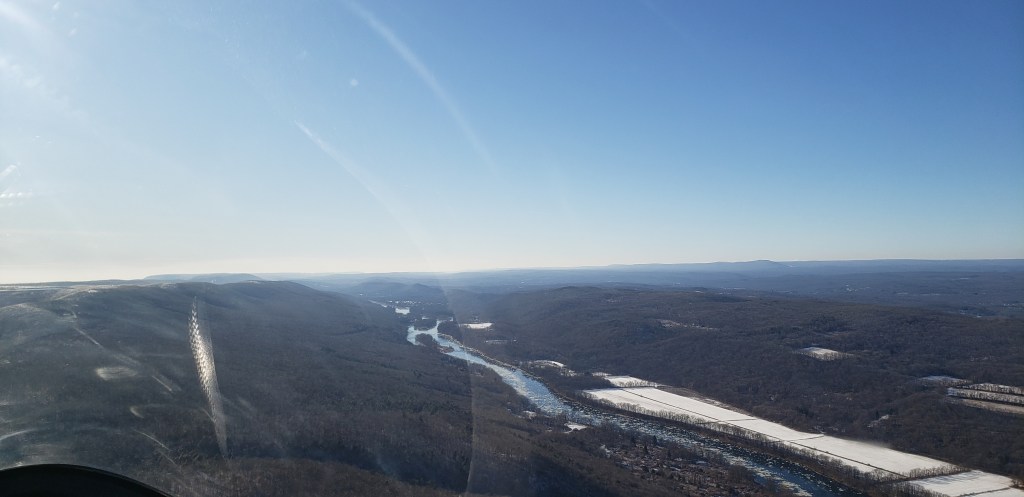
As I soared up to the Delaware Water Gap, I looked down at the icy black river. Ice floes gently floated down, marking the snaking path of the current. The water was absolutely crystal clear; you could see all the way to the bottom of the river bed in many places.

It was a real joy to fly this wonderful machine. The conditions were weak, with an inversion at around 2500ft MSL and the wind at ridge top perhaps around 12 knots or so. I was not eager to go anywhere in particular, so I was perfectly content to mosey around. I took turns here and there and practiced thermal entries. It was really fascinating just watching the ship fly. There are so many different ways to thermal it; slow and flat, fast and steep and all sorts of nuances in between. Many different ways to center it; bank and yank or mosey around at 50 knots and nibble at the lift in a flat turn. The ship has a lot of character and feel. Most gliders have a certain way they want to be thermalled and you adapt each thermal to its “style”. The Duckhawk can be flown in many different ways and you can feel the difference when you do it right. I felt like it will take 500-1000 hours of consistent flying to really figure out how to get everything out of it in the climb.

I spent most of the time floating around at 60 knots. On one instance, I nosed over to 85 knots. The deck angle changed, but the glide angle didn’t. As I let it go, it felt like the ship was a racehorse, relieved that this incompetent fool finally cut it loose. Boy was this ship happy to fly fast!

It’s a crime to fly the Duckhawk slow, but I wasn’t keen on working hard today. You have to be sharp flying this fast, ready to fling the ship into a turn in an instant. I pulled the glider back from its canter to a trot, patted it on the side and said in due course we will let ‘er rip.

After two hours I was ready to call it a day. Everything was working and the ridge was softening up. After a nice landing, I pulled the ship off the runway. There was not a soul around, so I was now stuck with a beautiful machine with no way to get into its box. A quick call to Gus and he was willing to help disassemble the ship on his ride back from work. In the meantime, I went over to get the trailer to bring it to the glider. It’s much easier to move the car and the trailer than it is to move the glider across the whole runway! Along the way, I marveled at the beautiful ice coating all the gliders and the airport.

Thanks a million to Cookie, Andrzej, Gus, and Tommy for helping me fly today. Thanks to Bill Thar for giving me the opportunity to fly this magnificent sailplane; in the past, present and future. I hope to not disappoint.

See the flight log here.

12-07-19 | Catapulting the Cow

Normally winter is a quieter time for glider operations. Not so for Aero Club Albatross! We just wear the appropriate cold weather gear when it gets chilly. As Philip DuPlessis, our resident expert sailor says, there is no bad weather, just poor choice in clothing. And this year, we came up with a very enjoyable way to spend an early December day; learning to launch using a winch!

Beltzville Soaring Club has a winch, but few opportunities to use it. So when I contacted David Bradley to express that several ACAers were interested in learning how to ground launch, he was very eager to help! Dave suggested that we fly from Grimes Airport, a wonderful little grass strip at the base of the ridge about 70 miles from Blairstown. The airport management at Grimes is very familiar with glider flying and has hosted quite a few events and fly-ins. They don’t operate much this time of year and were eager to host us. Gerry Wild was our local airport contact and all-around great glider guy. He volunteered to help instruct, run the operations and drive the winch!

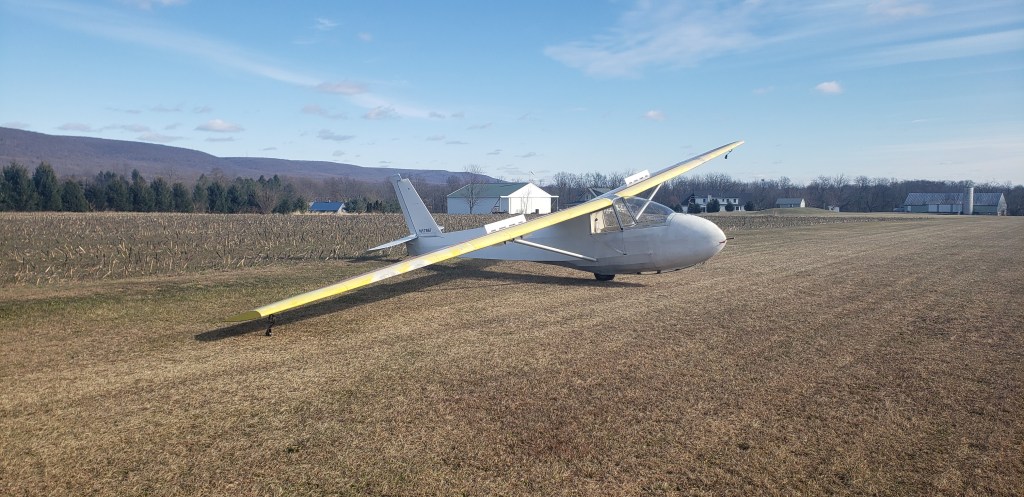
Aero Club Albatross, in turn, voted in David Bradley and Gerry Wild as honorary members and the club volunteered to handle a considerable portion of the logistics. We brought our venerable 2-33, nicknamed the Mad Cow to the event. To our knowledge, no one has ever ground-launched the Cow before. We were really excited!

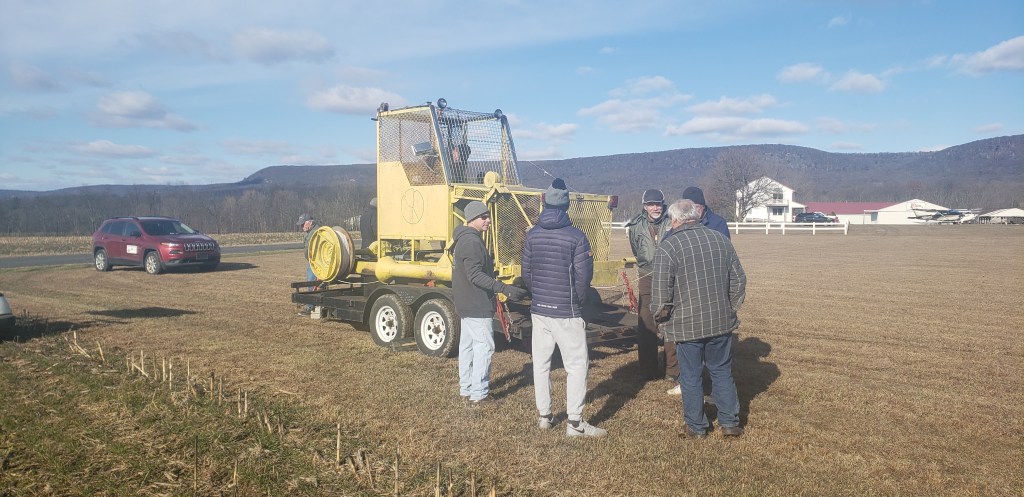
The event was a massive undertaking, involving a large and motivated crew. On Friday, Pete Ayers and Tommy came out to prepare the towplane and the Cow for its long aerotow to Grimes. They cleaned off all the snow and ice on the 2-33 so it didn’t have to thaw in the morning before its journey. On Saturday morning, Philip and Luke DuPlessis volunteered to do the long cross-country tow. To deal with the frigid temperatures and drafty cockpit, they were instructed to wear clothing fit for an arctic expedition! Tommy and Sebastian towed in the club’s Cessna 182 towplane. Jonathan and Gus picked up the canopy covers and tiedown kit and followed the Cow to Grimes in their Aeronca Champ.

Steve Beer picked up Bobby and membership documents for Dave and Gerry. Rob Dunning brought lawn chairs, coffee, bagels, and donuts. Bob Graf brought two cases of water and more chairs. Cookie and Joe (Dave’s son) also came to help out and crew.

My job was to haul the winch from Dave’s shop to Grimes.

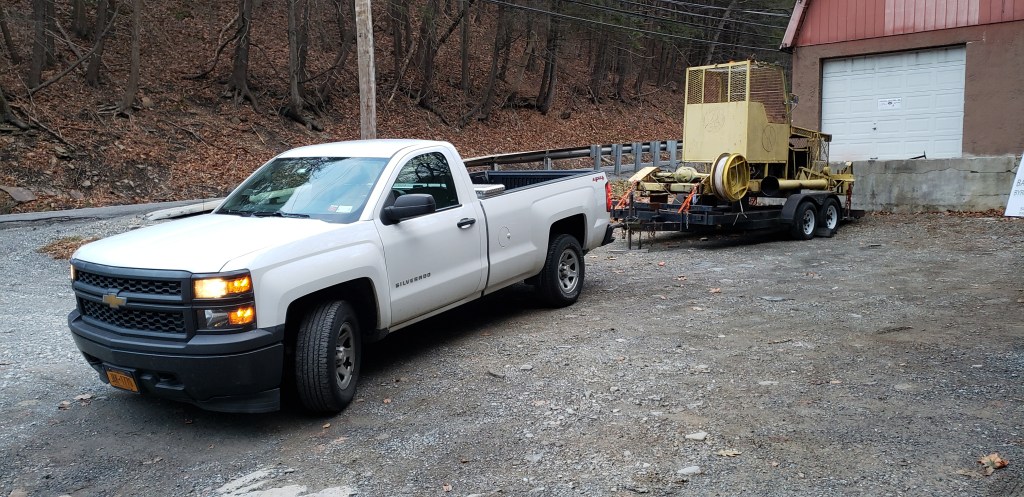
The winch was a freakin’ monster! It weighed 6-7000 pounds, with 600lbs on the tongue. Only a large vehicle like a pickup truck could move it safely (and legally). It was an ordeal getting it on the hitch and we had to position the truck perfectly. Then we found we couldn’t get it on the hitch because the tail end of the trailer would hit the ground. Through a combination of gingerly pulling it with a chain, a 12-foot pole as a lever to lift it, concrete blocks and huffing and puffing, we finagled the trailer onto the hitch. We were finally ready to hit the road!

Joe joined me for the drive as the navigator. The winch was a real monster to drive; unlike glider trailers, you *feel* this thing behind you. So did my gas mileage; I was getting 8.5 MPG thanks to the weight and the flat plate dragging through the breeze. But we arrived safely at 9:20 am, right as Phillip and Luke lined up on short final. Everything was coming together!

Gerry and Dave started the morning ground school and briefing at 10am. Gerry introduced the museum and noted that it’s a volunteer, non-profit organization. Gerry’s wife, Kristin also introduced herself as a contributor and made us feel very welcome. She was so kind as to cook hotdogs for us and provide a variety of snacks! They offered membership forms and five of us joined to support the organization.

Dave discussed the mechanics and safety of winch launching, emphasizing the decision-making at different points of the launch. When launching, first establish a 10-degree climb until reaching a safe altitude around 100-150ft or so. Then rotate into a 30-degree climb, while maintaining adequate airspeed. Flying too fast is bad; you don’t get as high and you can over stress the glider. If you have a rope break, you have to shove the nose forward and visually verify that you’ve got airspeed. Dave’s mantra was, think with the stick forward and emphasized that experienced pilots training to winch tend to think faster than their airplane can fly. After releasing, consider your options. If you are within a 5-1 glide, land straight ahead. If you’re above 250ft or so, consider tear-dropping back. Use judgment, maintain airspeed and be coordinated in the turns.

We really liked Dave’s approach to safety. He clearly conveyed, here is how winching can kill you. The winch driver can accelerate the glider too quickly and flip it over. Once you’re in the air, the glider can over-rotate, break the rope and hit the ground before getting flying speed. During the tow, you can have a rope-break, fail to achieve flying speed, and subsequently stall/spin. And for the folks on the ground, the rope is moving at 50-60 mph and can unpredictably go in different directions. Stay clear, behind the glider or on the safe side of the winch while the operation is in motion.

Then there was the fateful moment when Dave asked,

“So who’s going first?”

Everyone looked at each other, offering the opportunity to someone else. Finally, I volunteered to be the guinea pig.

Next, we hustled over to the winch. After some fiddling and adjustments, it roared into action. While Gerry and the onlookers were figuring it out, I walked on over to the Cow, patiently waiting on the side of the runway.

The Cow looked like it was nervously grazing on the beautifully manicured grass runway. She was probably thinking, “What are we doing here, so far from home? I can see it their eyes, these guys are up to no good!

I walked around the glider and it looked in ship shape. A whole entourage of glider pilots rode over in the golf cart, eager to see Dave and me off. They brought the rope and we strapped in.

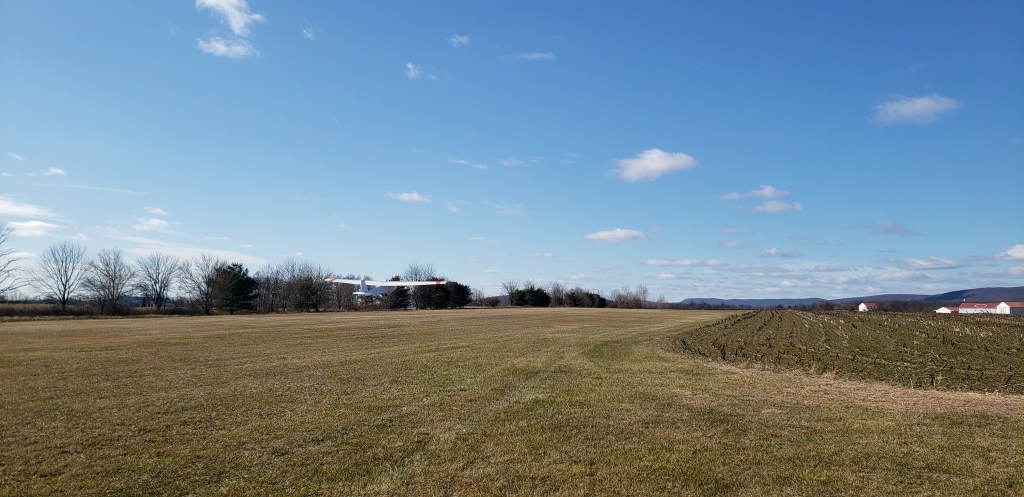
The experience of winch-launching is on the edge between being excitement and terror. Steve hooked us up and was our wingrunner. Once on the tip, he waggled the wings up and down, up and down, indicating to the driver to take up slack. Once he stopped, the winch driver “hit the goose” and we rocketed up. We were airborne in less than three seconds, screaming along at the speed of heat.

It was quickly apparent that we were going too fast, approaching 80 mph on the dial. Dave kept the angle flat rather than rotating to minimize the load on the wings. After getting to only 250ft, Dave released and said, here you go! I did a quick 180 and landed back where we took off.

After landing, Dave called up Gerry to ease off the throttle and turned us around. He said that I would have the controls on the next launch.

It was amazing how quickly we were airborne! I kept too much forward pressure and Dave eased us back. At 100ft or so I rotated into a climb. We were still too fast and climbed to little more than 250ft.

I made a dumb decision after releasing the rope. Figuring we were a bit more upwind than we were, it felt that we lacked the room to maneuver to turn upwind (we had a slight NWerly crosswind). I did my 180 to the left, downwind and this did not work out well at all. I drifted in the turn much more than I expected and button hooked the final turn. I was not happy with that approach.

The third flight was better. This time we got to 450ft, enough to do an abbreviated pattern for a downwind landing. I was not eager to do a “full” pattern from this height.

The fourth flight was better yet and we got to around 550ft on this launch. I still had to work on rotating more deliberately, but I got the mechanics of the launch figured out. We were high enough to do a full pattern and had an uneventful landing.

Dave asked me if I wanted to do the next one on my own.

Sure deal and better now than later; I want to do it while the training is fresh!

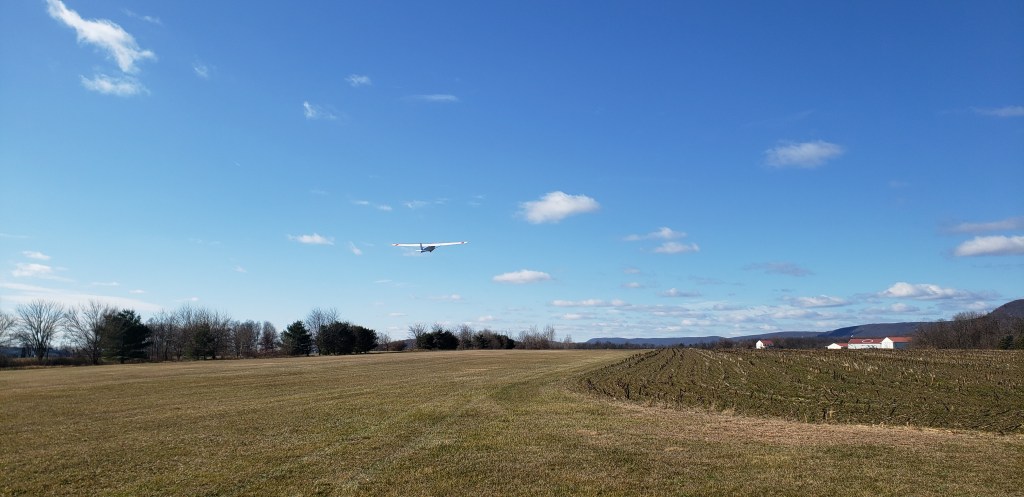
Dave hopped out, buckled up the belts around the cushion and cut me loose. After hooking up, I rocketed up. Man, the Cow climbs so much better solo! Climbing up to 750ft, I saw the airspeed bleeding off and firmly pulled the release twice. I was free!

A left 90 degree turn and I stumbled into a thermal. How convenient! I started circling, happily gaining height every turn. A raptor even joined me!

I looked down and watched the action on the ground. People looking up at me from the winch. The golf cart traversing along the runway. The cars buzzing along I-78. The beautiful and familiar ridge a little over a mile away. What a gorgeous place!

When I saw the golf cart making its journey back to the launching area, I cut my flight short and headed back. I felt like a king entering the pattern at 900ft. Compared to all the unusual attitudes and altitudes, I felt high. I even got to make my base leg at 500ft and turn final around 300ft or so. What a blessing!

After landing, everyone was smiling. Dave asked me if I wanted to throw his CG hook equipped 1-26 (020) together and try to soar in the afternoon. I eagerly agreed!

Dave’s son, Joe and I went on over to assemble the ship. We got halfway, but couldn’t find the fourth main pin to finish the job. We looked everywhere but to no effect! We relayed this to Dave, who arrived 45 minutes later after being relieved of his instructor duties by Gerry.

He found the pin stuck in a deep socket in his toolkit. We were all relieved that the pin wasn’t missing and Dave laughed his butt off and singing, “Victory!”

By now, Gus had taken several instruction flights and completed a solo flight. Jonathan was on his third flight. But then, the Cow decided it had enough winching for the day. On Jonathan’s last landing, the tire went flat. This unfortunately grounded the ship for the rest of the day.

Since the 1-26 was nearly ready to go, I quickly sealed it up and got it out on the line. Best to use the winch while we still had the chance to fly!

Launching the 1-26 was really fun! It got airborne really quickly and settled into a very natural climb. The CG hook definitely makes it climb better! I firmly pulled the release at a comfortable 800ft. 020 is a simple ship, with basic instruments, but man it flies great. 1-26s are just a total blast!

The glider quietly sailed through the sky. There was little lift left this late in the day, so I quickly fell out and entered into the pattern. After landing, a whole bunch of folks eagerly took up the 1-26. Dave went up first and had a grand old time. He entertained the crowd with mild aerobatics and screaming along the runway at 100mph. 020 was surprisingly quiet at such a high speed! Dave was all smiles, waving as he passed us at the winch.

Gerry and Adam then took their turns in the 1-26, getting as high as 1100ft off the tow!

As our friends were flying, we surveyed the Cow situation. We really wanted to get the wheel fixed, both so Steve B. had a wheel to fly on the following day back to Blairstown and so that the ship was airworthy when it returned. The mechanic at the shop found an old 600X6 tire, which fit the Cow’s wheel. A whole crew of us got to work. Bob Templin, Bob Graf, and Bob Cook all played key roles in this project, helping to get the glider jacked up and the wheel off. Walter, a local Grimes member helped coordinate different parts and materials and helped us a whole bunch. The rest of us Beltzville and ACA members lent our brains and brawn while these guys labored away.

The job took us several hours. The wheel hadn’t been taken apart in many years and the Cow resisted getting its appendages operated on. The axle had to be banged out. The backseat, torsion bar, and wheelbrake had to be taken apart to get to the wheel off.

Taking the wheel itself apart was a nightmare. The axle was deformed and the hub wouldn’t separate. Mike the airport volunteer mechanic spent a good hour and a half, sanding off the burrs on the edge of the axle and hammering the unit apart. As the sun went down at 4:30pm, we managed to get the new tube in, the wheel together and reassembled back on the glider.

Steve B, Bob Graf and I tied down the 2-33 in the darkness, all ready to fly the following day while Dave and Joe hooked up the winch to my truck. We all had dinner at the local Midway Diner, only four minutes from the airport.

After trading stories and having a great time, we parted ways. I went back with Dave and Joe to drop off the winch at Beltzville airport. I hit the road back to Brooklyn at 8:30pm, thoroughly satisfied after an awesome day of flying.

___________________

The next day, Steve and Tommy safely aerotowed the Cow back to Blairstown. The ship is now happily back in its tiedown, ready to fly.

The winching day was a real blast! Everyone had a great time and contributed to make this event a blast. We learned a lot about winching thanks to Dave and Gerry’s wonderful instruction. Thanks a million to Aero Club Albatross, Dave Bradley and the Beltzville folks and Grimes airport for making this happen for us. We are all eager to do it again, get more people endorsed and promote winch flying!

10-06-19 | Exploring New Ridges

As the year wanes, the summer eases into the mild and pleasant autumn. This is my favorite season, with the landscape transforming into a joyous palette of reds, oranges and yellows. It’s like the whole land celebrates another harvest, another trip around the sun, another successful cycle of life. There is the foreboding of the coming winter, as the days get shorter and shorter and progressively cooler and cooler. But perhaps this is why the land celebrates. Maybe it is to keep you in the here and now, enjoying the wonderful scenery, the beautiful life as you see it without thinking too much of the future. I love autumn.

Aside from a couple short flights in the backseat of the 2-33 and the Grob, I haven’t flown much since I returned from Hungary. Certainly not cross country or any interesting flights worth mentioning. So when the first solid cold front of the season was forecast to roll in, I felt the urge to fly again. Even better was that I was largely ahead on my week’s work. It looked like fate would have me fly on this nice ridge day.

Steve was the spark plug for the day, getting the tows organized and taking the first tow. By the time I drove up from Philadelphia, picked up Bobby, and arrived at the airport (a 2.5 hour commute nowadays), I saw Steve pulling 508 out to the runway. This is probably the first time in my recent memory that someone else was launching earlier than me on a ridge day, good for him!

But in any case, this motivated me to get the LS4 together and I worked diligently and efficiently. It is amazing how easily and quickly the whole process goes when you’re well practiced and eager to go. I had the ship together and prepped to fly within 25 minutes and that included helping get Bobby’s wings on as well! The wind already picked up, it was time to get on the ridge and go.

By the time the ship was on the flight line, Tommy was just arriving back from towing 508. Socks changed, in the cockpit and we were ready to fly. Cookie and Jonathan launched me and we were on our way.

It was a rough tow! I measure how challenging the tow is by how close I am to opening the airbrakes. Normally I am relaxed and don’t think about it. When it’s gusty, I have my hand ready to open the brakes in anticipation of big gusts and the resulting slack line, which was the case on this tow. Huge thanks to Tommy who was pummeled for half a dozen tows. He was a real sport doing all those takeoffs and landings in those conditions!

A quick tow to the ridge and the lift was working solidly. The wind direction was almost right on, perhaps a touch north of perpendicular. I drove onto the ridge and was easily established in the ridge band. A quick run up to Fairview Lake and then I was heading southbound.

Boy it was wonderful to be back on the ridge. After not flying it for a while, it all just comes back to you in a gleeful surge of memory. It’s a moment of joy, similar to when you come home after being away. You forget how familiar everything is.

Local ridge early in the morning. What a beautiful ridge!

The previous week I had hiked the local ridge with my father. We trekked from the Delaware River almost the whole way to Catfish Pond. The round trip took us a little over 9 hours and I was absolutely exhausted at the end of the day. It really put this ridge flying business into perspective when I flew the whole length of the hike in about five minutes! Soaring is absolutely amazing!

The ridge was pretty rough. Every once in a while the gusts would fling my feet off the pedals. I kept up a good clip for now, 90-100 knots, happy to play the conditions for now, but not any faster. The trees danced below.

By the time I got to Hawk mountain, the sky was bordering on overdeveloping. My first thought was that it wouldn’t be possible to make it upwind and to come back a bit later. The cloudbase was around 3500ft MSL and it didn’t look like it was working all that well. I tried to find a thermal and even went off the tip of Hawk to do so without much luck. But when I turned back, I figured it wouldn’t hurt to try to get to cloudbase and give it a try anyway. And at that point the thermals cycled in nicely and climbing up to cloudbase wasn’t too difficult. And given, why not attempt an upwind crossing? It was a bit trickier since there was not a clearly solid line and I wasn’t that high. But a thermal in the middle of the jump got me comfortably high enough to get across to Sharp. Very nice!

Nice cloudstreet!
Second and Sharp Mountains on the transition upwind.

With the solid northerly wind, Sharp was working gangbusters. Normally I’d be more inclined to thermal through this section if I was flying recreationally, but today it was just totally solid. Sparing myself the trouble of thermalling along, I just floated along in the ridge lift without breaking a sweat.

With the northerly wind, the line to Bear set up closer to Tremont. Again no troubles climbing up and an easy crossing to Bear Mountain. Bear had a line of lift that smelled a lot like wave. I fiddled around in the rotor a little bit, but the line was not staying stationary enough to be worth the effort, or at least so it seemed. Gus Johnson, the rascal, got up to 10,000ft in his 1-26! Evidently the wave was working well!

Bear Mountain. Maybe a hint of wave?

But in any case, I kept enjoying soaring the ridge and worked my way down the Mahantango. It seemed best to stop at the Susquehanna River with the overdeveloped sky ahead on Buffalo Mountain and the northerly wind. The OD can slacken up the wind and suppress the thermals; best to head back.

Susquehanna River. Buffalo Mountain is ODed, not looking good over there!
Mahantango, heading NE-bound.

It was only around noon and it felt disappointing that this was the most the day could offer. It didn’t excite me to go back to Blue Mountain and do laps and laps; I’ve done that plenty before. So as I was climbing to transition back to Bear, I looked upwind. There are two ridges there, Little Mountain (aka: Northumberland Ridge) and Nescopeck Mountains (Bloomsburg Ridge), both that I hadn’t flown before. This seemed like the perfect opportunity to fly with them; the northerly wind that should make them work very nicely!

It was a bit of a challenge getting from the Mahantango to Little Mountain. The cloudbase hardly lifted any higher, getting only up to 3800ft. With the stiff headwind, it was tough to buck the wind while maintaining glide back to the ridge behind me. Slowly but surely I made it around the tip.

The tip of Little Mountain, looking at the Susquehanna River. You can see the end of Shade Mountain in the distance.

What a beautiful Little Mountain (hehe)! The tip had a very cool perspective on the valley, with the Tuscarora and Shade Mountain off in the distance. Selinsgrove Airport was just the northwest, along with the broad Susquehanna River beside. With the ridge working solidly, I headed northeast bound, floating along at 85 knots or so. I enjoyed the view several hundred feet above ridge top.

Little Mountain NE-bound.

Trevorton was off my right, with the wooded landscape and strip mines from days past. To the northwest was a beautiful valley, with fields full of corn and cut hay. I saw a nice paved runway at Northumberland Airport and a beautiful little grass strip at the northeast end of the ridge. This would be a very nice place to fly gliders!

Time to make another jump to Nescopeck Mountain. This one took me freakin’ forever. Every time I climbed up, I drifted back quite a bit. It was two steps forward, one step backwards for a good half an hour. Finally one cloud higher than the rest took me to 4200ft and this was enough to comfortably make it across.

Heading upwind to Nescopeck Mountain.
Nescopeck Mountain NE-bound.

Nescopeck Mountain worked great! The Berwick Nuke plant beckoned in the distance, belching a huge column of steam. That plant offers a very consistent thermal when you need it; my nickname for it is “Ol’ Faithful”! I’ve hoped to fly this ridge on future triangles. It seems like a very nice way to get home from Lockhaven; climb up to 6000ft, do a glide to Nescopeck Mountain, pick up a downwind bubble from the nuclear plant and then glide across the Poconos to Cherry Valley. This would save quite a bit of time on the way home.

The ridge worked very nicely all the way up to where Rt.80 crosses through a gap. At this point the ridge loses a bit of definition and the fields become sparser. I floated along at 2300ft a little beyond the gap where Rt.81 crosses. Beyond this point the ridge fades away and becomes hardly usable. Time to head back.

Rt.81 Gap.

Since the cloudbase was still low, it wouldn’t work out well to cross back over the Pocono Plateau. As such, I flew the same way back as I got here, along the same ridges. This was a very nice fast run, with easy downwind jumps back to Little Mountain and Mahantango.

Berwick Nuke Plant (Ol’ Faithful!).
Nescopeck Mountain SW-bound.
Crossing back to Little Mountain.
Treverton, tucked away between the ridges.

With the sky cleared up, I flew the length of the Mahantango and took the chance to cross the river. The wind slackened a bit on the other side, but the ridge hung on a bit. It got soft enough that I was eager to take a thermal up when I found one at the tip of Buffalo Mountain. This let me plod back to the Susquehanna River and sneak back across to the better working ridge on the other side.

Second lap on the Mahantango.

Right as I crossed the river, I saw two bald eagles playing with each other. They left a thermal, flying wingtip to wingtip, occasionally getting in each others way! There were many birds migrating along the ridge system, though the five eagles that I saw were the highlights of the day. These majestic raptors actually take interest in your presence and are the most fun to fly with!

After this point, I worked my way back home. The sky ODed over Sharp, so it was a bit trickier to make the downwind jump back to Hawk. But finally a solid thermal took me to 2800ft and then it was easy sailing getting home.

Bear Mountain on the way home.
Pottsville; the Yuengling brewery is below in the large brick building.
Near Fitch’s Quarry during the golden hour!

It was freakin’ cold. My camelbak leaked and the sun was on my back. I was shivering the whole way home. Once back on the local ridge, I finished the leg to the Fairview and was eager to get back on the ground. The ridge was softening up anyway and I was pretty satisfied with the flight. Time to go to Blairstown.

Catfish Pond an hour before sunset.

When I landed, I learned that Bob Janney landed the club Pilatus in a field and a big crew went out to get him. Steve and Taz helped me put away the LS-4 and we hung around until the rest of the ACAers came home. Taz and I ate dinner and got pizzas for the ravenous club members, who arrived from the retrieve 10pm. We had a jolly time in the warm ACA shop, content at the completion of the first nice ridge day of the season.

____________________

Thanks Aero Club Albatross for giving me the opportunity to fly the gorgeous LS-4. Thanks Tommy for the tow!

See the flight log here.