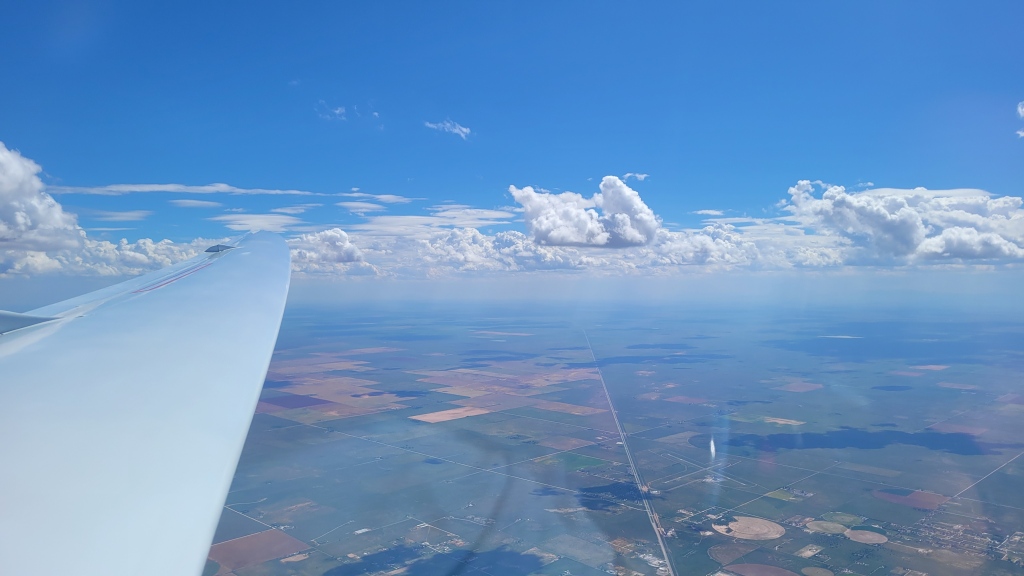
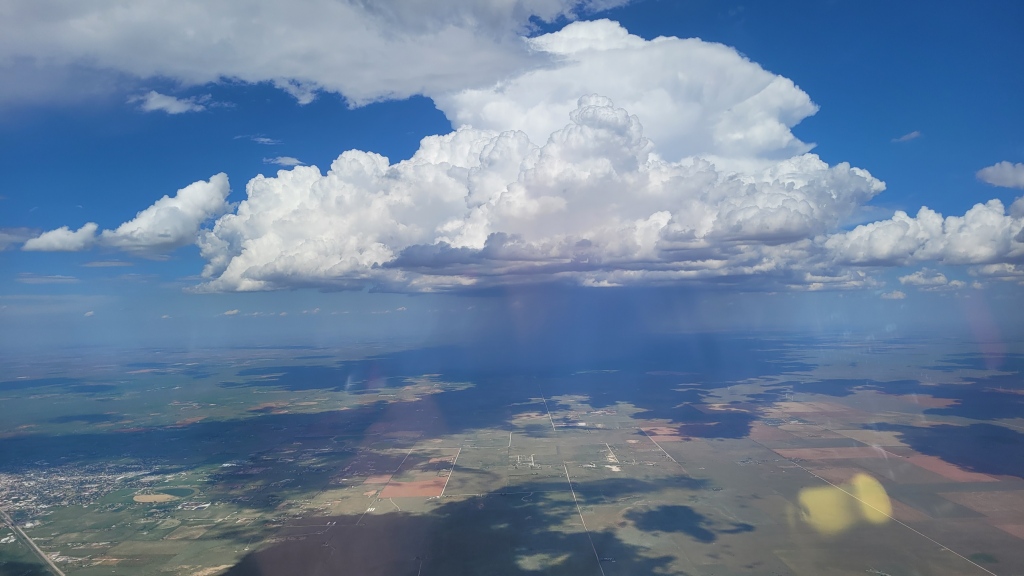
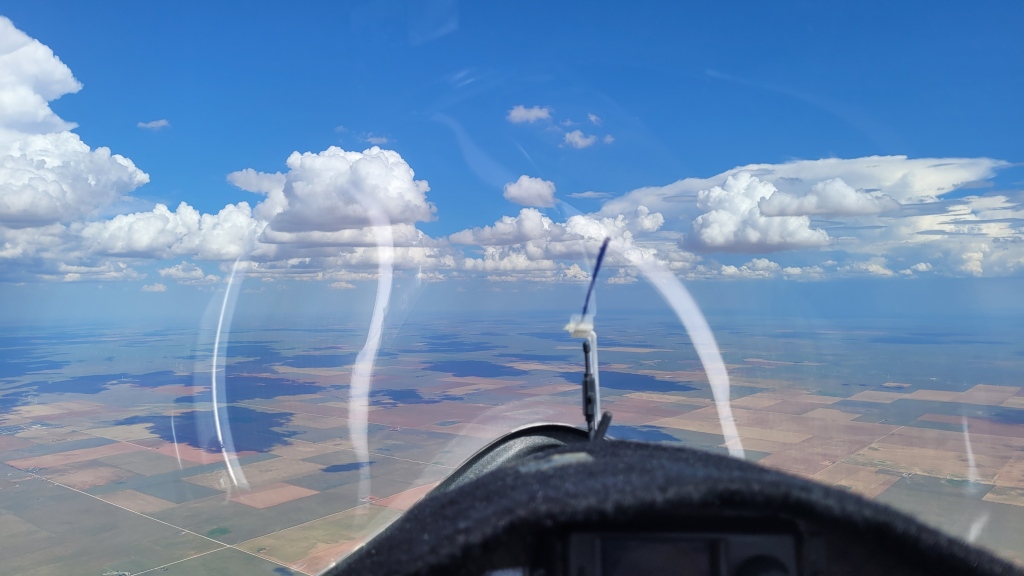
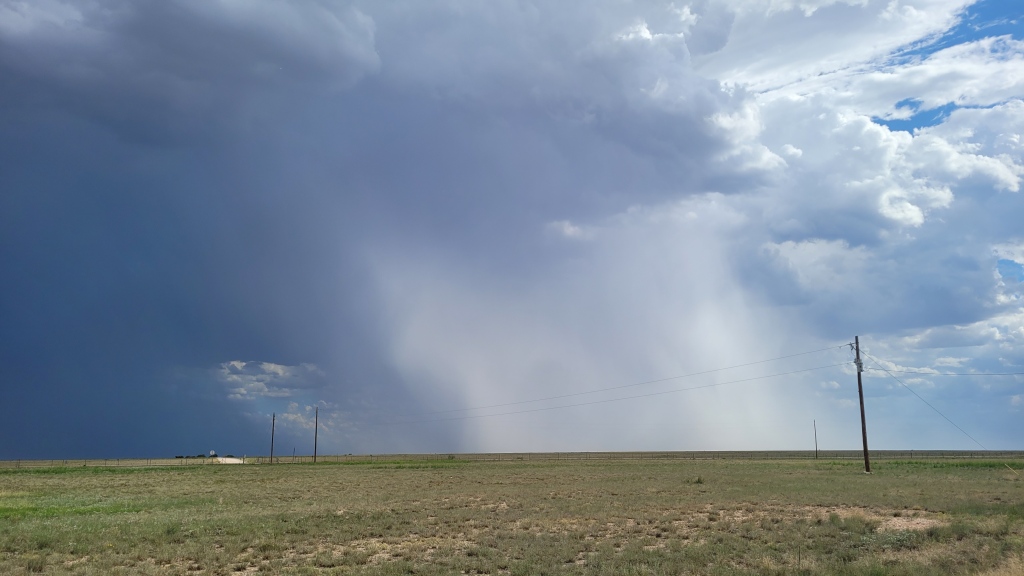
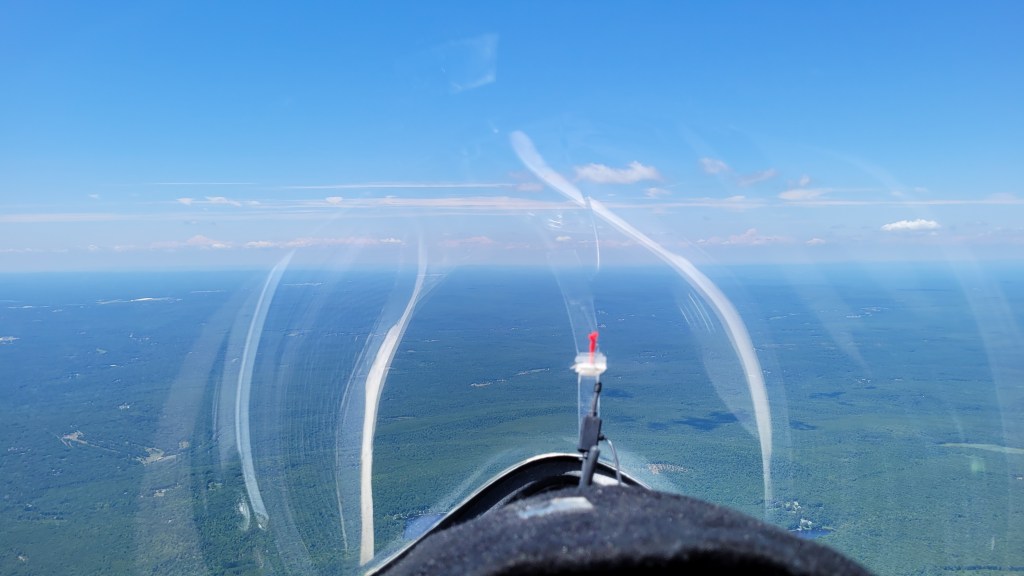
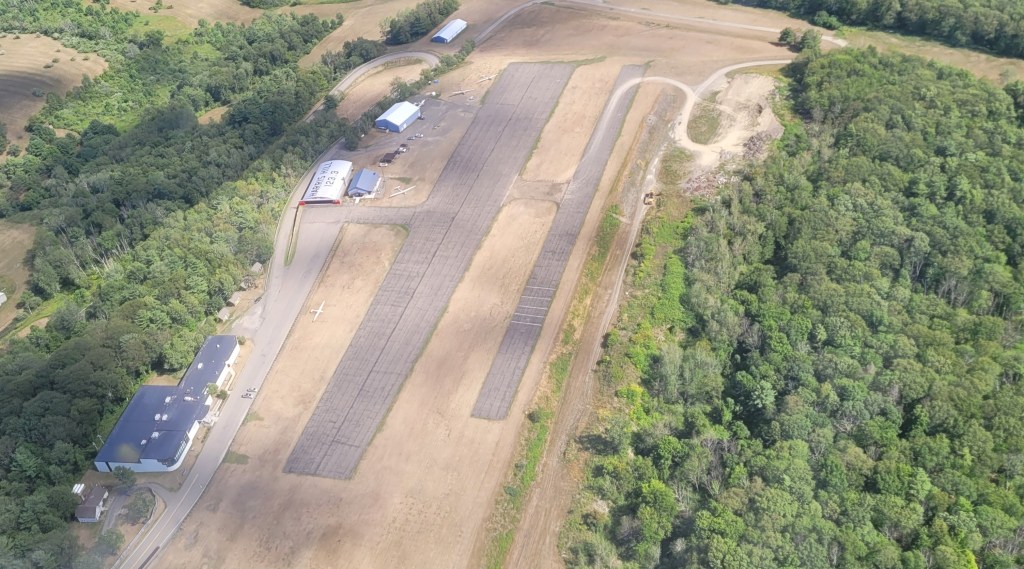
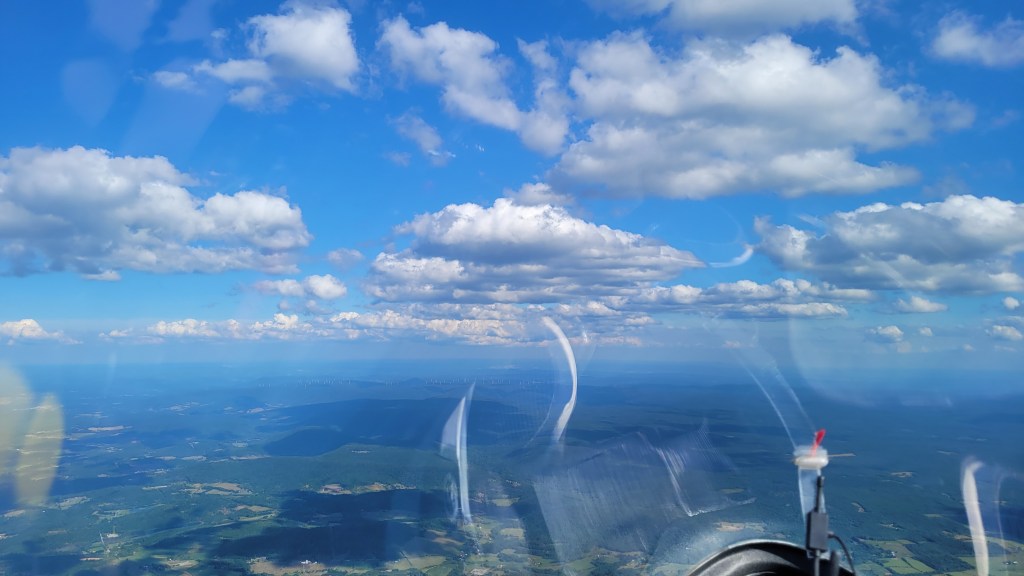
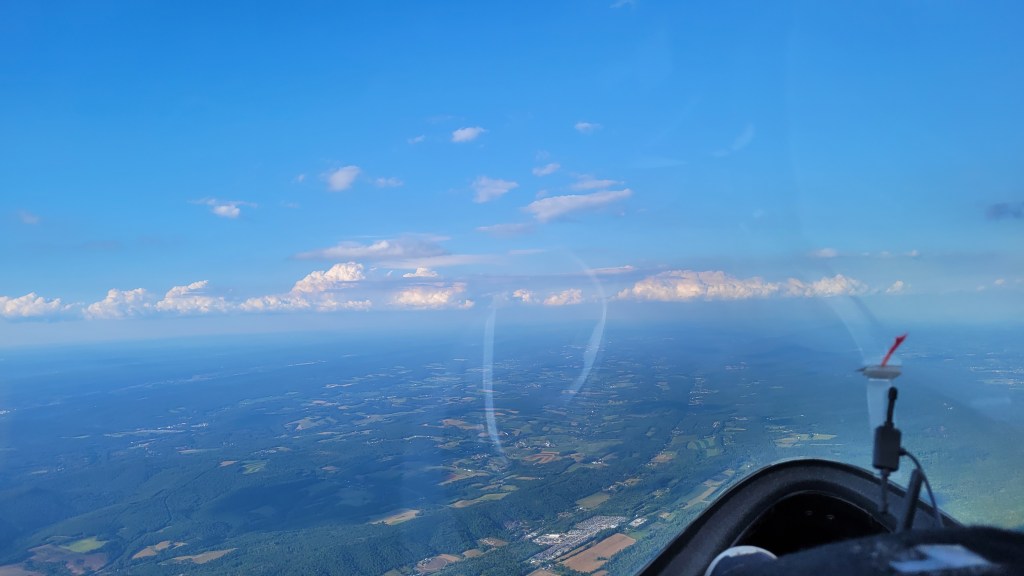
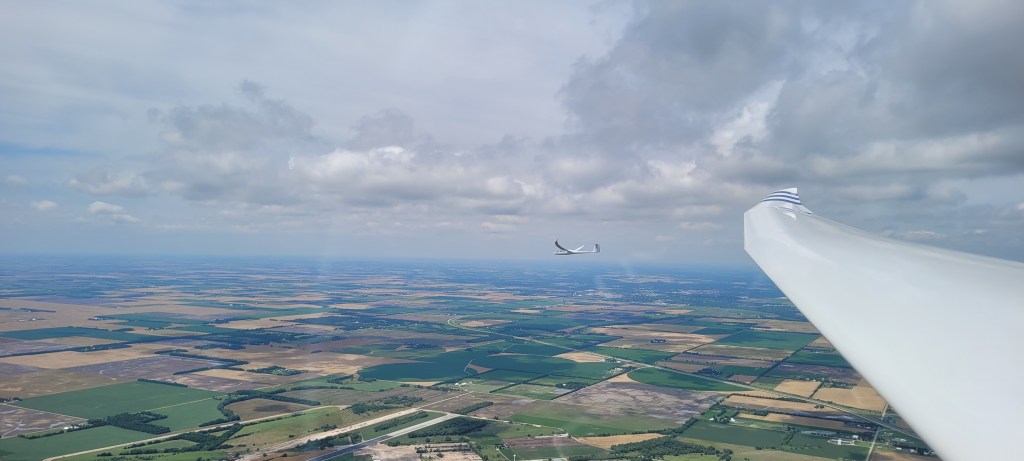
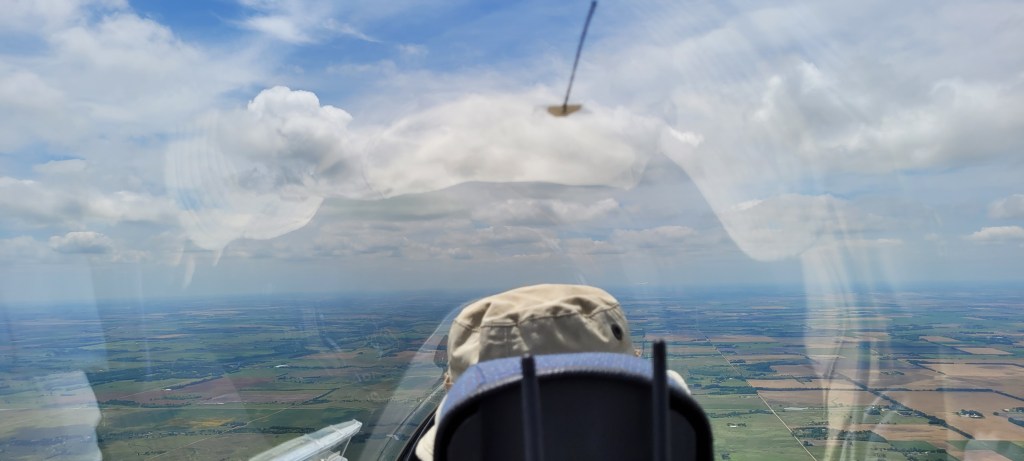
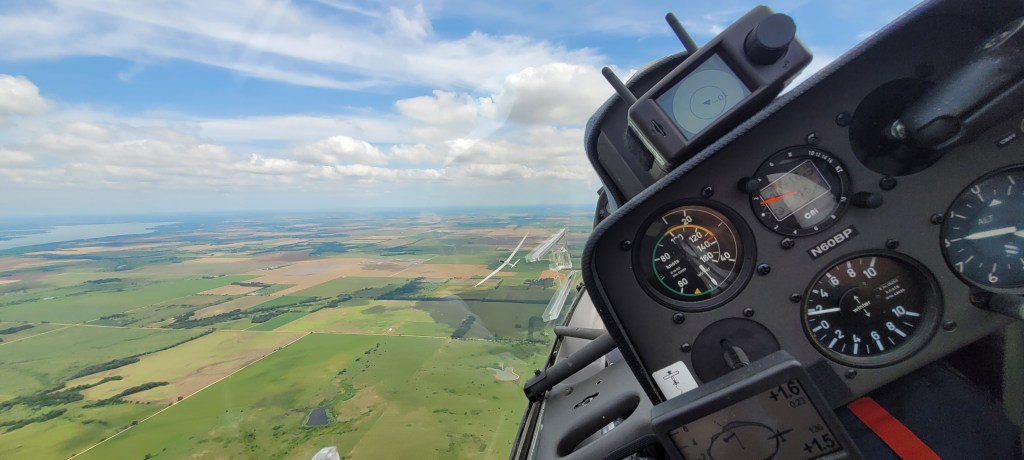
06-27-24  | It’s a Race!

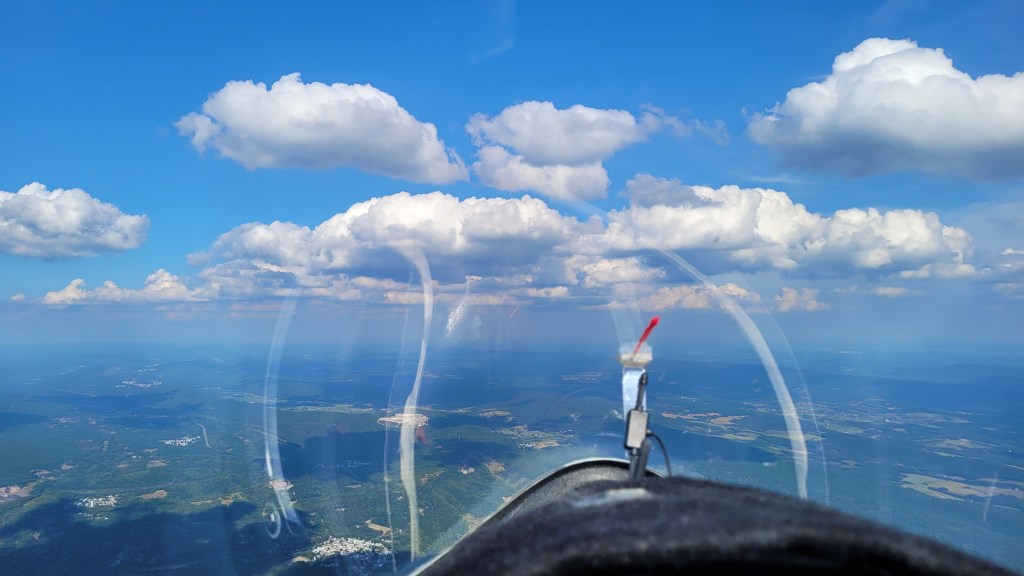
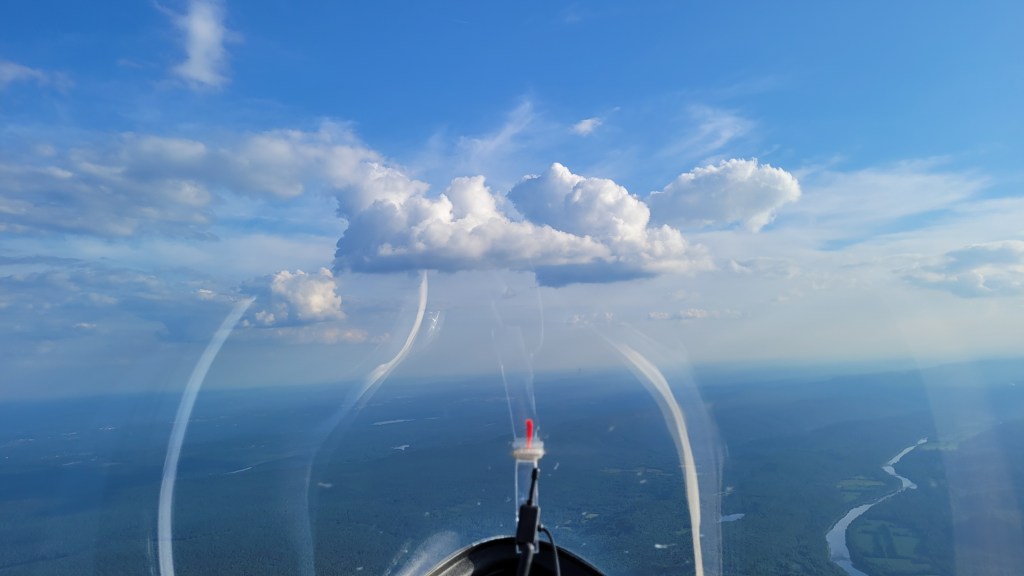
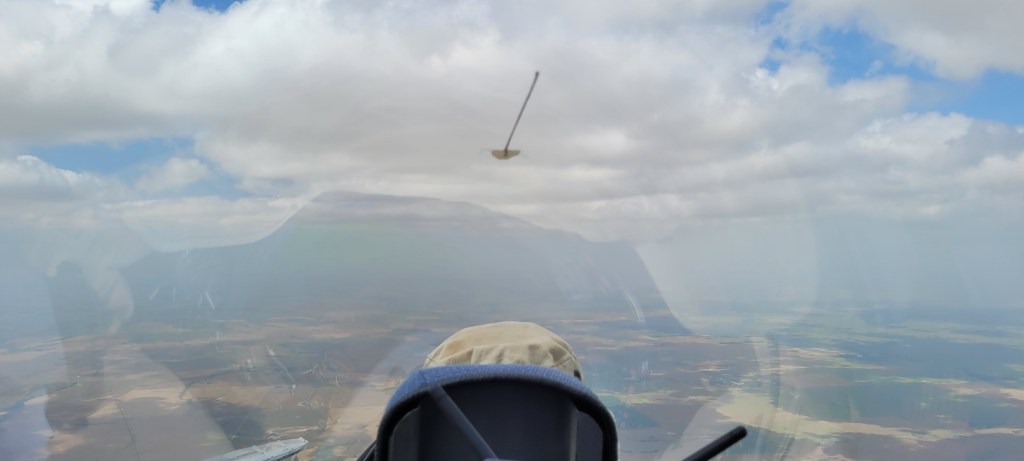
The contest is almost at an end and that means that the time to make points is dwindling. At this stage, points amount to being a certain amount of time ahead or behind another. And today, Noah had his work cut out for him. He was in second place, a little over 60 points behind Mike Sorenson.

My landout on the thunderstorm day ended any hope of me having a reasonable performance here. Going into the last two days, all I’m concerned with is helping Noah get to the top of the podium. To do that, Noah needed to have a clean flight, but make a clean break from Mike. A tie would not serve Noah well going into the last day. We strategized having either an early or late start, whatever it took for him to break out on his own.

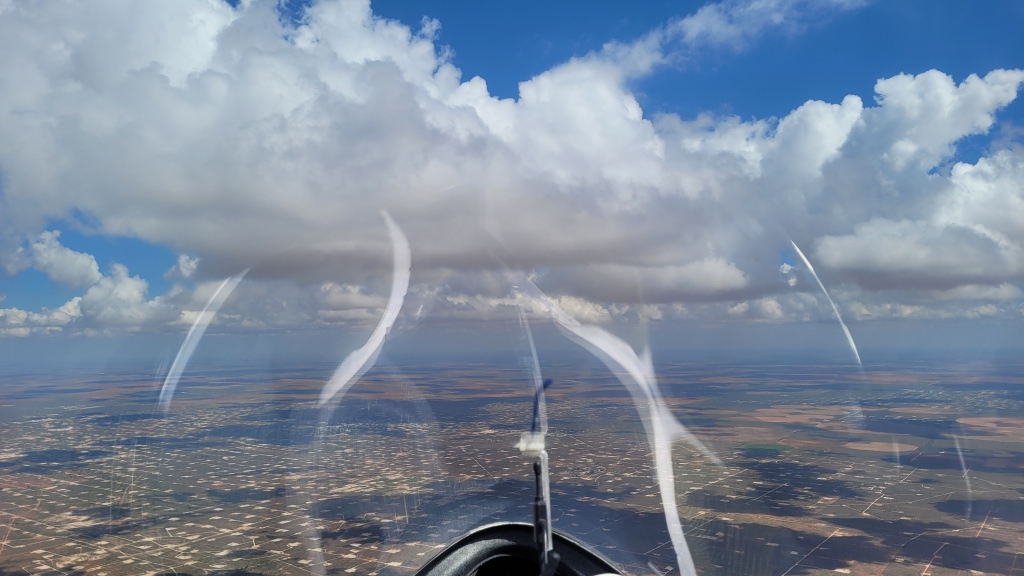
My morning went to pieces. I had trouble the glider and spent all morning getting it ready. It was a bit of a rush to get set up on the grid and be contest ready. I reviewed the assigned task, a nice 217 mile sprint, and the weather on my phone. John Bird also gave us some forecasting advice. The day should peak late, with cloud suck and vertical development. Watch out for the cirrus at the end of the day.

We launched and Noah and I got together. The day was taking a while to cook, likely due to some residual ground moisture from the storms several days ago. Starting early was not the best strategy. We waited under a cloud, and Mike joined us. What to do?

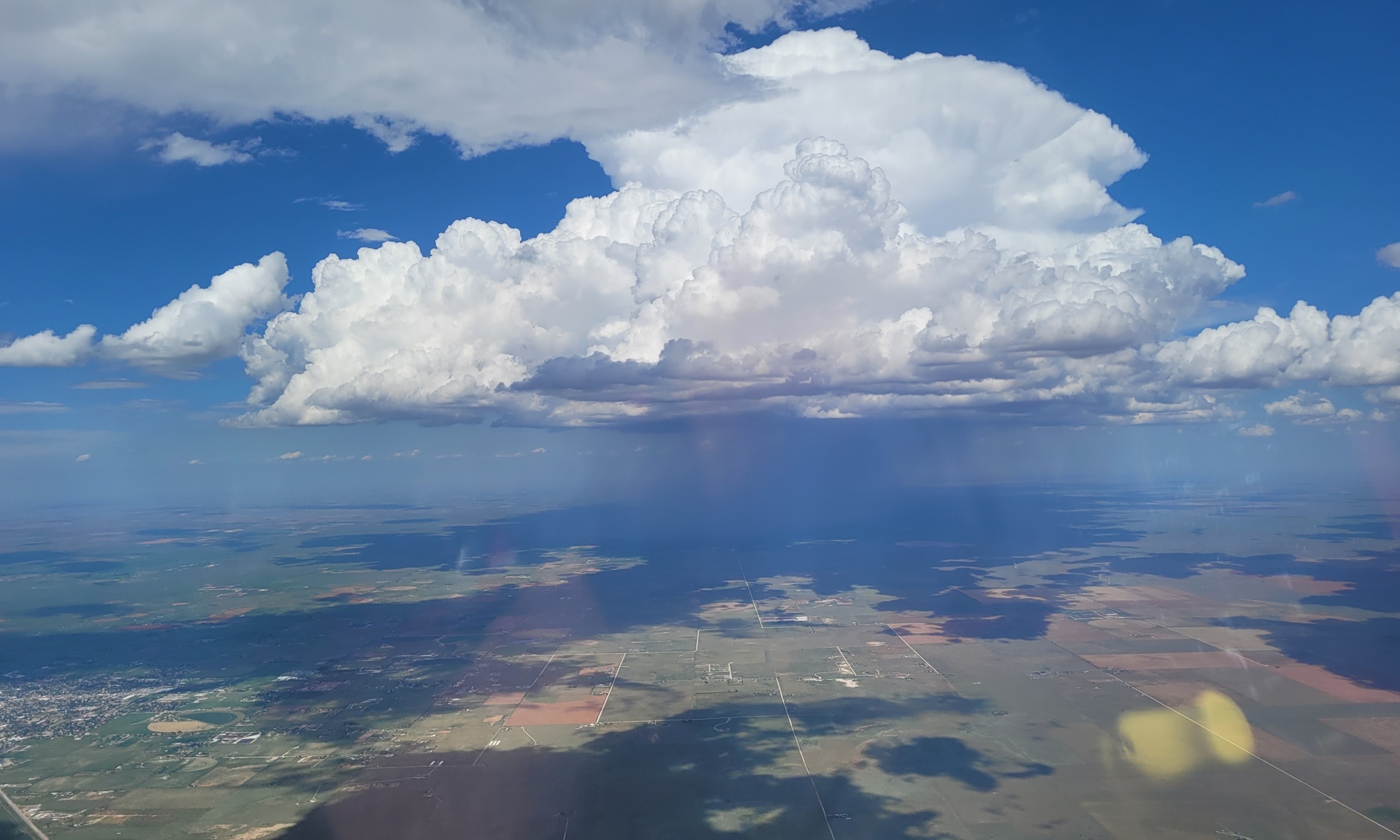
We waited and waited. All of the Club Class and 15 meter glider had gone. The 18 meter task was just about to open. At 2:30pm we headed out to the line. As I turned the line, I saw Mike glimmer two minutes behind us. I smiled, went for the line and then made a hard right back to the cloud that we came from. We created a dilemma for Mike; start now with the prospect of catching some folks ahead, or give chase to us and potentially be dropped behind the pack at the end of the day. Covering several minutes behind is tricky; maybe that cloud several miles from the start won’t cycle in below if he gives chase. In the end, he took the bait and rolled out on task.

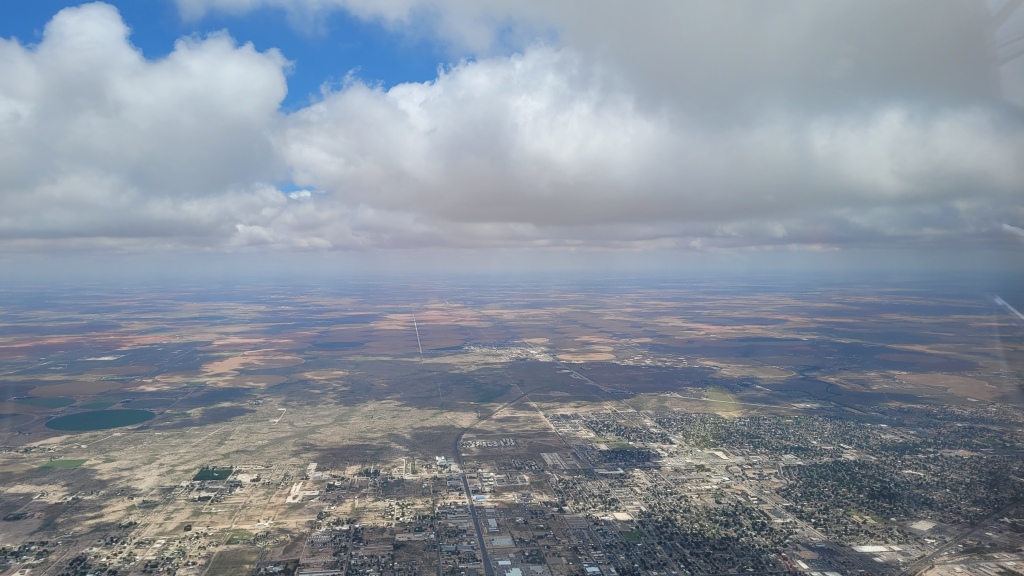
Noah and I peddled hard to get back to the cloud and climbed up. 10 minutes later, we went through the line again, now with the 18 meter gliders just ahead on our left and below. We pressed hard, climbing only in the best lift. We made good time on the downwind leg and drove into a busy thermal close to the first turn. We caught Mike!

At this point, I started to fade. The heat and the morning excitement was getting to me and my performance was dropping off. Noah was now 600ft above, in perfect position with the gaggle. I felt like a spent bicycle racer, having gotten my lead man to where he needed to be. He made his break and I contented myself to simply get around.

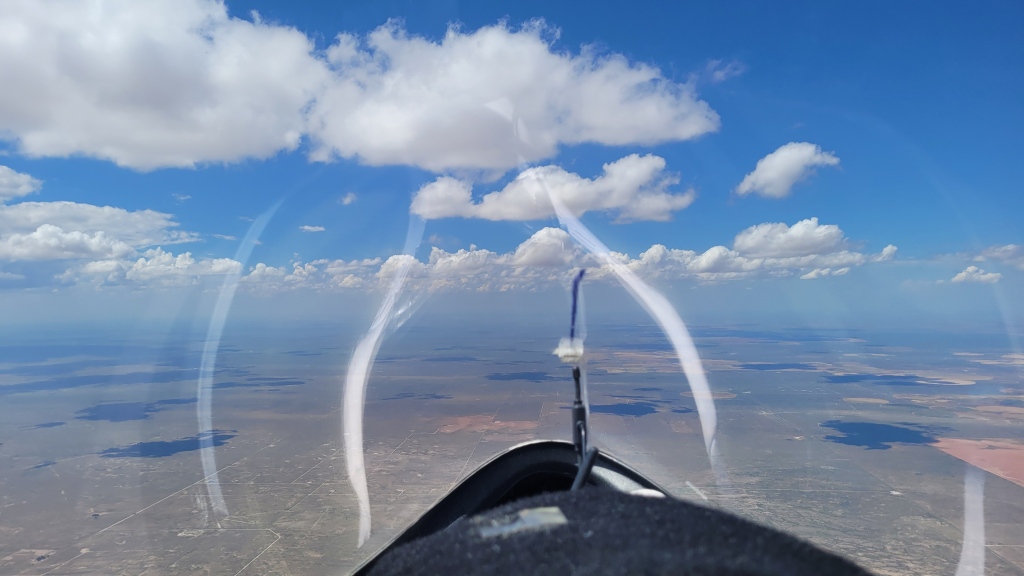
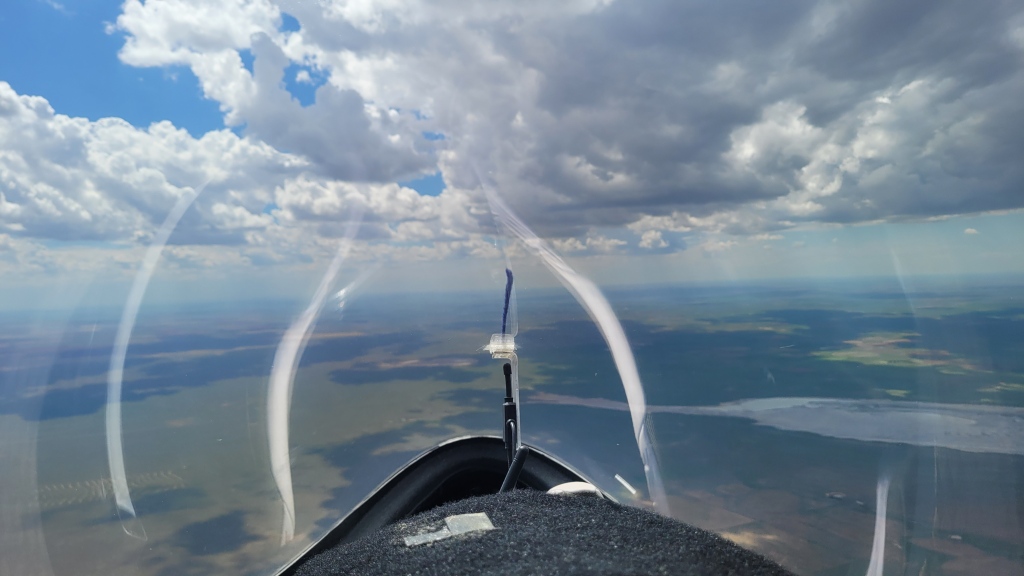
The second leg worked out fine. I took the less travelled line to the left and it did not work as well. I got low approaching the high cirrus rolling in, though I connected, got in and out of the turn and set up for final glide. I got home 15 minute after Noah, about middle of the pack. Noah’s glider was already parked and mostly put away by the time I opened the canopy.

First thing I asked Noah was, “Did you beat Mike home?”

Noah grinned ear to ear and reported that he beat him home by 30 seconds. He got him by a full 10 minutes and was now only three points out of the lead.

A job well done!

06-25-24  | Storms!

Day Five changed character many times. What started out as a cool morning with some mid-level clouds quickly started to bake the pavement. The sky was bright blue and you could feel the wind blast the heat into your face like a hair dryer. I spent my morning reconfiguring the Duckhawk. Some fixed ballast here, less tail weight there and the center of gravity and wing loading was nicely sorted. I looked forward to flying it and seeing if the ship was happier.

The main theme today was when and how would the day develop. The contest administration set shorter tasks with the hope of getting everyone home by 5pm. Storms were expected to develop after then and the idea was to get everyone around and down safely before they blew up.

The day started slowly. The first class had several relights and struggled to climb above release altitude. I figured that the day was delayed somewhat and that a closer to 2:30pm start would work out fine. The 15 meter class launched and the day kicked off. I enjoyed milling around before the start, finally feeling that the glider was set up perfectly. It tracked well in the thermals, responded well to my inputs, and ran much better.

At around 2:20pm, most of the class had went and Noah, Tim and I started.  Much to our mutual surprise, the three of us evaporated into thin air within seconds of starting. We completely lost sight of each other visually or on FLARM and our flights separated for the rest of the day.

I drove out of the gate hard. I figured that the clouds ahead were working well and was keen on getting a solid first climb. Sure enough, 6.5 knots rewarded my good run. I climbed up and drove ahead, catching up to most of the earlier starters. I took the left, much more developed line of clouds, figuring that I had enough room in the second turn area to make my distance. After maxing out the first turn area, I flew toward the towering cumulus line, stopping for 10.5 knots. Safely at cloudbase, I drove off to the back of the second turn area, Jared Graznow (WR)  close behind.

It looked like right at the edge of the turn area that there should be a solid climb on the front side of the towering cu. I found good air, but nothing solid to climb in. I turned and dove off toward the sunny, developing area ahead. Jared connected at that point and our days diverged.

Nonetheless, I found solid lift, picking up to 7 knots. Up to 11,000ft, I saw that the sky ahead was starting to blow up. I thought about my options, seeing that heading east would take me on the wrong side of the storms, the west side was a bit far away to connect with, and gliders and a cloud street mostly straight ahead. I banked on the storms moving east and then the line redeveloping on the back.

After several climbs, I pushed out toward the storm. Even though there were some cumulus clouds, the air was crushed. I kept getting lower and lower. I had glide to Tatum Airport, but with not much extra to spare. About 8 miles out, I pushed the nose down, reconciled to my fate.

About 4 miles from the airport, I got flung into a strong thermal. I started climbing and saw other gliders converge to my area. At this point, the storm on my left and the storm ahead of me were throwing out lightning every 30 seconds to a minute. It occurred to me that I could sit here, work my way up and maybe wait for the storm to pass. But the prospect of being a carbon fiber lightning rod just did not appeal to me. I figured that I could try the far side of Tatum and maybe if there was a strong climb there, I could wrap further west.

There was nothing there. And looking at the menacing storm to the south, I just decided I was done. I pulled out the boards and dumped into Tatum Airport. I was the first to land there, with eight more gliders joining me over the next hour. We ran a fine operation, with each landing glider being pushed off the runway to make room for the next one coming in. Gliders were coming down into airports and fields all over. Around half of the contestants tiptoed their way around the storms, and with others running the gauntlet between some of the cells. Pilots reported experiencing 20-30 knot sink and severe turbulence. A gust front rolled through the Hobbs and many scrambled to get their ships into the box before they were flipped over.

I know of two gliders that had especially interesting retrieves. Niemann Walker had his borrowed Libelle carried out of the field and Andy Brayer’s ASW20 is still stuck in the mud.

After I landed at Tatum, I thought to myself, better to be on the ground not wishing you were in the air, than to be in the air, wishing you were on the ground.

06-24-24 | A Little Better

As the Beatles sang, “It’s getting better all the time!” Day Four was another tricky blue day, but it was the first day where I felt that all the decisions were made correctly.  My execution and thermalling still needs some improvement and hopefully that will be addressed today.

The 15 meter class was up first, which made things considerably less stressful getting up and positioned for the start. After wandering over to the start line, the class was mostly linked together. It was a struggle to climb much above 9,500ft, and looking ahead to the south was not terribly inviting. It is completely unlandable in this direction, with the exception of an abandoned airstrip and an airport at the center of the turn. I was eager to wait for the group to go.

After the task opened, pilots waited and waited. But with the launches rolling quickly, we heard that the 18 meter task was soon to open. With the prospect of more company, I felt the energy of my class perk up. The race was on!

I linked up with Noah and several others. After some false starts, we rolled out on task, dragging several gliders with us. We had a long glide into the blue, settling lower and lower toward the nasty oil derricks. We sampled effectively by raking the air with three gliders abreast. When we would find a thermal, each would turn and we would look over to see who found the better core. Sometimes the solution to tricky air is simply to throw enough gliders at the problem. It usually works.

Much to everyone’s surprise, there were clouds going into the first turn area at Jal. There’s a well known military proverb that, “No plan survives first contact with the enemy.” Well the glider equivalent is, “No plan survives first contact with the clouds.” I figured I would turn early at Jal, but now I found myself with the group driving toward the back of the sector. Seven knots, thank you very much and we rounded the turn at 11,000ft.

Heading toward Brownfield, it became more and more of a struggle. We glided and glided and found nothing. Near Seminole, I saw 5,700ft on the altimeter before we swept into a good thermal. Unfortunately, Noah and the rest of the group hit a better cycle in the bubble and rose up and away. I found myself deposited alone in the blue at the top of the lift.

It is lonely and eerie flying alone in the blue. Clouds breed a certain optimism, probably because they keep your eyes up in the sky. When you’re staring at the ground most of the day, it is much easier to envision yourself somewhere down there, scratching in the dirt.

After rounding the second turn, I saw a wisp form at the edge of the sector. I drove over and found a solid climb. At this point Steve Vihlen (SV) joined me. We worked our way up, punched through the inversion and up to 10,000ft. A nice controlling position for the next leg.

Some gliders were catching up now, notably Dave Leonard in ZL and others in 18 meter. I did not mind; having help in the blue was very helpful. We picked our way through the leg, watching each other center the climbs and move on to the next thermal. A bunch of gliders converged in the third sector at Caprock. It was trivial finding a climb at that point.

Steve had pushed ahead for a while and drove the group. I caught up with him, though picked up a thermal for a couple turns while he pressed ahead. Since it was only 3 knots and I was drifting downwind, I was eager to leave. Figuring that there should be one more solid climb left and I could shadow his course, the risk seemed perfectly worth taking a solid shot for final glide. I pressed ahead.

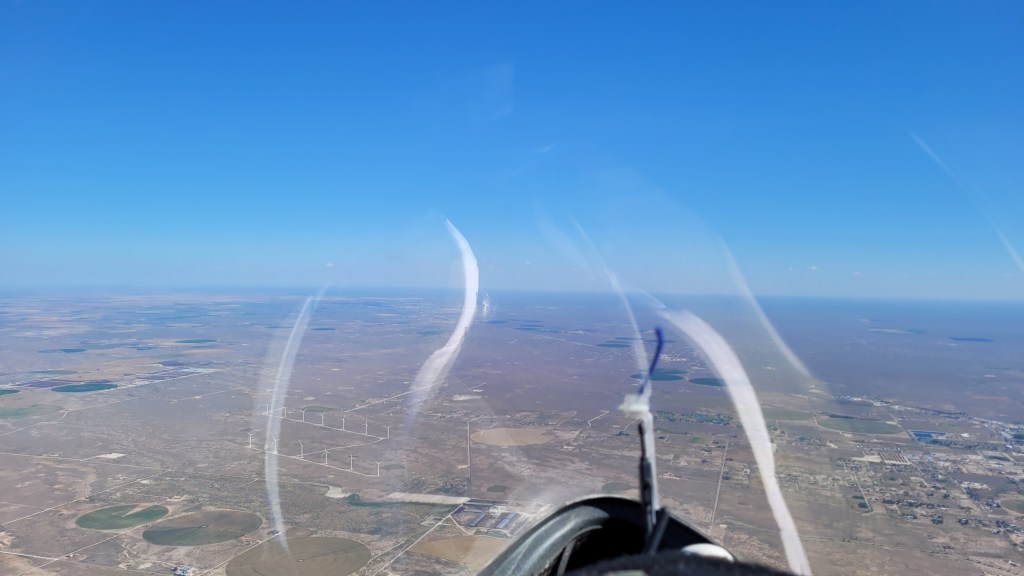
Downwind of the windmills, I felt some burbling. I reckon they are triggering a thermal. I could see Steve wafting left and right and likewise I worked the air upwind. He turns, and I turn and we found a 4.5 knot thermal. We get together, work our way up to a MC 5 final glide and charge off toward the finish line together.

He finished just ahead of me, though we both dropped a lot of people on the last leg. It’s nice when the tricks in the bag work every once in a while.

As far as the soaring, one of the common patterns noticed is that the wind tends to get stronger at lower altitudes, back off, and then get stronger again toward the top of the boundary layer. This C-shaped profile really messes with thermals. When the wind shears, it tumbles the thermal and the thermal does not always survive the shift. The trick was to transition into each respective layer at the right time.

Going into today, my main goal is to get better at thermalling and running. I am satisfied that I am getting back on the ball otherwise. I suspect that the Duckhawk may have been a touch too far aft in C/G and this was making it less efficient in the glides and stalling out the tail in some of the gustier thermals. Today looks stronger, so a more forward center of gravity is probably warranted anyway.

06-23-24 | The Long Glide?

In my first report, I opined whether the past nine years of experience would have helped me figure out Hobbs this time around. So far, the answer seems to be no. The thermals here remain as befuddling to me as they were back then. I feel like flying here I am constantly grasping at each point, always a step or two behind what the air is doing. The Duckhawk is particularly frustrated with me. This is a glider that needs to be flown; she will complain when the pilot does not know what he’s doing. If you anticipate the gust and pull, the glider will get a lot of energy and do great. But if you sort of aimlessly blast around, the ship will lose all the more on the backside of the gusts. It has been very frustrating.

Day Three was interesting as the conditions were to be quite good, but blue for most of the task. Only the leg to the north from Littlefield to Muleshoe was to be in cumulus. Coupled with a 220 mile assigned task to keep all the gliders together, I thought this would finally be a day that would make sense.

Getting up and to the start was much more straightforward today and the gliders merged into a coherent start gaggle. I found Noah and Tim Taylor and we were happy to stick together to play, and watch the others play their start. After losing a cycle and getting a bit lower and watching the other gliders go, we found ourselves a little below the start, but in an excellent starting position. The gaggle was ahead and it invited us to give chase.

We charged off across the start (this time BELOW the speed limit; lesson learned from Day 2) and we picked our way along the blue toward Littlefield. I quickly disconnected from the lift band and watched Noah waft his way up and up, 1000ft above me halfway up the leg. At that point our days diverged and he pressed ahead.

My main goal was to get in a controlling position on the gaggle. Once I hit a 3.5 knot thermal, I threw out the brakes and worked up and up, trying to get higher than the people ahead. Finally, going into the turnpoint things were looking halfway reasonable. I was flying with TT, MB, SV, and FS, and we were making good work of the clouds.

Approaching Muleshoe, I saw the clouds dissipating ahead. I worked my way up to cloudbase with the tailwind, finally well established in the band. We rounded the turn and I worked the east side of the courseline, staying upwind and with the several wisps. One more final climb to 11,000ft and I headed off into the blue with FS and SV.

The air was dead smooth for a while. This is particularly concerning when you’re heading toward what looks like a desolate moonscape. We got lower and lower, and more and more concerned. The gaggle was taking weak thermals, working together to core the scraggly thermals and then moving on to the next whiff. We did this the whole way to Tatum, where we finally connected with a 3.5 knot thermal. Some took it to cloudbase, I worked a bit further and found a somewhat stronger climb. Even with a meaty margin, I got crushed on the final glide. At one point I thought I would come up short and took several turns in 1 knot to just get a bit higher. I then floated my way up a little street and squeaked in above the minimum finish height.

Noah had made it home something like 20 minutes prior. He managed to get connected with the Club Class gaggle and ride the better part of the day home. He’s now first overall, having had an absolutely crushing day. Sylvia Grandstaff also had a great day, sitting several points behind in second overall in Club Class. It’s fun watching them go!

As far as I am concerned, I’ll be satisfied when I no longer feel like I’m flying like a drunken sailor. My current theory is that the thermals here basically refuse to coalesce. In most places thermals organize somewhere between 1000 and 2500ft above the ground or so into a more-or-less coherent core. Here, if this happens at all, it happens closer to 2/3 of the way up the band. This is even the case when the wind is fairly light.

Additionally, at lower altitudes the thermals will still be fairly strong, but they rarely last more than several turns before they start conflicting with a neighboring bubble. The centering and recentering here is unbelievably frustrating. Each turn you have no idea if you’re thermalling badly, or you just need to move 300 yards elsewhere.

All of this is to say, that being lower here is penalized severely. It is kind of like those days where you get cloudsuck and if you stay high and connected that you sail over all, but as you get lower, the band diverges and it can be a struggle to get back. The difference is that here this happens all the time, even with no clouds, and with little wind. If you stay within a 1000ft band, the top of which where the lift starts to weaken quickly, and the bottom where it just starts to halfway organize, then you can float along and periodically pick up a decent thermal. Ideally, it is best to do this while covering others to work the better air and get higher L/D in the glide. This favors “the long glide” approach of yesteryear, where backing off 10-15 knots to give more distance to sample for a better thermal. While the Europeans have soundly rejected this approach and in most places flying faster (in good air) does better, perhaps favoring theories from the 80’s is the way to go in a site that is from the 40’s, flying mostly with pilots born in the 60’s and 70’s.

06-22-24 | Late and Weary

As the days progress, each day is getting hotter and hotter. And out west, this means higher thermals and faster speeds. The big question as far as the weather was concerned was whether the day would be dry and blue or have clouds. If there were clouds, it would be better to go somewhat earlier while they contained more energy and sucked you up to cloudbase. If it was blue, it would be better to go late to catch up to gaggle that would inevitably slow down, struggling to find the lift. I figured it would be blue, so I was not too worried when I was at the very back of the grid of the last class to launch.

Before launch, there was oodles of time to wait around. Even with the 18m class launching at 12pm, it would take at least two hours before I would be up. I stayed at my rented house and moseyed out to the airport. I waited around in the hangar, talked to the folks, even got a professional consultation by Alex Fairbairn. She was more than happy to oblige and educate me about massage therapy techniques as she kept looking over her 6-week-old little girl, Olivia.

Additionally, I had the joy of seeing my good friend John Bird. One of the pilots had disaster strike the preceding day when a strong gust managed to pick up his Libelle and damage the horizontal stabilizer and undercarriage. John Bird also flies a Libelle and generously offered to let the fellow fly it for the rest of the contest. Contests are fun for the flying, but they also bring together new and old friends. It was lovely spending the day and evening with John!

I headed over to the glider and got it ready to go. But much to my surprise, when I did my pre-takeoff checklist, I found my left flaperon was binding. With the towplane whirring, I called a dead stop and got out to see what was going on. It turned out that the flaperon had expanded a fair bit on the baking ramp, and the foam seals at the wingroot got in the way. I got back in and then the rope got stuck under the wheel and back released. Hooked up once more, we were finally on our way.

Time was ticking. The gate was to open in 15 minutes and after release it was a race to find the climb to get connected with the group. I tried here, there, and everywhere and could not find any thermal that was solid enough to climb in. I finally drove off toward the Hobbs delta and got down to 1000ft under a set of gliders. 2 knots, but enough to start working my way up.

The gate opened. Gliders streamed out on course and I was nowhere near 10,000ft. Approaching 3pm, I was still 1300ft below the top of the gate, but I felt like I *had* to go. I pushed over and went to the line, forgetting about the speed limit. Double ouch, taking a speed penalty and a height penalty.

I flew hard. Pushed the airspeed up to 110 knots, intent on running down the gaggle. I found the thermals reasonably enough and worked my way higher and higher in each one. Down on my flarm, I saw TT a half mile off my wingtip passing by. And then ahead a wing flash. VW pulls into a 5 knot thermal at my altitude! I’m thrilled to join and were climb harmoniously together.

He pushes off, and so do I and we’re racing to the back of the first cylinder. By raking the air we found the better lift lines and cored the thermals quicker. After the turn, I dropped off a bit and fell behind. One bad turn and Noah was gone, both visually and on the flarm. I looked ahead and pressed hard, hoping to find him again. The next time I caught a glimpse of him was when I finally hit a 6.5 knot thermal, to see him 700ft above. The rascal!

We parted ways for a while and I raced along the right-hand street. I periodically saw some gliders in the distance, but I was in my own sky. Approaching the second turn, I look over my shoulder and there was Noah again, but now at the same altitude. We tucked in together and worked our way into the turn, just nipping and going.

The time was approaching 6pm and the day was starting to weaken. I was also fading. The heat got to me and I was exhausted. Looking ahead, we needed one more solid climb to get connected and set up for the final glide. Here and there any everywhere, the lift was just not solid anymore. I was willing to settle, but the weaker thermals also had the nasty habit of dying off sooner. Finally, I look above and Noah is 800ft above me, driving into the last sector. Seeing that I was getting closer and closer to the surface of the moon beneath me, I turned tail into the wind, starting to get desperate to connect with the last thermal.

There were some clouds left, but there was less and less to work with. I had glide made to Lovington and I needed around 1000ft to get home. A bad turn here, a bad turn there, but at this point I’d take anything to get home. Finally, a solid 3 knots. Tim Taylor slid in and sailed out above me. As I left the thermal, Noah was off my wingtip. We’re going to get home!

Upon landing and opening the canopy, I took a deep breath and let out a big sigh. My performance was mediocre. Part of it was bad luck getting up on the start, more of it was being stupid and taking a start penalty and having an inefficient final glide. Staying ahead of the heat is also crucial as I was really beat and dehydrated. I spent the rest of the evening chugging water and trying to get my body to recover. Hopefully on Day 3 I’ll do better on all accounts.

06-21-24 | Down at the Crossroads

It has been wild times. My baby daughter, Anna, has just turned a year old. She is absolutely adorable and has rightfully consumed my attention. Additionally, I just defended and submitted my dissertation toward my PhD and have been on the job search. And with that comes the prospect of selling a house and moving on. It’s like you blink and all of a sudden each day you’re staring down a list of 20 items, 10 of which are urgent and 10 that are important, yet intractable. It’s easy to feel like you’re drowning, but step by step, day by day everything seems to work out.

As far as my writing is concerned, writing professionally seems to suck the wind out of my sails. Research in a PhD is measured by publications, and I currently have three in the queue at various stages of submission and revision. Having taken the rest day to get ahead on my writing, I finally feel like I have cleared enough mental bandwidth to write for fun.

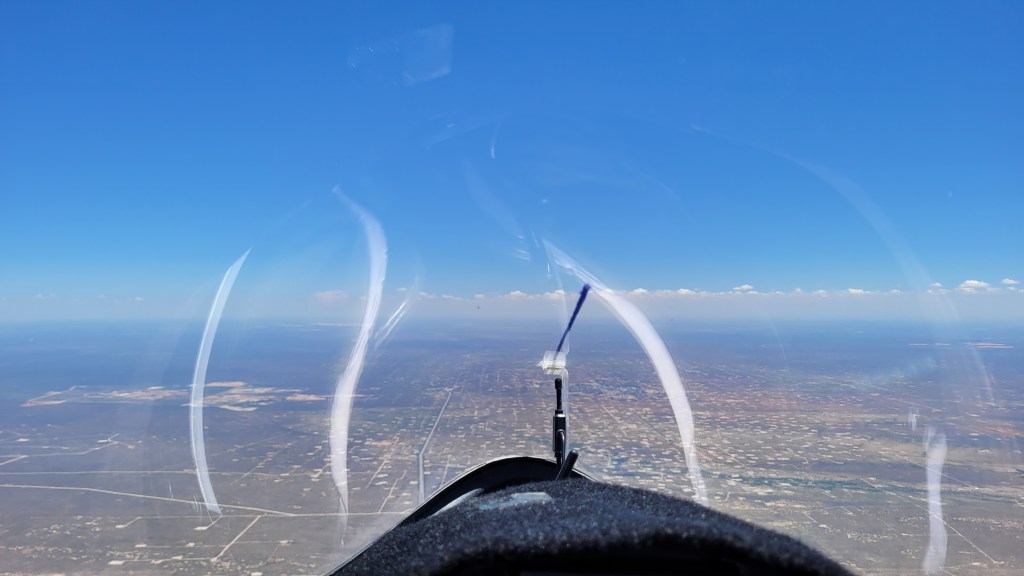
So here we are in Hobbs, New Mexico. I’ve been here nine years ago at the Club Class Nationals and the biggest thing I remember about the weather is that we flew almost every day and that none of the thermals ever made sense to me. The cores are often disorganized and volatile. There can be clouds, but none of them seem to work. It was one of the most frustrating, befuddling sites I had ever flown at. It’s an open question if I had learned anything in the past nine years to get a better sense of how to approach flying at this place. I was definitively reminded about how befuddling it is for me when I landed out on the first practice day!

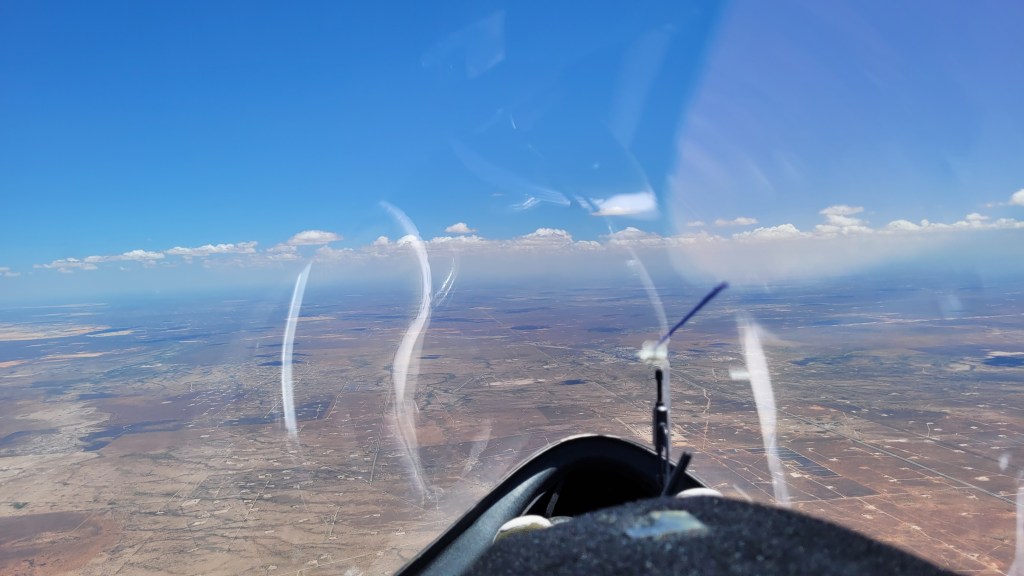
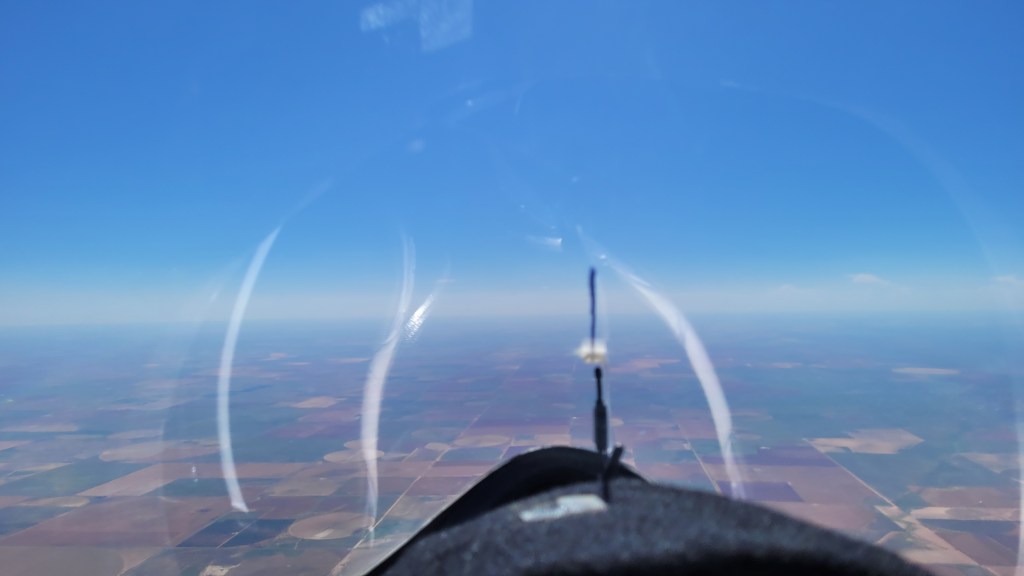
The site itself is tucked away on the border of New Mexico and Texas. The border is fairly apparent as on the Texas side there are huge fields and on the New Mexico side, mostly oil wells fading into the desert. One curiosity of flying near the border is that we are on the boundary of Mountain and Central Time. This kind of throws off some of the intuitions about the timing of the day, not to mention your cellphone if you happen to be on one side of the line or the other.

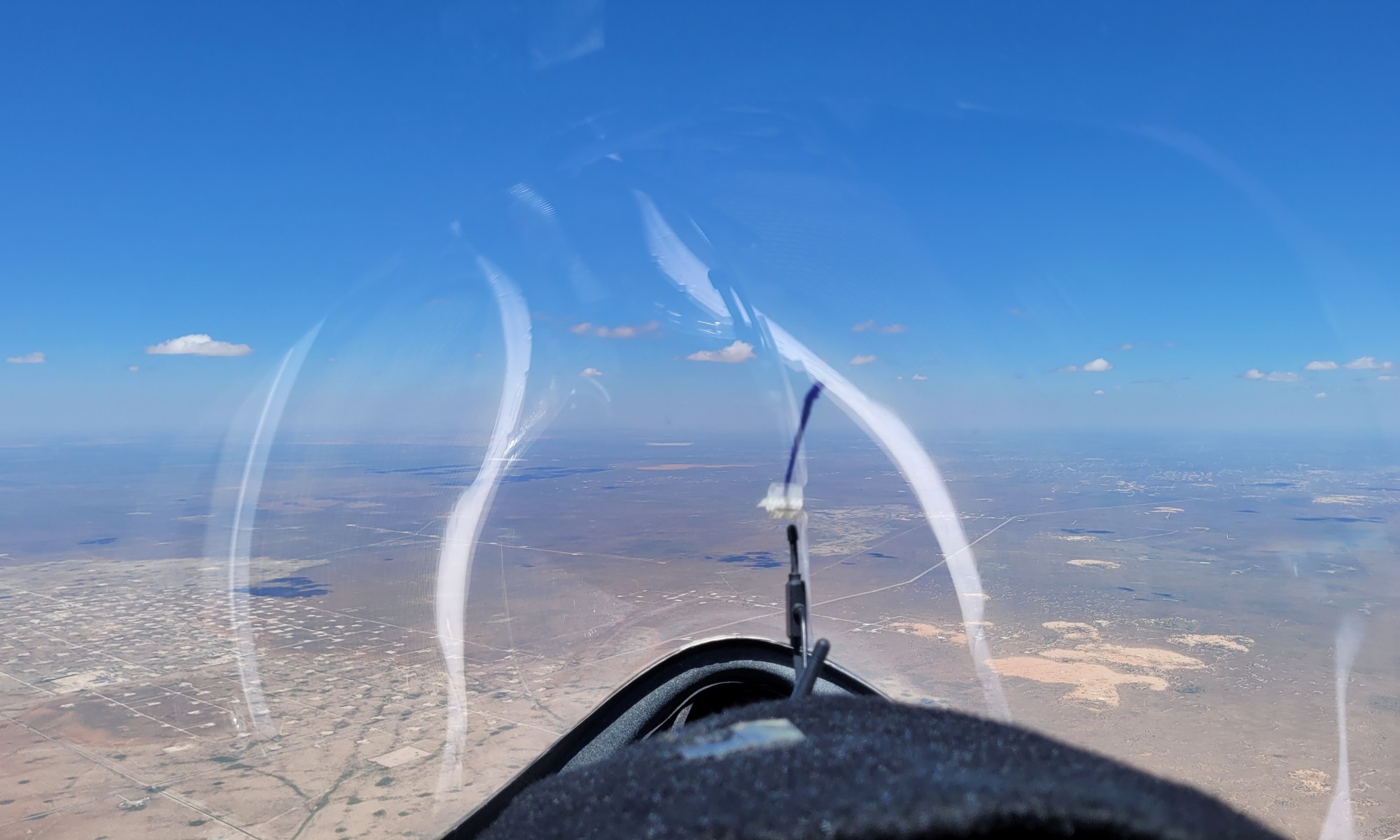
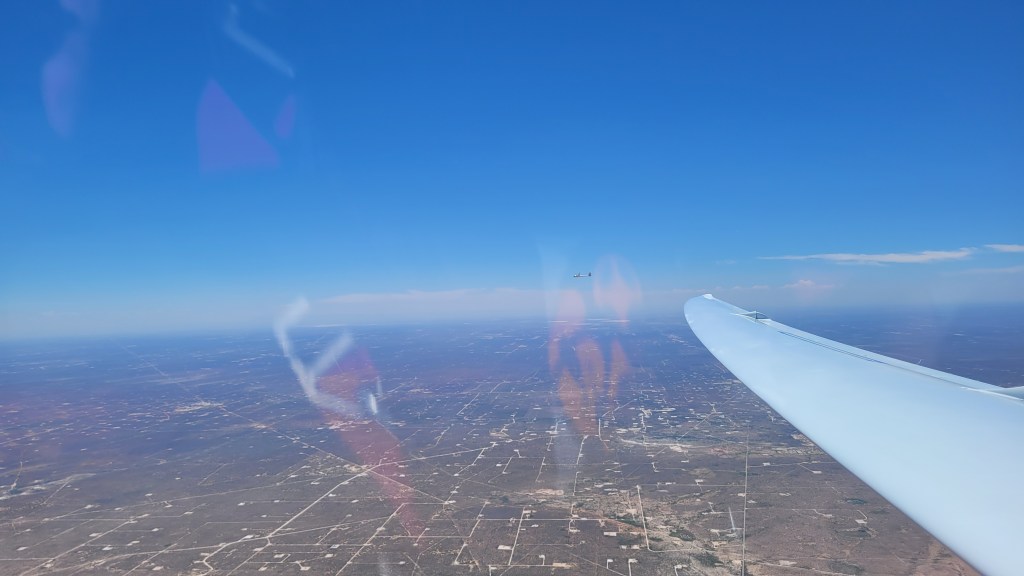
The landscape here is a bit sad. North and south of the airport is littered with oil derricks. The oil pads on the desert are crisscrossed with random arrays of powerlines, oil tanks, and pipelines. The older derricks kind of look like a metallic, monstrous cow, sucking up the oil from the Permian basin underneath. The newer derricks look like cleaner, vertical posts. The upward and downward action on these derricks seems to make the figurative action of raping the earth a bit literal.

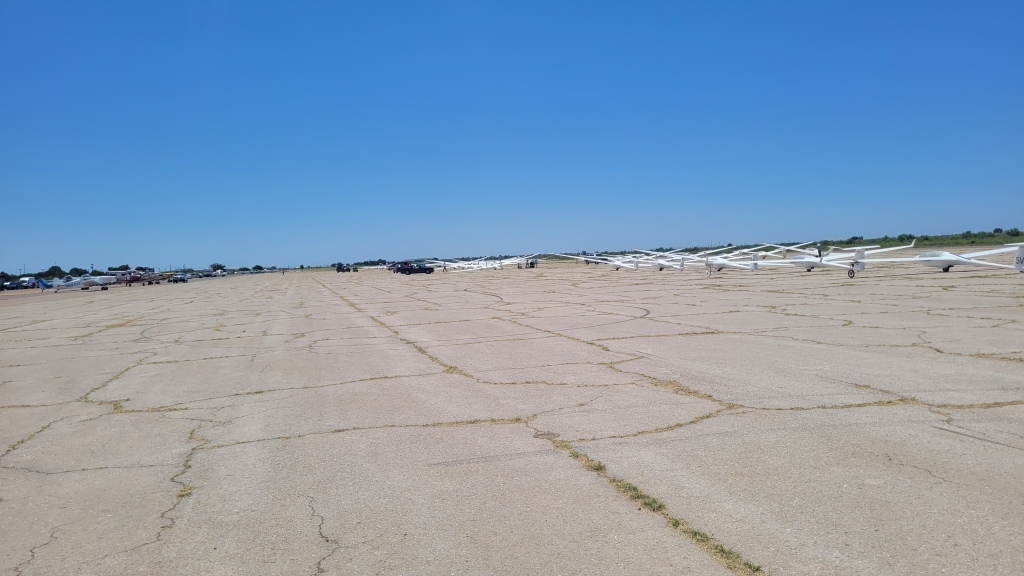
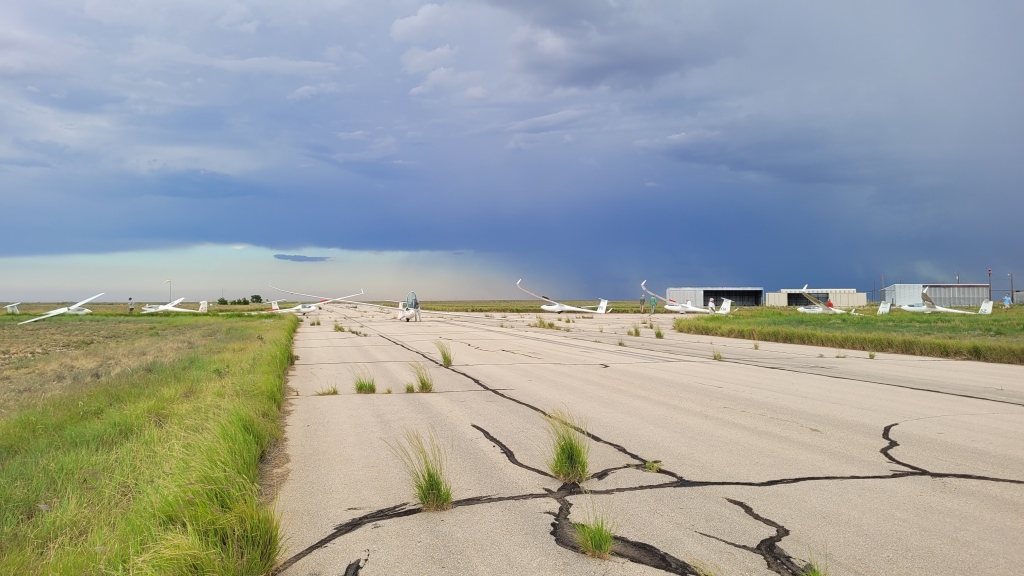
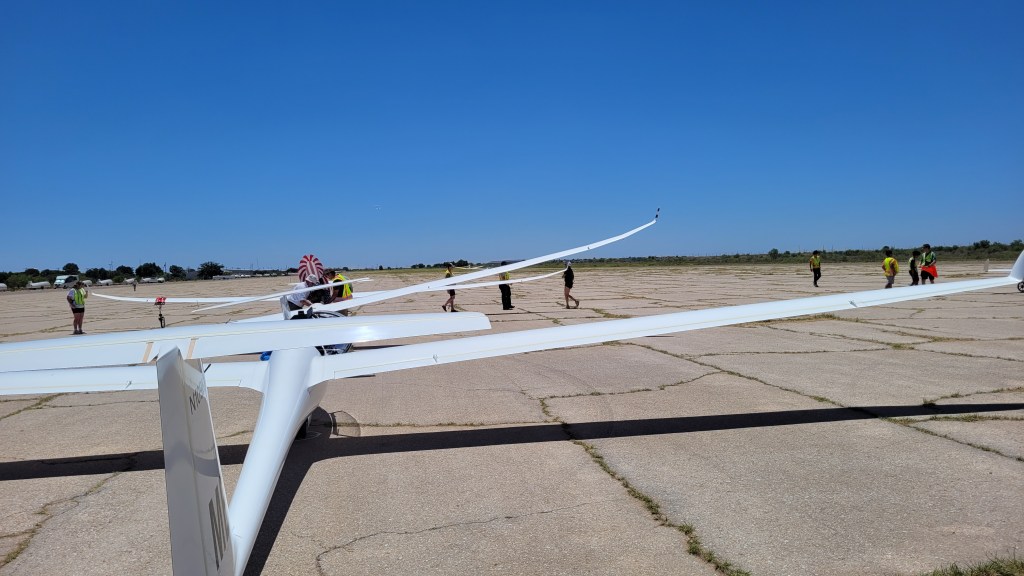
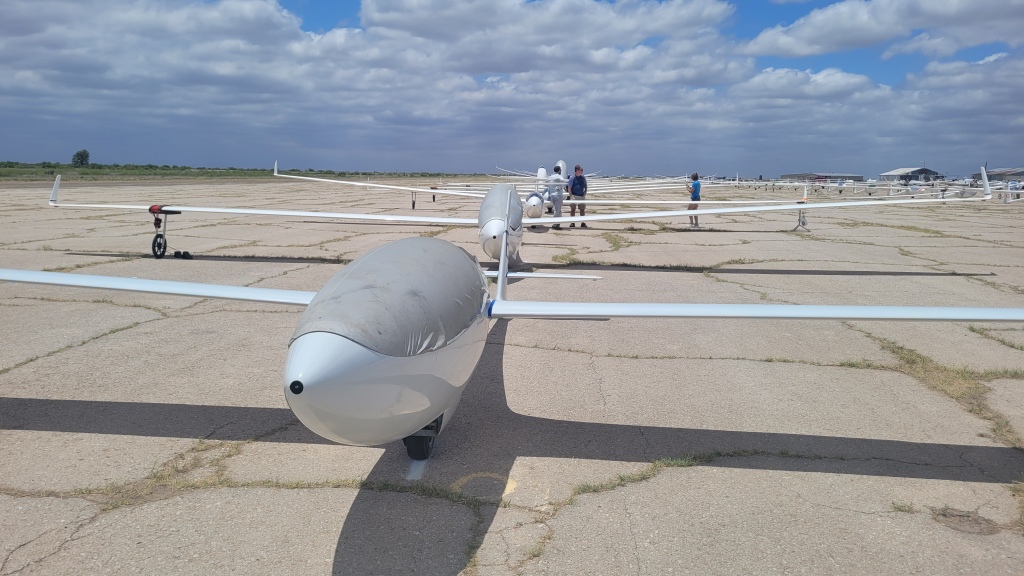
Hobbs Airport (also known as Industrial) is a WWII B-17 bomber base. Over the years the airport has been transformed by the town into an industrial park, drag strip, and even a prison. The north and west sections remain an airport, though there are only several hangars and little continuous activity. Most of the airport has deteriorated, though the huge ramp and sections of the paralleling runway remain in good shape. The cross runway is also landable if you mind some of the potholes and rough sections. Nonetheless, the activity largely happens on the ramp, with the gliders parked along the perimeter, and the gridding and launching happening down the middle.

Today was our first contest day. The weather was dicey for a bit, with cloud cover in the morning and a forecast for clouds that hardly rose much more than 4000ft above the ground. There was high cloud cover forecasted to roll in from the west to east, suggesting that the day would shut down early. Today seemed like a day to be conservative, go early, and get home. Few contests are won on the first day, but many can be lost.

I was at the very front of the grid and ready to launch at 12:30pm. Looking at the cumulus above, it was not too concerned with sticking. The main challenge after release was to push into the 15-20 knot headwind and get positioned relative to the start. I ended up driving low to catch a thermal, tucking into the airspace of the neighboring airport. The controller was friendly enough, and I slowly worked my way up, while drifting downwind, correcting back upwind, and repeating the process. Several iterations later, I was at cloudbase, vents open and going around in circles, waiting for the gate to open.

The sky on courseline looked somewhat foreboding. It did not look like a day to linger. So when the gate opened and Tim Taylor was nearby, I figured it was time to go. He looked willing to oblige, and we left on course together.

We had a great run, weaving to and fro along the cloudstreet, making an excellent glide the downwind street. But then we got lower and lower, and the clouds ahead got darker and darker. The oil wells here simply turned into a sandy no-mans-land. Finally, we were down to 1300ft above the ground and I felt my neck pivoting towards Tatum Airport. I’m rapidly running out of cards to play here.

Somewhere around this time, I realized that the turnpoint ahead was “Crossroads” and I just could not help hearing Eric Clapton singing, “Went down to the crossroads… fell down on my knees! Asked the Lord above for mercy….Take me, if you please!”

We individually found our climbs, though mine was a weak 1.3 knots for five minutes. Best to stick with it and console myself that at least I was drifting downwind toward the first turnpoint. Right as it organized into a round three knots, several other gliders joined me. Finally back at cloudbase, time to get back in the business of racing.

Shortly thereafter, I look over and saw Noah Reitter pull in alongside me. The rascal mowed me down on the first leg, but boy is it great to have a friend to play with! I eagerly got on station on his left wing and we raced ahead.

We went fairly deep into Crossroads and worked the street back upwind. The idea was to nip the second sector and position ourselves to go as little as possible into the third. Pushing upwind with a buddy was very nice. We made quick work of the tricky bubbles and mostly stayed connected as we were bucking the headwind. Going into the third turn, to our surprise the conditions got stronger than weaker. We rolled into a 7 knot thermal and just kept driving and driving into the turnpoint.

I looked over at my computer and realized that it was getting time to turn to get home at minimum time. So when I had a good bead on abandoned, I looked over at Noah and gave him a salute, and banked the Duckhawk over hard to head toward Abandoned, the final steering turn. Figuring that the day was on, I drove hard, looking for my final climb.

Normally, taking a bit more sporting risk when the day is cooking and you’re looking for one more climb is a pretty reasonable bet. Not this time. I drove right out of the band and could not find a round thermal to save my life. I missed having a buddy to help me out here! Out of options again, I parked in two knots and drifted toward the back of the sector. When it petered out 1000ft below glide, I pushed upwind to slam into a 7 knotter. How frustrating! Having climbed up there, I drove toward the finish with a vengeance having lost 8 minutes on my flight by stepping into that hole.

After beating myself up the whole way back home, I was happy to finish and be in a position to fight on another day. But the frustrations ceased as I entered the pattern to land. It’s a bit surreal flying in such an expansive concrete space. Once you turn final, it’s hard not to glance over your shoulder at all the neatly spaced gliders and the hubbub of activity as you’re whizzing by. But then you must look straight, hold the glider off, make a nice landing and then taxi off right to your spot. Pull open the canopy, pull the glider forward 10 feet and you’re done for the day!

Does Time Heal All Wounds?

It’s been a quiet year on my blog. Many folks may wonder why this is the case, but those who are close to me know that I’ve had some monumental life events that have been occupying my mind. On the positive side, my wife and I now have a lovely daughter, Anna. She’s now nearly four months and is an absolute delight. My whole life has transformed around my baby girl and soaring has been naturally put on the backburner. I have also entered my fifth and last year of my PhD, so my research and writing demands have increased considerably, causing my enthusiasm for “fun” writing to be diminished.

But there has also been a negative side to my absence – as many of you know, I had a very traumatic experience in a sailplane last year, when I crashed an Aero Club Albatross 2-33a during an off-field landing in the 2022 Little Guys Meet that I had organized. Although both my passenger and I have emerged from the crash physically intact, I have spent a large part of the past year wrestling with the more invisible mental and emotional wounds that have been much slower to heal. It has taken me a long time to be in the right mental space to finally write about the events leading to and following my crash, and I am now ready to share my thoughts and experiences in the hope that my lessons learned can be in service to others. I will first recount the accident as I remember it, and then I will delve into my reflections and lessons learned.

The Crash

Going into the Little Guys Meet, I wanted to participate from the angle of helping coach club members who were new to contest soaring. During the practice day of the meet, I flew the club Grob with several visiting pilots to introduce them to the area. I chose to drive back home to Philadelphia that night and then return to Blairstown early the next morning for the first contest day. I was tired, fatigued, and stressed and there was a lot of logistics to manage as Contest Manager. Early in the day, I flew twice with a young club member and fell out. Later in the day, the thermal conditions cycled in (interpreted generously). In the 2-33, we were flying at about 4000ft MSL, 3,500ft above the valley and 2,500ft above the ridge. The thermals for a short while were consistent and the wind shifted into an oblique, but favorable angle to the ridge. The task required going around four miles beyond the Delaware Water Gap, the last place where I was in gliding distance of the airport.

Surely the conditions would allow going out, finding a single thermal, and coming back to this spot? Besides, I was the task advisor; I noted to myself, to the contest director, and to everyone else that the conditions should support the task. There’s a level of ego involved when you’re the one that says it is doable, surely you can’t just put your tail between your legs and admit defeat? And looking ahead, the weather should hold for a while yet; it was sunny and there are a couple cumulus clouds ahead.

The troubling bit was that there are only two adequate landable options for this short foray. The first was the pumphouse field just below me. This field was challenged by the fact it had three pumphouses, each with a powerline across the field. The landable portion was in the first half, between the first and second pumphouse as the distance between the second and third pumphouse was too marginal to attempt an approach and landing.  Several pilots had landed in the field in the past, I had walked the field twice and flown over it multiple times in recent flights. My visual inspection confirmed my past judgment that it was a viable out in case I got into trouble. The second field was the hang glider Landing Zone at the base of Kirk Ridge, a somewhat larger square-like field at the base of the eponymous hang glider launch site. Otherwise, it was a sea of trees and occasional fields that would barely qualify as marginal for an off-field landing.

As I glided toward the turnpoint, my judgment of the conditions was quickly put to the test. The clouds did not work and I was rapidly losing altitude. As I approached the hang glider Landing Zone, I maintained enough height to make the field behind me. Upon inspection, the field looked landable. I rounded the turn and circled several times in a weak thermal.

Looking back to the northeast, surely the ridge could trigger a thermal? It was sunny yet and I had a quartering tailwind. All I needed was to find a bubble that would gently rise as I would drift with the wind back to the Delaware Water Gap. I still had the Pumphouse Field in glide, and so I left the Landing Zone and flew back along the ridge.

There were no thermals to be found. One or two short beats along the ridge diminished my sink rate, though the lift was not enough to sustain me. At ridge top, I conceded it was time to land out and left to the Pumphouse Field.

The situation rapidly fell apart as I approached the field. Much to my surprise, in the intervening ten minutes since I had inspected the field, a 1-26 had landed there. I had flown with this pilot multiple times and had briefed him about this critical field in an otherwise tricky area, and he successfully completed his first off-field landing into it at that point. The trouble for me was that he was parked pretty much in the middle of an otherwise fairly narrow field. I judged that I could not land short of him, or safely to his sides.

With precious seconds ticking and the situation rapidly heating up, I judged that my best course of action was to over-fly the 1-26, duck down and get under the second powerline. On final, I told my pilot passenger, “There are wires to worry about in this field” and set up for a challenging approach.

It Falls Apart

The sun is shining right into the canopy and my eyes are fixed on the 1-26. The 1-26 pilot notices us on approach and runs to the front of the glider, trying to push it out of the way. I am worried about getting too close to him. My left hand is gripping the spoiler and my right foot is primed to swing into a hard slip. Then my passenger nervously interjects,

“POWERLINE!!! POWERLINE!!! POWERLINE!!!”

My eyes jerk up and I squint ahead. I instinctively back off the divebrake and trim for speed to buy myself some time to figure out what to do. Then I see the black line flash into view.

I desperately haul back on the stick.

The following episode is blurry. I hear a loud kapow as we impact the powerline. I feel the cable press across my neck like someone running their fist across my jugular, then over my cheek, and up and across my ear. The glider is still airborne, but it is no longer flying.  The controls are limp as I feebly put in right rudder and left aileron. The left wing just keeps dropping and dropping.

The left wing hits the ground first and then the nose at about a 30-degree angle. I remember feeling surprised that it did not hurt when the nose hit the ground. But just as quickly as that thought ended, the rotation began, and I slammed across the right side of the glider as it pirouetted 180 degrees to its initial direction.

As the cloud of dust settles, I ask my passenger if he was OK. He is in a state of shock, but responds that he was OK. I look left and right and could see the powerline wrapped up in the glider. I take about ten seconds to reevaluate the situation, an eternity when you’re hopped up on adrenaline, and decide to evacuate the glider in the possibility that we become fried after grounding the wire. Since the right door is obstructed by the wire, I open up the left window and climb out. I then got my passenger out and laid him on the ground.

Aftermath

My passenger described feeling back pain. I gave him water, instructed him to remain still, and I coordinated the emergency response. The 1-26 pilot came running over, distraught. I assigned him the responsibility of organizing the retrieves. My mind was hazy, albeit focused on the immediate task of ensuring that my passenger was passed off safely to emergency services. There was just an almost imperceptible, but momentary difficulty in expressing the words “I crashed” when I called up my wife, who promptly got in a car and headed over to the field from Philadelphia. In the subsequent whirlwind of activity, all I concerned myself with was staying with my passenger. Once he was in the ambulance and the doors were closed, my day was over.

In the immediate aftermath, there were several people that were especially supportive. Of the people on the field, Paul Harris and Philip DuPlessis took a moment to triage the situation and make sure I was OK, I really appreciated that. On the way home, I gave a call to Phil Jones, a former club pilot, and a working therapist who has helped people work through and make sense of accidents. The immediate conversation was helpful along with subsequent ones in trying to mitigate the emotional trauma.

Once I was home, I remembered that once the shock wears off, the body will start to hurt. I started taking Aleve and Tylenol in consistent doses in that anticipation. I managed to sleep some through the night, though the mental simulations kept going on a loop, trying to make sense of what had happened.

The sequence all made sense, except the part where I “forgot” about the powerline. I could not fathom how it was possible when I knew it was there, that I still managed to hit it. The piece that came a little later was that the unfortunate distraction by my passenger pulled me out of my intended sequence of slipping down and over the glider in the field. The thing I intended to do, and the only thing I could do was to focus on the 1-26 as my aim point and then execute my approach. In my mind, there was no powerline, because the powerline was not the problem, the 1-26 was the problem. If I could simply get over the 1-26 and get down, then the situation would be solved. My passenger unintentionally made the powerline the main problem and when I tried to take a moment or two to recalibrate, I no longer had time or mental capacity to solve that problem.

Lessons Learned

In looking at the broader picture, I want to first emphatically state that I do not put any blame for the accident on my passenger or the 1-26 pilot, or anyone else other than myself. They both did what was reasonable and safe for them to do and they tried their best in their situations.

It was readily apparent to me in retrospect that I should not have attempted the task in a 2-33. Beyond being in the backseat with limited visibility, in a glider that is heavy and not very maneuverable, there is an added responsibility in ensuring the safety of the passenger. Even beyond how that should adjust general decision making, there is an added cognitive load of dealing with another person that complicates things in an emergency.  Professional pilots spend a lot of time and energy training and developing systems and procedures such that two pilots are more than the sum of their parts in emergencies. As glider pilots, we don’t do that, so in “hot” emergencies, we should assume that a second person increases risk in that situation rather than decreases it. After the accident, my risk tolerances as far as flying in a two-seater in an instructional or coaching capacity have very strongly adjusted. One specific example of this is that I am much less willing to be in an off-field landing situation short of “good” airports or “great” fields when I am responsible for someone else’s safety.  

Naturally, there are a million contributing variables to any outcome. The most notable one here is that I misjudged the conditions. There are times when the thermal conditions at the spot are pretty low, but the thermals remain consistent along the ridge. I felt that the cycle was still on the upswing, whereas in fact it had already peaked when I made the decision to go.

With respect to the landing options, they were adequate, but just barely so. Once you introduce other complications, these options become marginal or unmanageable very quickly. On the one hand, it is possible to say that we should not consider such landing options as adequate. On the other, doing so precludes the ability to fly in that area, which is an area we routinely soar out of Blairstown. Blairstown is a technical site and some areas are simply tricky. I compensated for that through extensive local knowledge. The part that yielded the outcome was not, in fact, that there was anything “wrong” with the field; the 1-26 pilot clearly demonstrated that when he made a safe landout. The main issue was that the field became unusable in the ten minutes since I had scoped it out.

Among the other contributing variables were fatigue and pressure, both internal and external, to attempt the task. I was the contest manager and a task advisor. The following day was not likely to be taskable, so we were looking at the whole fun meet being washed out. So, there was a degree of pressure and ego wrapped up in showing that in fact the task was doable. It was not that I cared about the points or winning; if I cared about winning, I would have flown the Duckhawk instead. While I don’t feel that the pressure to Go was an overriding variable, it was one of the factors that contributed to the outcome.

In the months that followed, I nursed my wounds, physically and emotionally. Physically, the muscles on the right side of my body tightened up from the bruising. I went through extensive physical therapy to regain mobility in my neck, and I am still only about 90 percent of where I was when I was healthy. Emotionally, I was wrecked by the accident. It was completely apparent to me that I was a millimeter from bleeding out to death. I feel as though that I exist in a quantum state, one which died at that scene and one which exists in this place of writing. The feelings associated with that are bewildering, in negotiating the joys of being alive, with the stark reminder of the fleetingness of our existence. It could be described as leaving a sort of exoskeleton at the site of the wreck, with a degree of freedom in knowing that every day that comes after is a gift.

With respect to my personal attitudes toward soaring, I had to navigate two unsavory thoughts. The first was that my accident was entirely a product of bad luck. The trouble is that accepting this explanation would be to accept that the risk in the sport is uncontrollable. When you’re married and have a baby, this is an unacceptable feeling. The second is that my accident was entirely a product of bad judgment. The difficulty here is that to accept this would be to excise the things I love about the sport. Ridge soaring, competitions, wave, badge and records, along with novel and interesting distance flights are the kinds of things that motivate me. I am not at all interested in becoming a “gentleman” glider pilot that shows up to the airport, floats around the patch, and lands and drinks beer with the buddies. Sure, when I’m not all that proficient as I am occupied with more important life goals than soaring, I am not going to go off and fly gliders to the limits. But that fundamental machinery that is built on those experiences is still there. It’s the machinery that made me a national champion, holder of a world record and several national records, four-time member of the US Team, and the first person to do a 1000km flight in a 1-26.

On a personal basis, I reconcile these two unsavory thoughts by saying that there is truth to both, but that the combination of both is what makes the truth. When you fly a glider, you cannot control all outcomes; it’s inherent to the sport. If you get caught with your pants down when you’re low, there is little to no recourse as to what you can do. That risk is always there, and at some level it is also what makes the sport real. I have over 2000 hours in Condor, but none of those hours were as good as being up there and actually flying. The risk is also somewhat mitigated through risk tolerances and judgment. On this flight, I made mistakes, though I don’t feel that my choices were wholly unreasonable either. I methodically went through my decisions, and then the situation was not as I expected it. In accepting this explanation, I have to accept that there is a level of risk that I cannot control for each flight and that it could still kill me. In the months since, I have negotiated these thoughts and have accepted that the risk of the sport is worth the wonder and joy that it brings. The means and manner by which I go about the sport, that fluctuates based on where I am at in my life and my flying.

Unfortunately, others were less supportive of my process of reintegration within the sport. Aero Club Albatross, through the Safety Committee, grounded me after the accident. Their report concluded that the fundamental error was the Go/No-Go decision of going cross country at the Delaware Water Gap. The Safety Committee then recommended suspending my cross country privileges pending extensive reeducation and that the fundamental problem in flying was my Aeronautical Decision Making (ADM), especially as it relates to ridge flying, badges/records, and competitions. The ACA Board of Directors accepted their judgment, although softened the “punishment” by taking out the provision that my cross-country privileges were to be suspended. At a subsequent awards banquet, I was mockingly “awarded” the Dodo Award for nearly dying. One Safety Committee member explicitly advised me to “lay low” for a while, and to get my Flight Review completed elsewhere.

It was readily apparent to me that the club that I had grown up in was not going to support me through my accident. Instead of helping me get back on my feet, there was much greater interest in tying the accident to past grievances and to squash any future sporting goals. At best, my soaring would be tolerated rather than supported. And certainly, if I had any other kind of incident or accident in the future, I could probably expect much worse from the organization. While I am not entitled to the club’s support, there is a strong bitterness that stemmed from the organization’s response. The reason I was flying the old 2-33 to try to help the club. This was not because I have a strong intrinsic desire to fly around in an old, crappy glider, but because I feel a strong desire to grow our sport and support incoming pilots. Instead of offering me a hand to help me up after the accident, I felt constantly pushed down by the club members responsible for the organization’s official decision making. These are the principal reasons I am no longer an active member of Aero Club Albatross.

Since then, I have found extensive support outside of my former club. For one, David Bradley at Beltzville Soaring Club has been very welcoming. He has done my flight review, helped me get back into flying with his Pegasus and has been gracious in letting me fly his J-4 Cub. Michael Opitz lent me his Discus2b to fly at the Dansville Club Class Nationals. It is thanks to these wonderful folks that I am back in the sport.
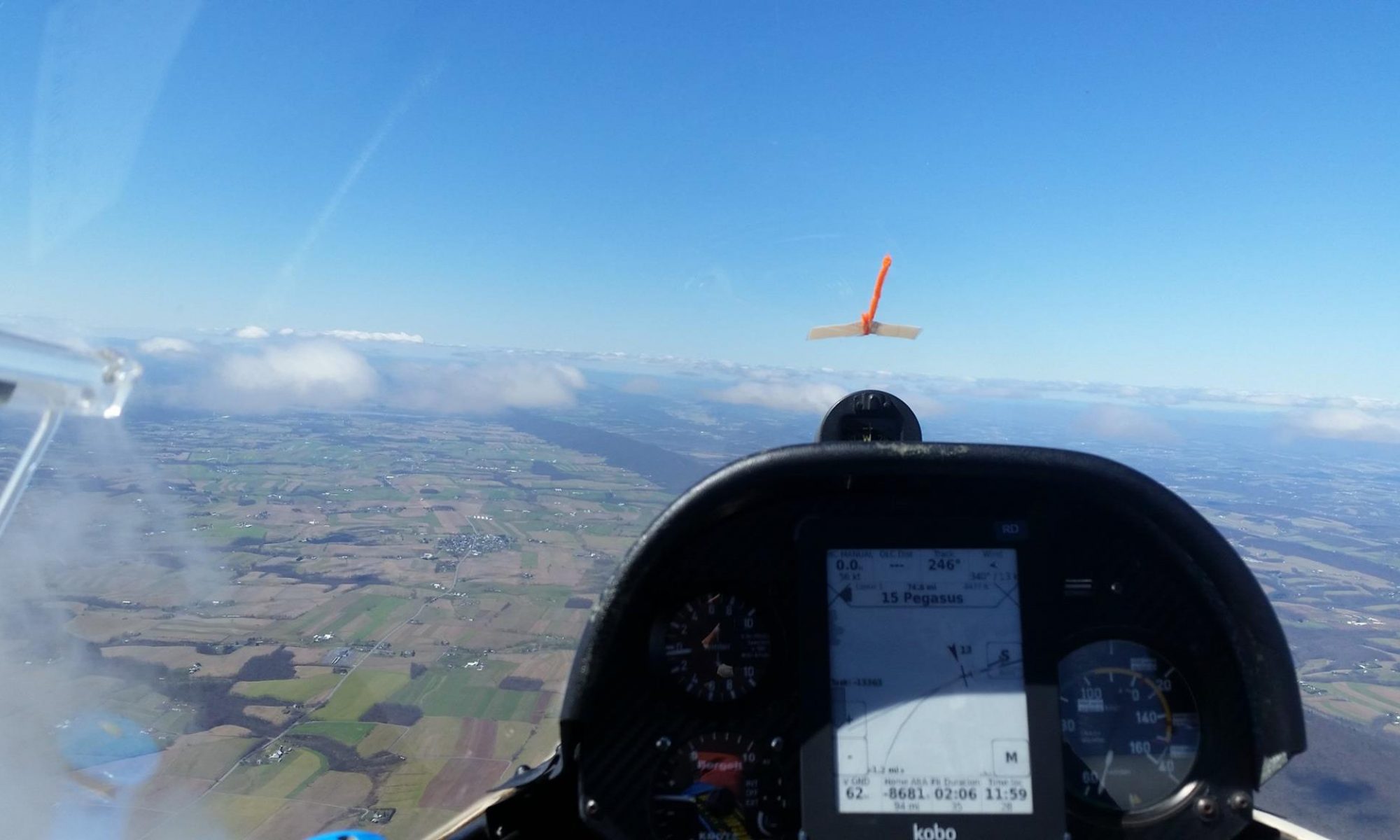
08-25-22 | What a Breeze!

It’s been a wonderful August. Having returned from some exceptional soaring out west while on my honeymoon, I was not expecting much from Blairstown. This time of the year tends to yield hot, hazy, and humid conditions. The kind where you can hardly see more than several miles away at several thousand feet. When you spend all day circling while the variometer occasionally beeps to remind you it is still on. When you yawn and start falling asleep as you keep going round and round in a thermal, to get high enough to make a several minute glide, to repeat the process all over again. Should you venture away from the airport, it is the frequent excitement of looking for airports and fields to land in that keeps you awake.

Not this August. Upon my arrival, I learned that the northeast has been enduring the longest sustained drought in two decades. The poor farmers… and the grinning glider pilots! Cool nights followed by hot and dry days set up long soaring days with high thermals, at times exceeding 9000ft. It was like the club awoke from a long slumber and pilots starting flying every chance they could. Make hay when the sun shines, at least if you’re a soaring pilot!

I had the most productive thermal soaring stretch I’ve ever experienced around here. Four flights, all exceeding 300 miles in distance achieved and averaging over five hours apiece. On the first I completed an out and return to Harris Hill, traversing the tricky high ground over the Poconos to transition toward the beautiful clouds beyond Scranton. One of the notable features of that flight was that the conditions were fairly heterogenous; there were pockets of good thermal activity and large stretches of blue in between. And by blue, I mean the totally dead and smooth kind of blue. I convinced myself that with a 50-1 ship that it should get across those challenging spots without too much difficulty, which worked out as intended.

In the following two flights, I worked the thermals forming along the northwest and southeast sides of the ridges for my first leg, followed by running east toward the coast and then back home for a long flight with a 300-400km triangle embedded within. The most exciting portions of these flights was flying in the vicinity of Philadelphia and Trenton, areas that typically are weak, wet, and dicey. Instead, I found some of the strongest and highest thermals in these areas, offering the ability to explore farther into New Jersey than I’d ever flown before. Maybe I could even venture to the Jersey shore? However, on both flights I ran into weakening conditions near Old Bridge as I crossed through the sea breeze front.

On the first instance, I barely escaped back to Princeton where I finally connected with lift that allowed me to complete a long and dead final glide under light drizzle. On the second, the sea breeze was pushed far inland due to the southerly winds. I found the step and a good single thermal, though it was not positioned satisfactorily relative to the surrounding airspace to take advantage of it as a lift line.

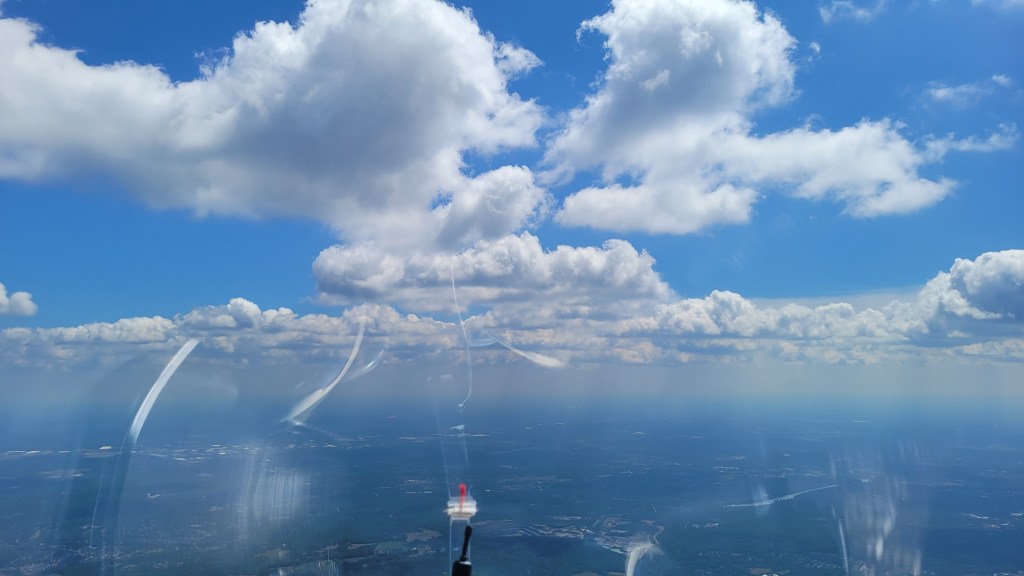
I had been fascinated by sea breeze fronts for a long time. I have seen them many times driving along the Jersey shore. It is defined by a line of blue, marine air paralleling the ocean, with a well defined line of cumulus clouds where the marine and warm and dry continental air collide. The clouds form a step, with the lower step forming a drooping curtain that looks like a waterfall. From the air, it looks like you are approaching the end of the four corners of the earth.

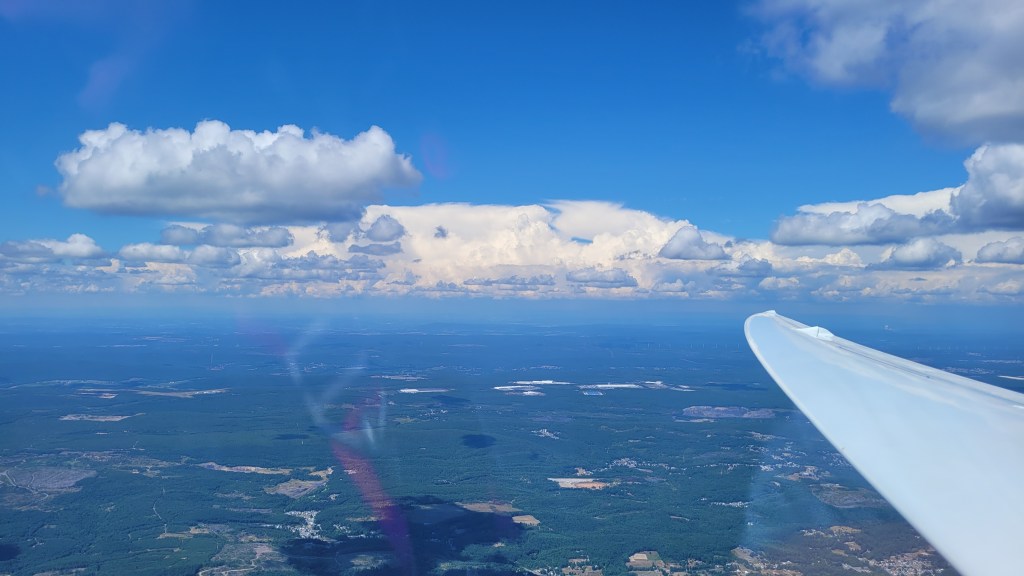
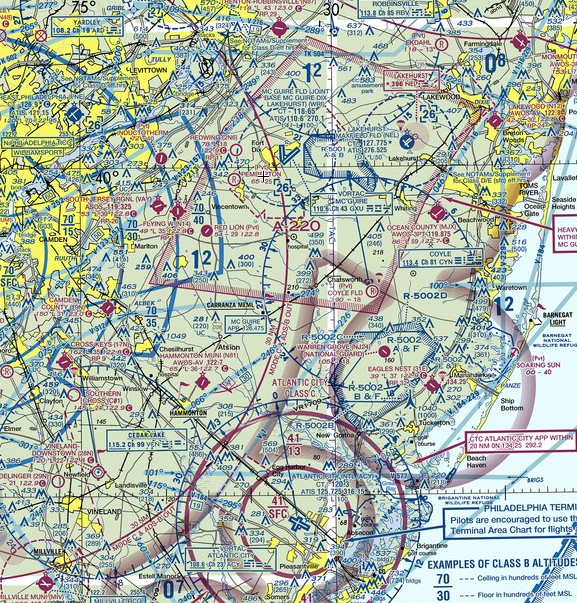
I’ve always wanted to experience flying along the front. It would be a lot of fun to soar along the long, defined edge. But there are several significant challenges that often preclude taking advantage of it. For one, the Jersey shore is a solid 50 miles away from Blairstown in the low and wet ground. This August is an exception to that rule and instead one could expect good soaring conditions in those areas. Secondly, the airspace is quite busy with extensive GA traffic. Thankfully Bill Thar installed a transponder in the Duckhawk, so this aspect was manageable. Thirdly and most importantly, the Jersey shore has complicated airspace. Bordered by the NY Class Bravo to the north and the McGuire MOA, several restricted zones, and the Atlantic City Charlie to the south, soaring the sea breeze would be no picnic. Further, the positioning of the front can move inland later in the day, which could create a situation where a pilot could head south early and then either run into airspace or fall out into the bad, marine side on the trip back north. These challenges had precluded my previous attempts to soar the breeze.

August 25th was when all the pieces finally came together. On this day, I just broke way from Blairstown and headed south first thing when I got up, regardless of the conditions setting up later. I took off at noon, settled into a thermal under the first cumulus cloud of the day along the ridge. Once at cloudbase, I could see the first clouds forming to the southeast near Hackettstown. I slowly floated out, taking every thermal, easing into the day. I had never left this early toward this direction before. It was exhilarating breaking from the standard mold of what we normally do and felt like I was flying at a completely different site!

My first solid thermal was near Round Valley reservoir and now I was established comfortably at 5,500ft. Nice looking cumulus clouds formed ahead and I picked up the pace. In what felt like no time at all, I was approaching Monmouth county and I saw the tell-tale signs of the sea breeze beckoning ahead.

Initially I downshifted and tried to get connected back to cloudbase again, though I was unable to find a solid climb. Initially, I followed the clouds all the way to the edge, right under the step. This did not work and I had to zig-zag back to the northwest when I finally connected with a solid thermal. What happened was I failed to recognize that the shape of the front created a wedge, with the apex of the wedge just under cloudbase and the marine air creeping in underneath. As I climbed, I drifted along the wedge up to the clouds, where I finally found consistent lift along the line.

As I headed south, I saw a flight of six fighter jets flying underneath in formation. Looking ahead, I was close to Lakehurst air force base and soon to enter the MOA. I tuned my radio to McGuire Approach, figuring that it was prudent and courteous to communicate with them. The radio was very active and I could hardly get a word in edgewise. When I announced McGuire Approach, Glider Four Six Three Two Papa, they got back to me and gave me a squawk code for my transponder. The controller asked me where I was heading and my intended altitude. I responded that I was heading toward Coyle Airport, an airport right on the edge of the following restricted zone and would fly between 5,500-6,500ft.

It was pretty nerve-wracking soaring the line. A little to the left and there was dead air. Off my right, there was restricted airspace. Ahead the airports were well in glide, though about ten miles apart. There was little room for error for if I started to drop it wouldn’t be easy to reconnect with the line. Finally I wanted to fly a bit more predictably for the benefit of the controllers; zig-zagging around like a crazed rabbit would cause me to be a burden and distraction to them. So I focused on the lift ahead, listened to the radio, and watched as C-130s took off underneath me.

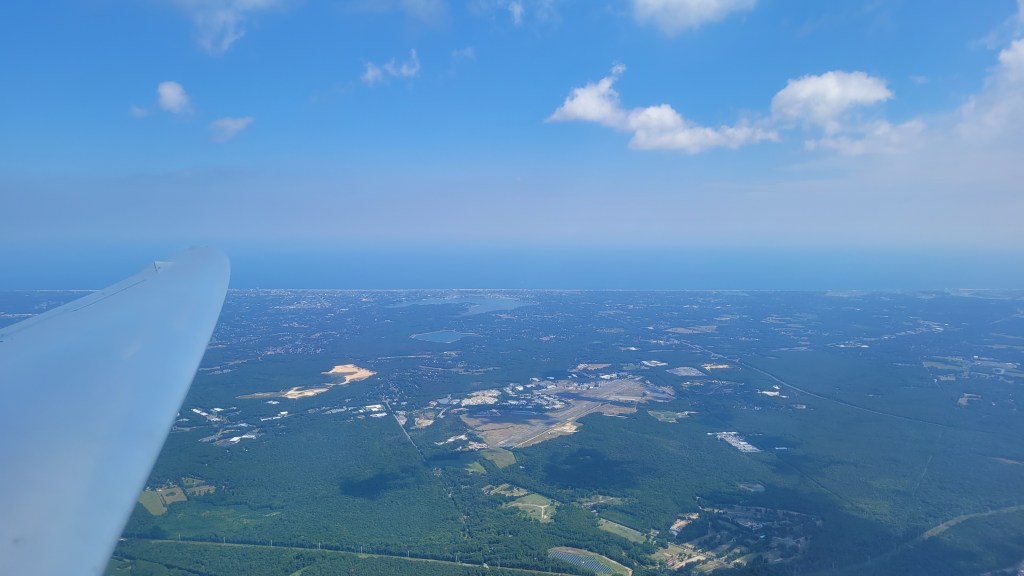
The lift was mostly consistent, though not strong. I floated along at 60 knots, bumping along here and there. The best section was about 20 miles into the run, with a solid 6 knot thermal to 6,700ft along a solid wall of cloud. Ahead the breeze extended into restricted airspace and there was no obvious path on the continental side to extend around the back. So at Coyle Airport, 30 miles from where I started, I turned around and heading back north.

Coming back north was less stressful as I quickly attained comfortable glide back to terra firma in the form of Princeton Airport. I knew that even if I lost the line that I would make it back to soarable territory. The line lost some definition near Monmouth County, though persisted for 40 miles all the way to the New York Class Bravo. I flew right to the edge of the airspace, peering out into the haze in the distance. I could make out the skyscrapers, the Verrazano Bridge, and the whole profile of Staten Island. I had never seen the “Vee-Zee” as us New Yorkers call it from the Harbor side in a glider! I thought to myself that I could glide to my parents’ house from there.

Near Old Bridge Airport, I saw a speck at my altitude. Turned out it was an eagle, and I gladly turned into his thermal. As I went round and round, I saw the profile of the bird outlined against the whole city. Later I looked down and saw that he was flying with a friend! This pair of eagles climbed right through me. The brief thought to give them chase was dashed when I saw the eagles head straight toward Newark, into the Class Bravo airspace. Then I remembered that is what happens when you try to fly with creatures that are motorgliders and are exempt from ADS-B Out, Mode S transponders, altitude encoding altimeters, and even talking to the controllers! We parted ways and I headed west toward nice looking cumulus clouds near the Delaware river.

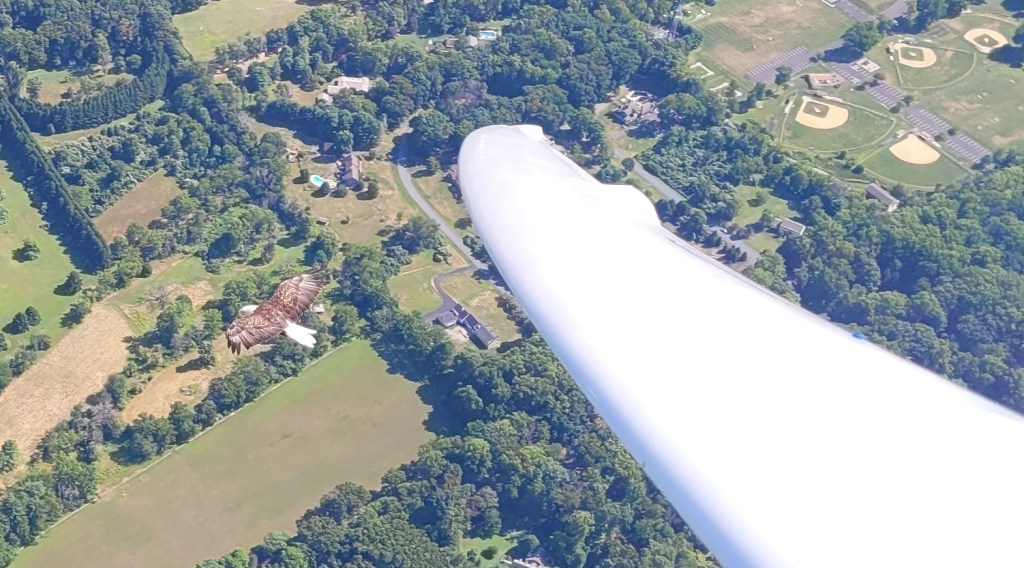
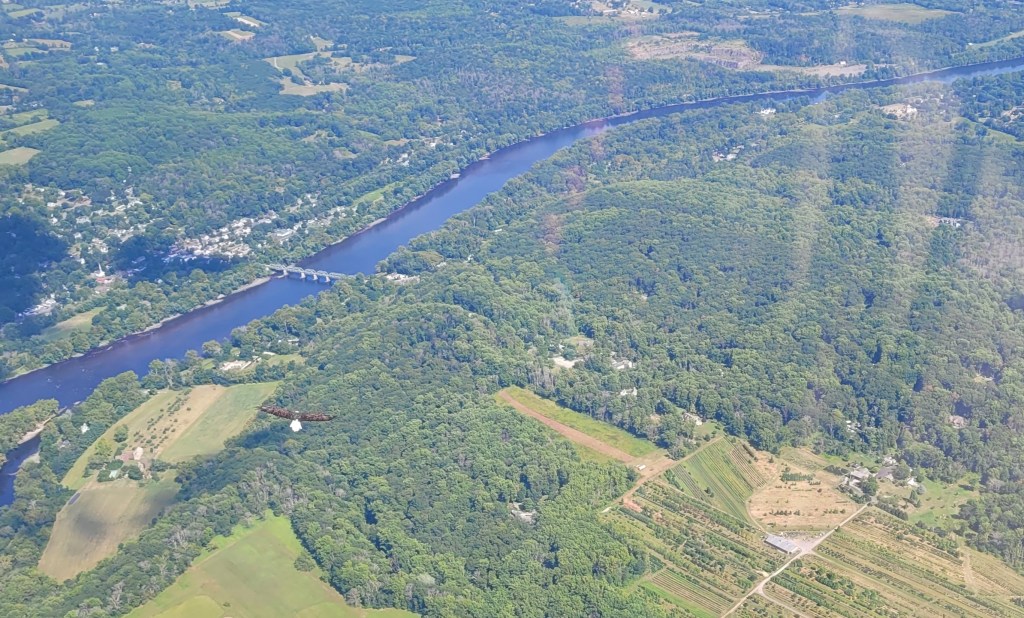
After a long glide, I got low enough to get a little grumpy and had to pay attention to landing options in the form of Van Sant airport and Doylestown as my outs. But as I crossed the river a little over 2000ft above, I saw yet another pair of eagles! I connected with a solid three knot thermal and rode up with these beautiful birds. I had several circles where one of the birds got very comfortable getting close to the Duckhawk, perhaps within several feet from my wingtip. It was surreal!

After the long climb, I looked over and saw that the high cloud cover off my shoulder to the left was arriving slower than expected. Ahead the clouds were high and well formed. This suggested that the day should last longer than forecast, so I kept heading west to extend my distance. After crossing the typical Kutztown hole, it seemed like the clouds were on steroids. A six knot thermal north of Hawk Mountain took me to 7,500ft. It looked like with the light winds there was some ridge-based convergence setting up in the area, creating bonkers lift. I ran the line just shy of Schuylkill County and headed along the edge of the ridges back toward Blairstown. The air felt marvelous!

Along the way, I enjoyed thermalling the Duckhawk. I finally felt like I had figured out how to thermal it. After extensive work to get the center of gravity in proper balance and seal ingthe canopy, I can thermal it shy of 50 knots in a solid 40-45 degree bank and 45 knots in a 35 degree bank and more flaps. Thermalling it is tricky because it gains energy so easily. You have to pull right on every gust and back it off just so when you fall off on the back side. After flying it for several hundred hours, I realized that I was doing this effortlessly and I was finally dialed into the glider.

After returning near to Blairstown, I climbed up to cloudbase and rode the last remaining bits of lift toward Dingman’s Ferry, completed my final glide in dead air and landed past 6 pm. I was very pleased to have notched another flight off my soaring bucket list; the New Jersey sea breeze has been conquered from Blairstown. This flight also doubled as my longest distance flown solely on thermals from my home site with 577km achieved on a six hour flight. Not bad during the so-called doldrums of August!

See my flight here.

06-15-22 | Time to Push

Only two days left in the competition and we’re second overall. There are not many opportunities left to make a play for the leading position and today looked like the best opportunity. The weather looked good, with high thermals promising a long soaring day and a long soaring task. This would lead to more points awarded for the day, and also possibly greater point spreads among the competition. The weather was most complicated by the presence of a cold front stalling in our area. This front was dry enough that it would create strong lift at its boundary and the task was designed for us to run along it toward Oklahoma.

Noah and I looked at each other and understood that the long game was over. No longer are we holding back, playing for consistency and maximizing the expected value of points over time. Today was the day to push and go for the win.

I was anxious. Timing was everything. We watched the front, trying to pinpoint when it would pass and how it would set up within the two turn sectors to the south and west of the airport respectively. Would it pass early, requiring an early start and a deep push south? Would it pass late, require a later start and stay to the north? How would the other contestants play the conditions? Should we be on the front end or the back end of the start? How are the conditions going to be on the front end or the back end of the front? On the front side, there will be a strong southerly headwind, but stronger thermals. On the back end, perhaps lower and bluer, but less wind. But then there’s the headwind at the end of the day and stronger sink along the way. So if the front moves faster, then we may have a lot of trouble getting back. But perhaps we can hook around the back of it, accepting a deviation over the lake? Besides, how is the front going to set up anyway? Theory suggests it looks like a wedge, but how will the clouds look? Will there be a step? How will we find it? What are the clouds doing upwind of us right now? Is that hazy layer northwest of us the front??

My thoughts kept going round and round in my head, with little resolution or recourse. Noah was somewhat bemused, watching as my eyes flitted about in an agitated state, trying to make sense of my stream of consciousness. He was right there with me, looking at the forecasts, and sort of resigned himself that we will just need to figure it out when we get up there. Having accumulated all the information I could, I accepted the range of uncertainty in the day, and we finally sketched out a couple scenarios for how we could play it. In all cases, we needed to drive hard and roll on our own. If we played the same flight as the others, today it would not do.

With an early grid, we got in the glider a little after noon, looking at a fairly stiff quartering headwind for takeoff and good looking cumulus clouds just above us. We released in good air all around, suggesting that the front had finally arrived. We climbed up, got in position with the other gliders and waited for the gun to go off to indicate the start was open.

We watched the Standards go quickly and figured that the 20m folks would do the same. Sure enough, just before 1pm, our class streamed out on course. We held our breath for a couple more minutes and took a more easterly route. This got us a little higher on the start and a straighter run under better looking clouds.

We stepped on the gas. It was like I had a little prod and I would poke Noah every couple minutes and repeat, 85-90 knots!

We were catching up to several Standards on the first leg, and were looking at many southwesterly streets lined up with the wind. We couldn’t quite figure out where the front was, or where the best place to go. We drove short of the middle of the first sector, and the clouds further to the south looked lower and less defined. We figured that this was a good place to turn and set up for the following leg.

Noah was flying exceptionally well, right on the ball. We were loaded up with water ballast for extra weight to go faster, but he was cleaving this 70ft wide bird into the turns with little effort at all. The glider flew poetically, smooth, and gracefully. I always enjoyed watching him center the thermals; with a turn and a half the variometer was always humming a cheerful three to four knots around the turn.

I would keep an eye on course and watch for other gliders. As we would climb up, I would give a gentle nudge by suggesting maybe we could do better, and Ready. Despite being in the same glider, we still ended up using a fair amount of the standard team-flying lexicon for consistency.

Noah would reply, Ready… Last turn!

And off we would go.

On the second leg, most of the decisions were collaborative. Left or Right?, we would ask each other. There were good thermals out there, but the lift band seemed to work best higher under the clouds. It seemed like every two or three minutes there was a big tactical decision to make in terms of where to go under the clouds, like tiptoeing over a minefield. We mostly managed to stay connected with the lift.

Crossing into Oklahoma, the thermals started to get somewhat farther apart and the clouds lost some of their definition. With a 20 knot headwind, we still had to keep the pressure on, though we started to get lower and into the trap. We finally found a 2.5 knot thermal at 3800ft and promptly parked there to reconnect with the higher lift. But then Phil Gaisford in Standard Class started turning about a half mile off of our right wing, going up like a banshee. We joined him and found a solid 5-6 knots! Thanks Phil! Ryszard and David Hart also joined us and we ended up in the same area for a fair amount of the remainder of the flight,

It was a big decision how far to go into the second sector. On the one hand, once we turn we would now have the tailwind and streeting on the way home, which would suggest that we would go a lot faster than when we were flailing ourselves against the 20 knot headwind. On the other hand, the front was likely to keep pushing southeast, further away from the airport. If we went too far and if we fell off the day, we would have to then struggle into even weaker and blue conditions late in the day. A couple minutes here or there could determine the contest, 170km away from home.

I pushed Noah to extend a little bit farther. There was another cloud ahead and we milked the good air on the upwind line. We ended up turning with ten minutes extra on the clock and then turned tail for the mighty race back to the finish.

We now found ourselves getting lower and lower. We really did not want to fall out of the band and were willing to take a long, slow climb. Besides, with the tailwind, a 2.5 knot thermal ain’t so bad anyway. But we struggled to connect, having difficulty finding the thermals under the broad cumulus clouds. As we ground our way up, the thermals seemed to get cut off at various altitudes, making it a struggle to get all the way up. But with every climb, we ended up higher than we started. And about halfway into the leg, we were up at cloudbase, making great time with the tailwind, good air under the clouds, and high true airspeed. We were making such good time that we were likely to come in under time at this rate.Might as well stay conservative now and stay connected with the good lift.

Coming close to home, we were worried about the final glide. We wanted to tank up and then some to account for the change in airmass. We got ourselves on a MC 3 glide, but we knew we needed extra. The thermals started tapering off and we down-shifted. But we did so a bit too late. We were now on the back end of the front and the variometer dropped. We were bleeding altitude and we could see the airport rising in front of us.

Looking down at the windmills, one side had the wind blowing from the northwest, the other side from the south, and down the middle it was southwest. We were right over the convergence zone, but not in the good air.

I could feel the rudder pedals dancing back and forth. Then I heard from the front,

Noah is not happy.”

I was anxious too, but it’s an odd feeling being in the back, watching your contest completely unravel in front of you as you rapidly hurdle toward a field short of the finish. It’s almost comical watching the scene as a fly on the wall, having felt it on my own account so many times before. I snapped out of it, cleared my throat, and tried to take a level tone.

The air looks blue and hazy, but it shouldn’t be dead yet. Keep steady, we should find one out here.”

Down at 3800ft, I saw a vulture.

Bird! 2 o clock!”

Noah responds,

Where!? Oh, good visual!

He hauls the glider to the right. Good air, but no thermal quite yet. Five Mississippi, and sure enough we roll into a 2.5 knot thermal in the blue.

I interject,

Dump the water?”

And Noah responds with Roger and opened the valve.

We climbed up, took in some extra altitude and sailed on home. Looking down, we could see that our main threats were still not there. We knew we had a good day.

When we landed, we were exhausted. Unlike the second day with its adrenaline rush finish, we sort of hobbled out of the glider, zonked from baking in the sun and being under the pressure knowing that we were walking a tightrope the whole time. We were satisfied we got through and were happy that the several times we rolled the dice today that it went in our favor. This has set us up about 200 points over second place going into the last day of the competition, which is about as good of a place as we can hope for. Here’s to hoping we don’t squander it.

________________________

We thank the Harris Hill club for supporting us at this contest by letting us use their Duo Discus. This glider is an absolute marvel of performance and it has made it possible for us to compete at the highest level among the best pilots in the United States. We really appreciate all the work it takes for clubs to make these opportunities happen.

See race results here.

06-10-22 | Having Your Cake and Eating it Too

I was rudely awaken to a loud clanking at 3am. The vent above my head was fluttering and chattering in what sounded like hurricane-force winds around me. After tightening the latch, I easily went back to sleep, though others on the airfield were not so lucky. Piet Barber’s tent got obliterated by the gust front, with the sidewall of his tent smacking him across the face to wake him up. I pictured the scene like from a horror movie, with some shape shifting invisible demon going in and trying to suffocate you with tent padding in the middle of the night. With the rain pouring down on the field, he soon abandoned his valiant efforts to weather the storm in his humble abode. Quack Quack was seen run-skipping through the puddles to safer quarters in the clubhouse for the remainder of the night.

The airport received about an inch of rain, though the morning looked more optimistic than after our past rainy nights. The sun was shining, the wind was blowing, and it looked like the puddles were evaporating. Our task for the day was a three hour turn area task, which looked reasonably doable. We also celebrated Mitch’s birthday, bringing out the wheelchair to address his mobility limitations with advancing age.

After the meeting, Noah, David McMaster, and I retreated to the camper van for our morning huddle session. Sitting around the task, we saw several complicating factors. The first was that the soundings indicated high cloud cover should shadow the ground, preventing the essential sun from heating the earth and providing us our necessary thermals. The second was the presence of converging wind-flows just to the south of our location, which could provide a lift line of its own account. Finally, with all the rain in the local area, it should be tough going to get up and away, though further on course it was considerably drier and should provided better thermals. Content with our respective plans, we discussed general tactics and strategy, with an eye for practicing for the upcoming junior worlds. David has been very receptive to coaching and has been doing a great job in this contest!

Now that the gliders were all parked on the grid, it was time to wait for the ground to cook and the sniffers to launch and let us know how the thermals were setting up. Noah and I retreated to the clubhouse, where of course Alex Westbrook was milling about. He challenged me to a foosball match, and by golly the rascal beat me! He has been practicing, that’s for sure!

After playing several matches, he went over and picked up some of Mitch’s birthday cake and sat beside me. He looked wistfully out the windows toward the parked gliders in the sun and philosophically mused,

It’s so much better here than out there. Here we have cake… air conditioning… foosball… and cake!

Alex, I couldn’t agree more.

But then Steve Leonard in his BS-1 (one of out of 36 gliders in his collection) launched a second time and started finding some lift. I looked over at Noah, he looked back at me and nodded. So we got up and we headed over toward the grid.

On tow, we looked down and saw streams and ponds in the fields; not good. The air was buttery smooth. Further, ominous dark gray clouds were moving our way from the northwest. Upon releasing, we headed over to the clouds south of the airfield, quite a ways away from the start line. We struggled to climb and went to and fro under the clouds until we rolled into a four knotter. Looking at the wind shift on our computers, we figured we found the edge of the convergence and sure enough at cloudbase we could see the step as well. Others were struggling mightily to get connected and stay up. After some delays to opening the start line to account for the challenging conditions, Mitch finally had it and opened it anyway.

Getting to the start was a major decision to day as we had to traverse around six kilometers with no prospect of finding any thermal to get up any higher. The high clouds northwest were getting closer and closer. We figured this was not a day to linger and wait and wait, but a day to step on the gas and go. As we approached the line, we saw Karl Striedieck and Sarah Arnold, along with the Simmons had the same idea in their Arcii. We started with them, just behind, and were content to have company on the first leg.

We got lower and lower, bumping along from one cloud to another, struggling to hook into anything solid. Finally we climbed in around 1-1.5 knots, just hoping to get connected with the tops of the clouds. We proceeded in this manner to the west, methodically staying high and avoiding trouble. The Standard Class converged around us, and we were happy to be inside this cocoon of carbon fiber and fiberglass. Going into the first turn, it got bluer and bluer, though the thermals got stronger in places. We didn’t even make nomainal distance, but that’s about as far as it seemed most of the gliders would go.

Going into the second turn, we saw a nicer looking line and stepped on the gas, connecting several 2-3 knot thermals. We went about as far as we could into this second on the northern side and then flew back more-or-less on the same path toward the third sector. Now the high cloud cover was almost overhead and we were getting worried. Getting home might not be so easy if the conditions shut off soon. The clouds above us cycled down and we failed to connect with any lift under five or six clouds. I could feel the rudder starting to tap gently back and forth.

Noah, you’re getting antsy!

We started getting low, so we down-shifted hard and climbed in 1.5 knots. Looking ahead, there were some wisps that would evaporate as quickly as they would form. For a time we thought the day was going off the cliff and falling apart. The challenge now was to simply get to the edge of the sector and struggle to get home.
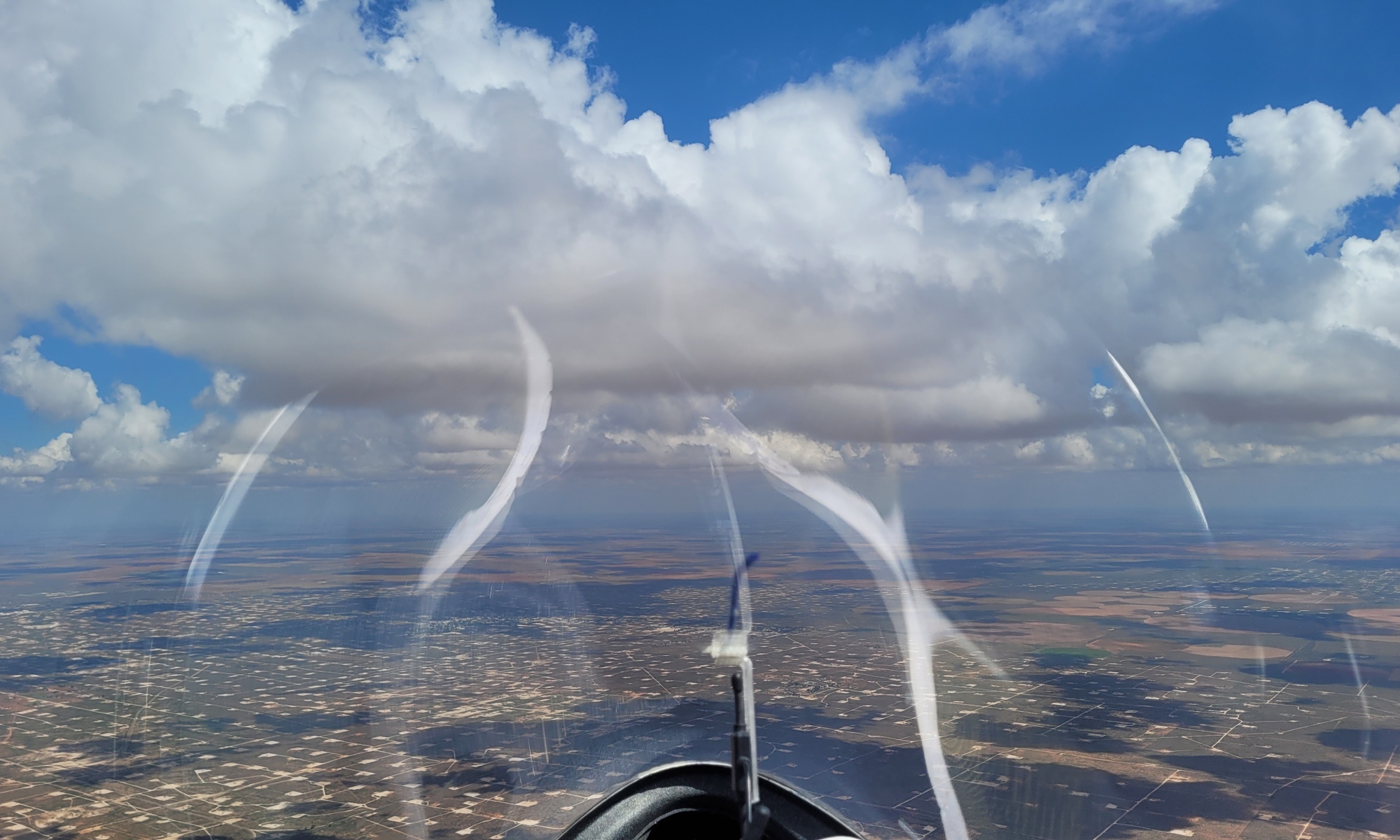
But then we rolled into a three knotter. Perhaps the day had some life left. And then we saw gliders on our left and ahead. Folks had a better time on this leg than we did. And when we made the edge of the sector, we found the wind had shifted around. We crossed the area of the converging wind flows! And sure enough there was some good lift to be had around here. We got into the business of climbing.
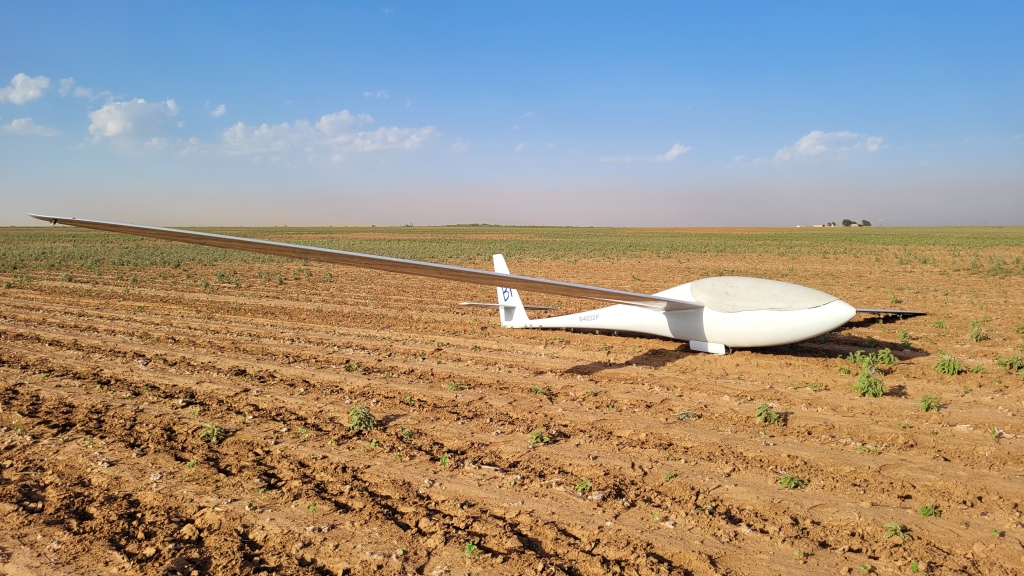
Looking toward the final leg, it looked bleak. Going into the final climb, we parked in two knots and climbed up and up. My glide computer said we could make it home, but Noah’s did not quite line up. We climbed up another several hundred feet and I showed MC 2.1 over a 500ft arrival (over the 800ft sector) and I urged Noah to go. After a little grumbling, he went for the glide.

We found sink, sink, and sink. Our margin evaporated from 500ft over to 100ft under. We headed to some scraggly cumulus along the course and bumped along, watching the needle hover just over and under, over and under the edge of the finish cylinder. At the end, we had just enough energy to pull up and bleed off our airspeed and get just up and over the finish. Think of it like a Foley flop on a high jump. We let out a huge sigh of relief.

We agreed to use Noah’s glide computer next time for the final glide calculation.

We ended up third for the day and were content with our performance. The conditions during the day felt sinister and that there were many traps that could easily get us and wreck our performance for the contest. We felt that maybe we down-shifted a little harder than we should have in several places and probably gave up around 20-30 points unnecessarily. But we were generally happy with achieving the performance we did with a risk-mitigation approach for the day.

During the evening, we had a chili cook-off contest. There were six different kinds of chili to choose from and all were wonderful. I do hope though that the vents are working well in the Duo after all those baked beans! The socializing with friends new and old is what makes contests so much fun.

On the whole, we had a very nice day. And besides, even simply making it home is always nice. It’s like having your cake and eating it too.

________________________

We thank the Harris Hill club for supporting us at this contest by letting us use their Duo Discus. This glider is an absolute marvel of performance and it has made it possible for us to compete at the highest level among the best pilots in the United States. We really appreciate all the work it takes for clubs to make these opportunities happen.

See race results here.