
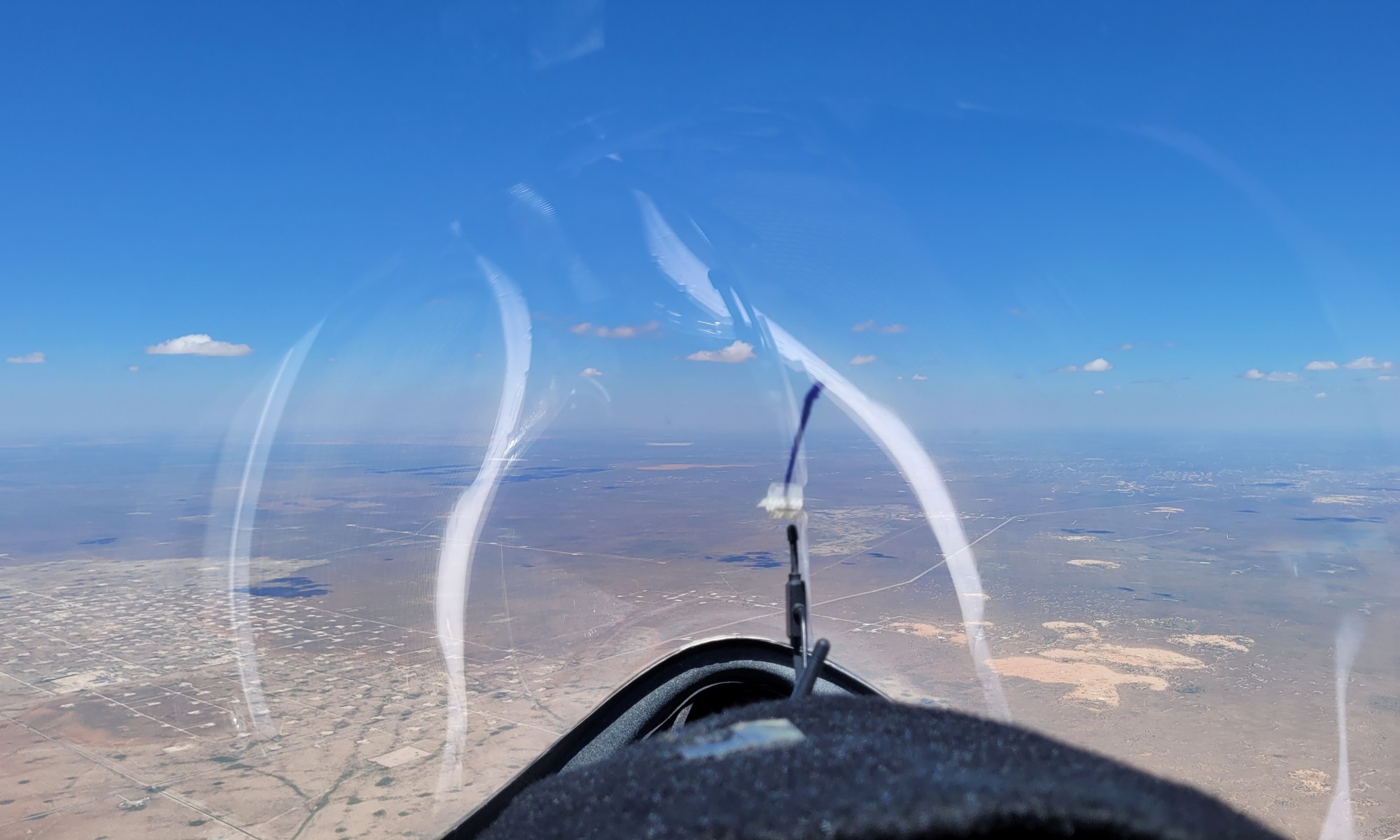
As the Beatles sang, “It’s getting better all the time!” Day Four was another tricky blue day, but it was the first day where I felt that all the decisions were made correctly. My execution and thermalling still needs some improvement and hopefully that will be addressed today.
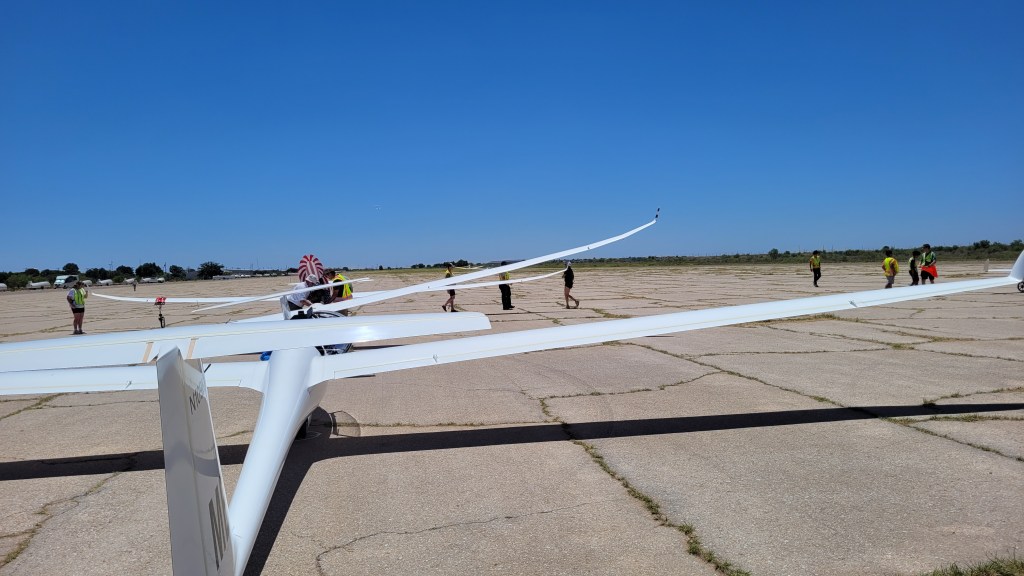
The 15 meter class was up first, which made things considerably less stressful getting up and positioned for the start. After wandering over to the start line, the class was mostly linked together. It was a struggle to climb much above 9,500ft, and looking ahead to the south was not terribly inviting. It is completely unlandable in this direction, with the exception of an abandoned airstrip and an airport at the center of the turn. I was eager to wait for the group to go.
After the task opened, pilots waited and waited. But with the launches rolling quickly, we heard that the 18 meter task was soon to open. With the prospect of more company, I felt the energy of my class perk up. The race was on!
I linked up with Noah and several others. After some false starts, we rolled out on task, dragging several gliders with us. We had a long glide into the blue, settling lower and lower toward the nasty oil derricks. We sampled effectively by raking the air with three gliders abreast. When we would find a thermal, each would turn and we would look over to see who found the better core. Sometimes the solution to tricky air is simply to throw enough gliders at the problem. It usually works.
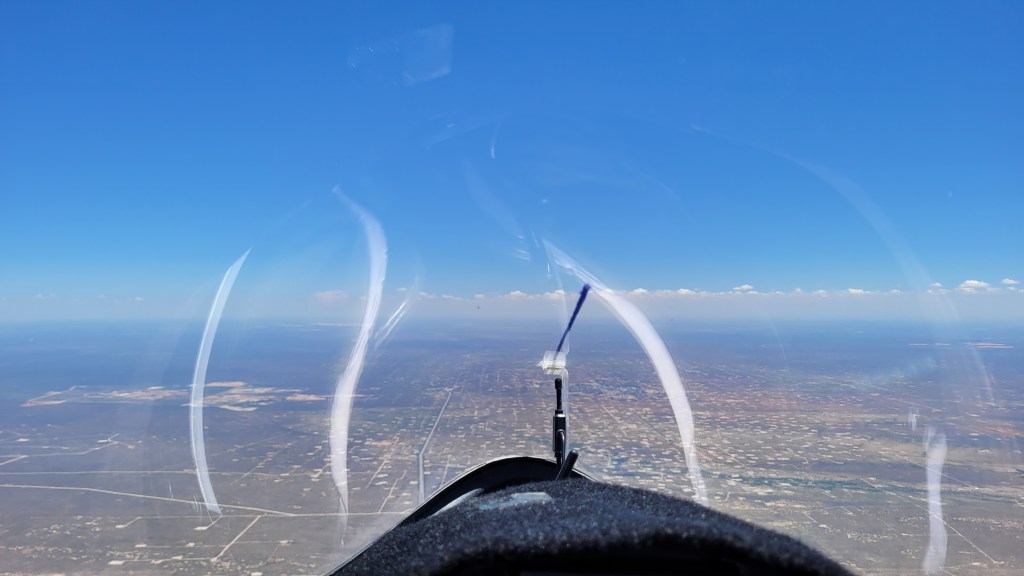
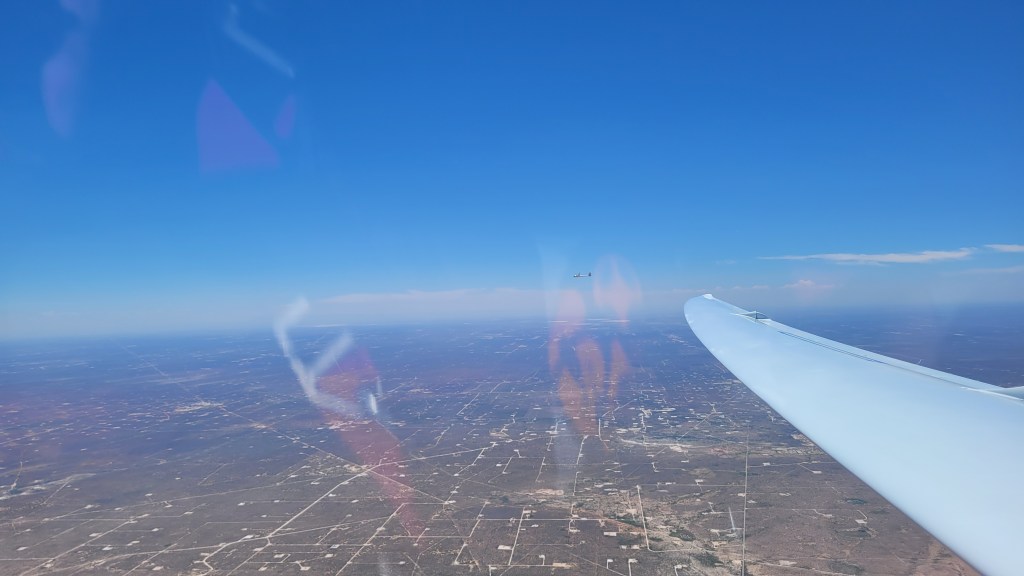
Much to everyone’s surprise, there were clouds going into the first turn area at Jal. There’s a well known military proverb that, “No plan survives first contact with the enemy.” Well the glider equivalent is, “No plan survives first contact with the clouds.” I figured I would turn early at Jal, but now I found myself with the group driving toward the back of the sector. Seven knots, thank you very much and we rounded the turn at 11,000ft.
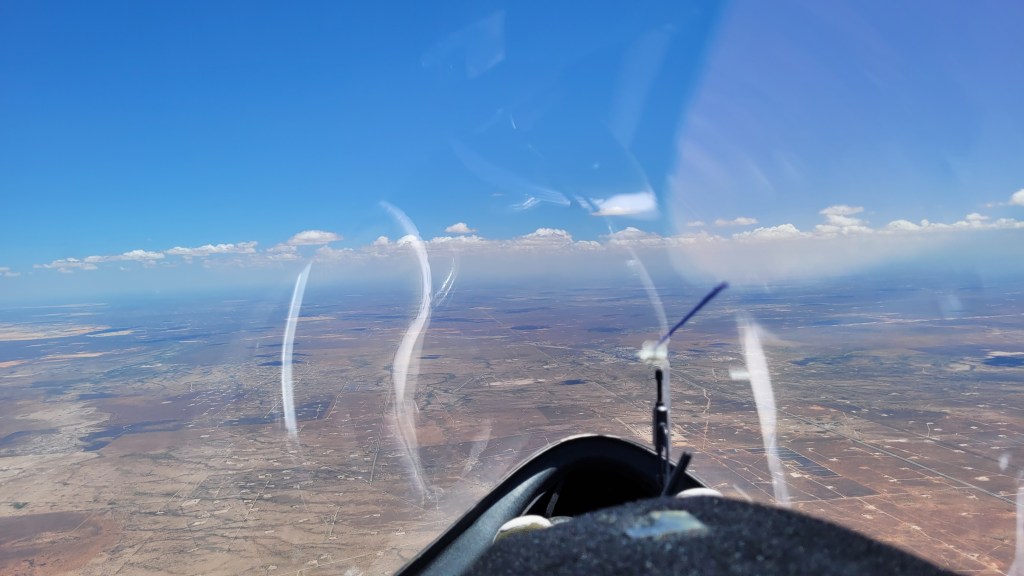
Heading toward Brownfield, it became more and more of a struggle. We glided and glided and found nothing. Near Seminole, I saw 5,700ft on the altimeter before we swept into a good thermal. Unfortunately, Noah and the rest of the group hit a better cycle in the bubble and rose up and away. I found myself deposited alone in the blue at the top of the lift.
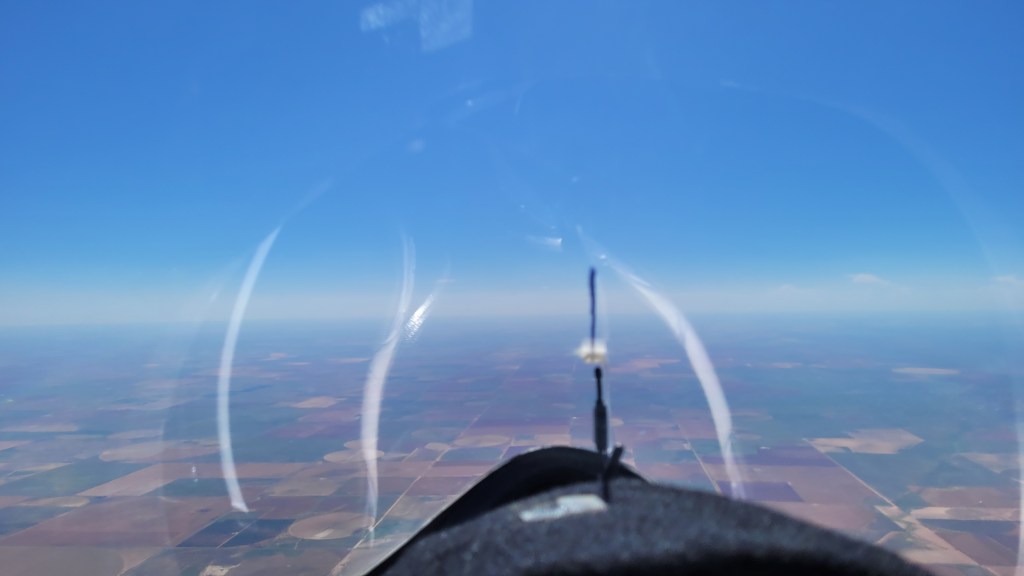
It is lonely and eerie flying alone in the blue. Clouds breed a certain optimism, probably because they keep your eyes up in the sky. When you’re staring at the ground most of the day, it is much easier to envision yourself somewhere down there, scratching in the dirt.
After rounding the second turn, I saw a wisp form at the edge of the sector. I drove over and found a solid climb. At this point Steve Vihlen (SV) joined me. We worked our way up, punched through the inversion and up to 10,000ft. A nice controlling position for the next leg.

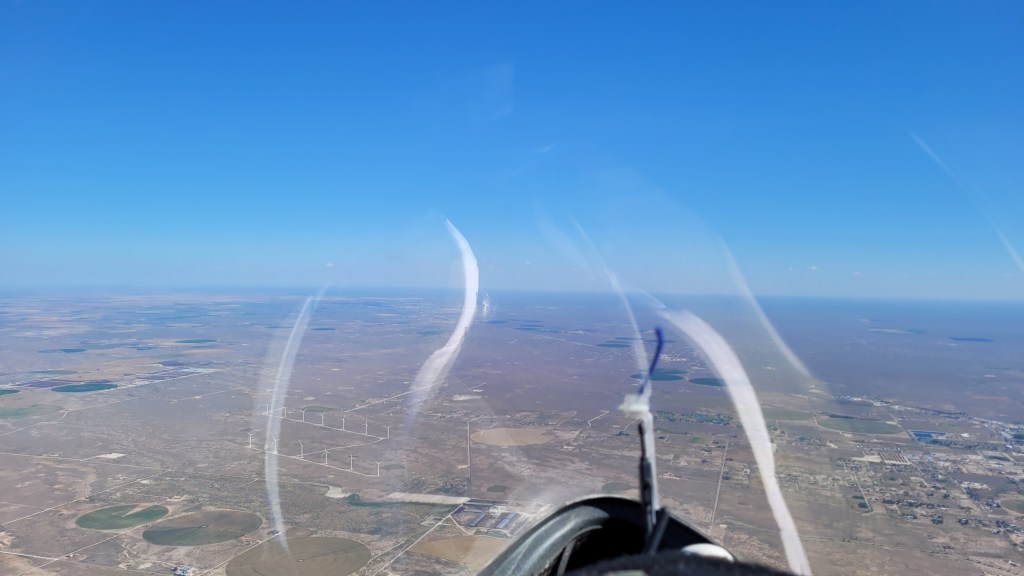
Some gliders were catching up now, notably Dave Leonard in ZL and others in 18 meter. I did not mind; having help in the blue was very helpful. We picked our way through the leg, watching each other center the climbs and move on to the next thermal. A bunch of gliders converged in the third sector at Caprock. It was trivial finding a climb at that point.
Steve had pushed ahead for a while and drove the group. I caught up with him, though picked up a thermal for a couple turns while he pressed ahead. Since it was only 3 knots and I was drifting downwind, I was eager to leave. Figuring that there should be one more solid climb left and I could shadow his course, the risk seemed perfectly worth taking a solid shot for final glide. I pressed ahead.
Downwind of the windmills, I felt some burbling. I reckon they are triggering a thermal. I could see Steve wafting left and right and likewise I worked the air upwind. He turns, and I turn and we found a 4.5 knot thermal. We get together, work our way up to a MC 5 final glide and charge off toward the finish line together.
He finished just ahead of me, though we both dropped a lot of people on the last leg. It’s nice when the tricks in the bag work every once in a while.
As far as the soaring, one of the common patterns noticed is that the wind tends to get stronger at lower altitudes, back off, and then get stronger again toward the top of the boundary layer. This C-shaped profile really messes with thermals. When the wind shears, it tumbles the thermal and the thermal does not always survive the shift. The trick was to transition into each respective layer at the right time.
Going into today, my main goal is to get better at thermalling and running. I am satisfied that I am getting back on the ball otherwise. I suspect that the Duckhawk may have been a touch too far aft in C/G and this was making it less efficient in the glides and stalling out the tail in some of the gustier thermals. Today looks stronger, so a more forward center of gravity is probably warranted anyway.
 Soaring Economist